


Staff at GTIC Holdings (金品軒集團), including its Singaporean owner, Victor Soh (蘇珖量), and general manager Lo Lee-chee (羅湘盈), a Chinese-Malaysian, were yesterday indicted for allegedly operating illegal financial schemes that promised high returns for investing in gold and precious metals.
Soh’s business activities cover Taiwan, China, Hong Kong, Malaysia, Myanmar, Singapore and other Southeast Asian countries.
Taipei prosecutors said evidence showed that GTIC’s operations contravened Taiwan’s business laws, with illegal profits of more than NT$37.2 million (US$1.34 million) made from Taiwanese investors.
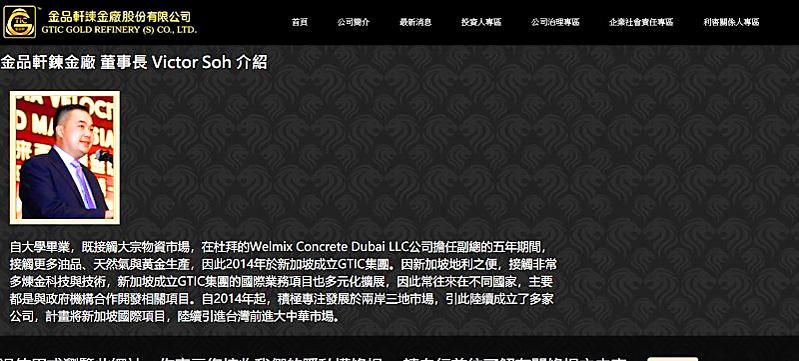
Screen grab from the GTIC Gold Refinery Co Web Site
Soh and his girlfriend Lo, who reportedly obtained Taiwanese citizenship through long-term residency, made a profit of more than NT$70 million in Taiwan, by offering shares of two unlisted GTIC companies on over-the-counter markets, they said.
Investigators said Soh, Lo and GTIC executives targeted the Chinese-speaking population in China and Southeast Asia.
Taipei prosecutors also indicted seven other GTIC staff members, including chief financial officer Lai Chien-cheng (賴建成), e-commerce head Lee Ping-hua (李秉樺), business education head Hsu Ming-te (許明德), accountant Chou Ching-hsuan (周靜萱), an executive secretary surnamed Chang (張), and two sales managers surnamed Lin (林) and Wu (吳).
They were charged with contravening the Securities and Exchange Act (證券交易法) and the Banking Act (銀行法).
The illegal schemes were based on the promise of high returns for investing in gold and precious metals.
Soh allegedly said his conglomerate owned and operated GTIC Gold Refinery Co, as well as authorized oil companies in the United Arab Emirates, and had joint ventures with two major mining companies in Canada and gold trading firms in China.
According to the company’s Web site, GTIC is an international conglomerate headquartered in Singapore, with major gold, precious metal and petroleum trading businesses.

The Centers for Disease Control (CDC) yesterday reported the first case of a new COVID-19 subvariant — BA.3.2 — in a 10-year-old Singaporean girl who had a fever upon arrival in Taiwan and tested positive for the disease. The girl left Taiwan on March 20 and the case did not have a direct impact on the local community, it said. The WHO added the BA.3.2 strain to its list of Variants Under Monitoring in December last year, but this was the first imported case of the COVID-19 variant in Taiwan, CDC Deputy Director-General Lin Ming-cheng (林明誠) said. The girl arrived in Taiwan on

South Korea is planning to revise its controversial electronic arrival card, a step Taiwanese officials said prompted them to hold off on planned retaliatory measures, a South Korean media report said yesterday. A Yonhap News Agency report said that the South Korean Ministry of Foreign Affairs is planning to remove the “previous departure place” and “next destination” fields from its e-arrival card system. The plan, reached after interagency consultations, is under review and aims to simplify entry procedures and align the electronic form with the paper version, a South Korean ministry official said. The fields — which appeared only on the electronic form

The Ministry of Foreign Affairs (MOFA) is suspending retaliation measures against South Korea that were set to take effect tomorrow, after Seoul said it is updating its e-arrival system, MOFA said today. The measures were to be a new round of retaliation after Taiwan on March 1 changed South Korea's designation on government-issued alien resident certificates held by South Korean nationals to "South Korea” from the "Republic of Korea," the country’s official name. The move came after months of protests to Seoul over its listing of Taiwan as "China (Taiwan)" in dropdown menus on its new online immigration entry system. MOFA last week
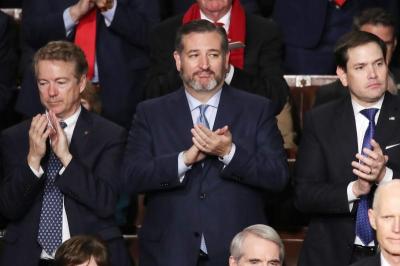
A bipartisan group of US senators has introduced a bill to enhance cooperation with Taiwan on drone development and to reduce reliance on supply chains linked to China. The proposed Blue Skies for Taiwan Act of 2026 was introduced by Republican US senators Ted Cruz and John Curtis, and Democratic US senators Jeff Merkley and Andy Kim. The legislation seeks to ease constraints on Taiwan-US cooperation in uncrewed aerial systems (UAS), including dependence on China-sourced components, limited access to capital and regulatory barriers under US export controls, a news release issued by Cruz on Wednesday said. The bill would establish a "Blue UAS


 RSS
RSS