

The military plans to start installing locally produced 105mm assault guns on its eight-wheeled Clouded Leopard armored vehicles next month, a military source said yesterday.
After they are installed, the military would from March begin testing the guns’ capabilities, they said.
The domestically made gun barrel has 60 percent less recoil than the imported barrels used previously, the source said, adding that its ammunition would also have better penetration.
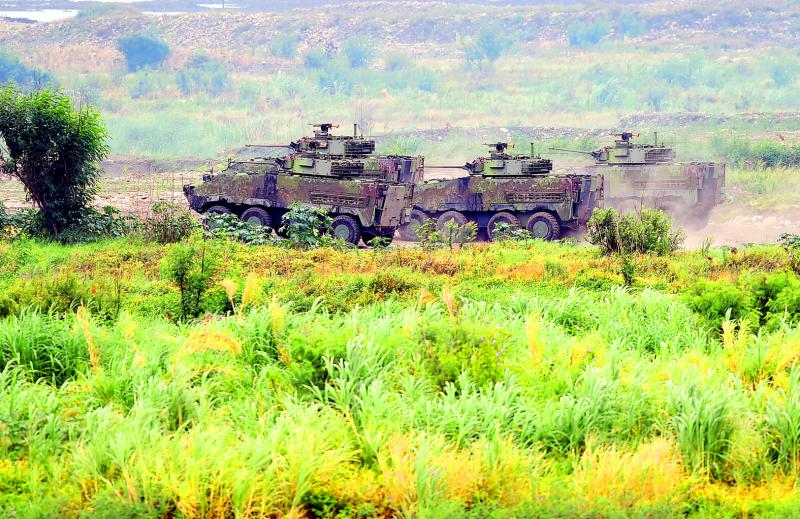
Photo: Liao Yao-tung, Taipei Times
Before a new weapon can enter mass production, it must pass through the military’s five-step development process.
The March tests would be the third step in the process.
After the assault guns have entered mass production, vehicles mounted with them would be deployed in the military’s newly formed combined-arms battalions, the source said.
The Ministry of National Defense’s Armament Bureau has budgeted NT$769 million (US$27.74 million) from 2019 to 2023 to build two prototypes of the vehicles that are to be equipped with the 105mm assault gun.
They would be the newest generation of the Clouded Leopard armored vehicle family.
Officially called the Taiwan Infantry Fighting Vehicle, the Armament Bureau has so far commissioned the indigenous CM-32 and CM-33 Clouded Leopard armored vehicles and has begun mass production of the CM-34 model.
The CM-32 and CM-33 models are armed with 40mm automatic grenade launchers, while the CM-34 versions are armed with the Orbital ATK 30mm Mk44 Bushmaster II cannon, which has a firing range of more than 2km.

A Hualien pomelo farmer refused to sell to China after the country announced it would permit more Taiwanese pomelo imports, prompting widespread support from Taiwanese consumers, who rallied to buy his fruit. China’s Taiwan Affairs Office last month said that China’s General Administration of Customs registered an additional 79 Taiwanese pomelo orchards and packing facilities in Hualien County, allowing more Taiwanese producers to export pomelos to China. “I am a Hualien fruit farmer and I refuse to sell to China,” Liu Tzu-hao (劉子豪) from Ruisui Township (瑞穗) said in an online post. Liu is a well-known farmer in the community and has served
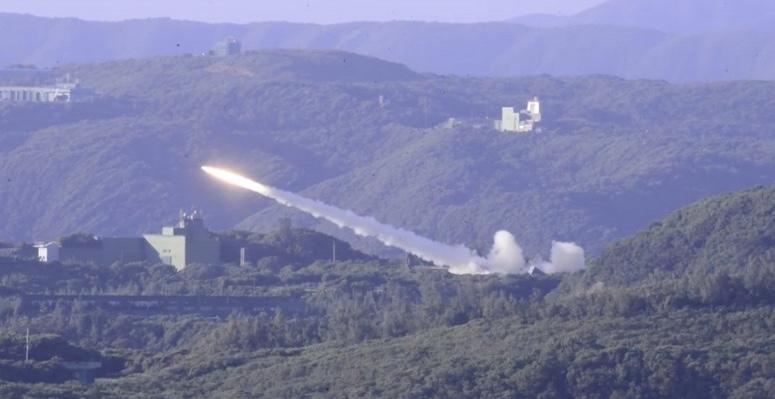
A Chinese military drone was spotted conducting reconnaissance off Taitung County as President William Lai (賴清德) visited Pingtung County this morning to inspect a drill of the armed forces’ precision-strike capabilities, prompting the military to closely monitor its actions. Today was the final day of a three-day military exercise at Jioupeng Base (九鵬基地) to test the joint combat capabilities of the armed forces and coast guard. The exercise began on Wednesday simulating air defense interception and yesterday tested long-range strike capabilities and new air defense weapons. This morning, the military conducted a final exercise involving air defense, anti-ship and drone operations. Military sources said

OCT. 31: The antiviral drugs Tamiflu and Eraflu have been distributed to about 4,000 medical facilities nationwide for people in seven groups who develop flu-like symptoms As the domestic influenza epidemic enters its peak season and continues to escalate, the Centers for Disease Control (CDC) yesterday announced that publicly funded influenza antiviral drugs for seven eligible groups have been extended to Oct. 31, allowing those who develop flu-like symptoms to receive the medication without undergoing a rapid influenza test. The CDC has extended the expanded use of flu antiviral drugs to seven groups: healthcare and influenza-prevention personnel; residents and staff at nursing homes, long-term care facilities and similar institutions; kindergarten and daycare workers and home-based caregivers; students from kindergarten through high school, vocational high school and the

Taiwanese Tsai Chin-shu (蔡金樹), who had been imprisoned in China for engaging in activity that “endangers national security,” said on Facebook on Friday that he has returned to Taiwan. Tsai, chairman of the Southern Taiwan Union of Cross-strait Relations Associations, had traveled frequently between Taiwan and China for years, and at one time ran a trading company in China’s Pingtan. In July 2018, he traveled to Quanzhou, Fujian Province, to attend a cross-strait food trade fair and stayed at a hotel in Xiamen. He checked out the following day and then disappeared. His family had made repeated appeals to the authorities


 RSS
RSS