


Those who contravene Lunar New Year holiday quarantine measures would face harsh penalties, the Central Epidemic Command Center (CECC) said yesterday.
The center last week announced two additional quarantine options for Taiwanese who arrive in the nation between Dec. 14 and Feb. 14 next year, as a surge of inbound travelers is expected before the start of the Lunar New Year holiday in late January.
Travelers who are fully vaccinated against COVID-19 can stay for seven days in a quarantine hotel or self-paid centralized facility followed by seven days of quarantining at home, while others can quarantine for 10 days in a quarantine hotel or facility followed by four days at home. Both options would entail additional COVID-19 testing and requirements for self-health management.

Photo courtesy of the CECC
Addressing concerns that allowing some inbound travelers to quarantine at home might increase the risk of local COVID-19 transmission, Minister of Health and Welfare Chen Shih-chung (陳時中), who heads the center, said that severe punishment would be imposed on contraveners of the quarantine measures.
Chen, speaking on the sidelines of an event in Taipei, said that the penalty for contravening home quarantine rules is NT$100,000 to NT$1 million (US$3,592 to US$35,925), but for the holiday measures the center would recognize additional degrees of contravention with increased penalties for each level, and those who fail to cooperate would be taken to a centralized quarantine facility.
Under the Communicable Disease Control Act (傳染病防治法), people who leave their quarantine location can be fined NT$100,000 for leaving for up to two hours, NT$200,000 for two to six hours, NT$300,000 for six to 24 hours, NT$600,000 for 24 to 72 hours and up to a maximum of NT$1 million for more than 72 hours.
At the CECC’s news conference, Centers for Disease Control Deputy Director-General Chuang Jen-hsiang (莊人祥), who is the center’s spokesman, said the CECC is looking to reduce the time periods of each contravention level or increase the penalty for each level.
Chen said the Civil Affairs Department would be responsible for the care services of people in home quarantine, while the mobile phone-based “electronic fence” system would be used to monitor whether someone left their quarantined venue.
The police would also play a role in preventing quarantine breaches, he added.
In other news, the Taipei Department of Health yesterday said a clinic on Friday mistakenly inoculated 23 people with a second dose of a COVID-19 vaccine that was different from what the recipients had registered to receive.
The 23 people were incorrectly given the Moderna vaccine after they had made appointments to receive a second dose of the AstraZeneca vaccine.
The clinic was ordered to suspend COVID-19 vaccination services until improvements are made, the department said.
Chuang said the 23 people do not need to receive an additional AstraZeneca shot, because the combination of the AstraZeneca and Moderna vaccines is considered to offer full protection.
Additional reporting by CNA

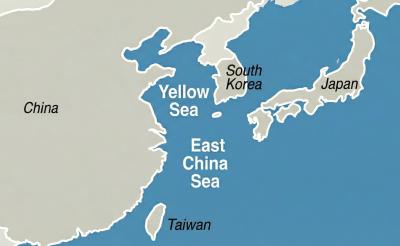
China has reserved offshore airspace in the Yellow Sea and East China Sea from March 27 to May 6, issuing alerts usually used to warn of military exercises, although no such exercises have been announced, the Wall Street Journal (WSJ) reported yesterday. Reserving such a large area for 40 days without explanation is an “unusual step,” as military exercises normally only last a few days, the paper said. These alerts, known as Notice to Air Missions (Notams), “are intended to inform pilots and aviation authorities of temporary airspace hazards or restrictions,” the article said. The airspace reserved in the alert is

NAMING SPAT: The foreign ministry called on Denmark to propose an acceptable solution to the erroneous nationality used for Taiwanese on residence permits Taiwan has revoked some privileges for Danish diplomatic staff over a Danish permit that lists “Taiwan” as “China,” Eric Huang (黃鈞耀), head of the Ministry of Foreign Affairs’ Department of European Affairs, told a news conference in Taipei yesterday. Reporters asked Huang whether the Danish government had responded to the ministry’s request that it correct the nationality on Danish residence permits of Taiwanese, which has been listed as “China” since 2024. Taiwan’s representative office in Denmark continues to communicate with the Danish government, and the ministry has revoked some privileges previously granted to Danish representatives in Taiwan and would continue to review
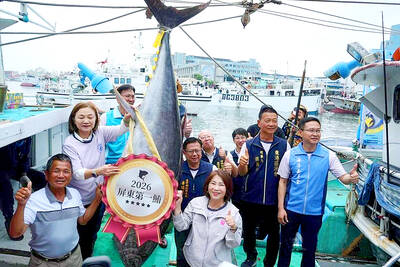
The first bluefin tuna of the season, brought to shore in Pingtung County and weighing 190kg, was yesterday auctioned for NT$10,600 (US$333.5) per kilogram, setting a record high for the local market. The auction was held at the fish market in Donggang Fishing Harbor, where the Siaoliouciou Island-registered fishing vessel Fu Yu Ching No. 2 delivered the “Pingtung First Tuna” it had caught for bidding. Bidding was intense, and the tuna was ultimately jointly purchased by a local restaurant and a local company for NT$10,600 per kilogram — NT$300 ,more than last year — for a total of NT$2.014 million. The 67-year-old skipper

China has reserved offshore airspace over the Yellow Sea and East China Sea from March 27 to May 6, issuing alerts that are usually used to warn of military exercises, although no such exercises have been announced, the Wall Street Journal (WSJ) reported on Sunday. Reserving such a large area for 40 days without explanation is an “unusual step,” as military exercises normally only last a few days, the paper said. The alerts, known as notice to air missions (NOTAMs), “are intended to inform pilots and aviation authorities of temporary airspace hazards or restrictions,” the article said. The airspace reserved in the alert


 RSS
RSS