


Enhancing the resilience of military reservists is likely to be a priority of a reported US military program in Taiwan, academics said this week.
The Wall Street Journal on Thursday last week reported that US special operations personnel have been deployed in Taiwan for at least a year.
Citing an anonymous official, the newspaper reported that two dozen US troops consisting of a special operations unit, marines and support troops have been conducting small-unit training for Taiwan’s ground forces.
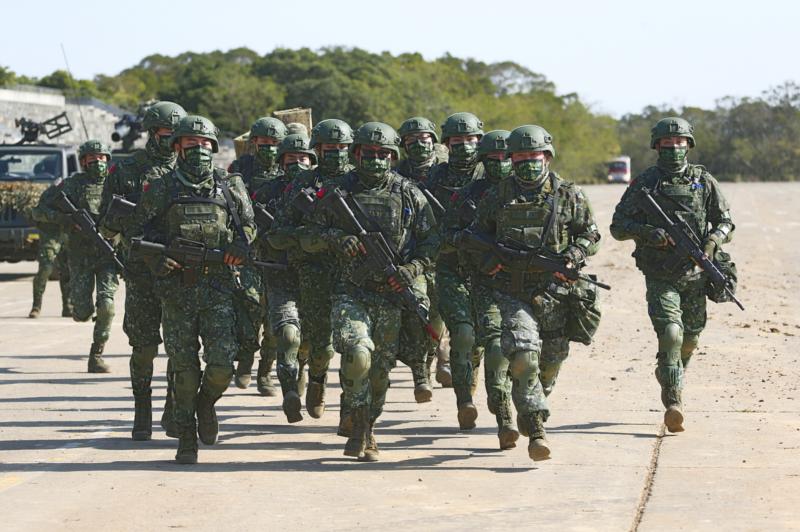
Photo: Chiang Ying-ying, AP
Institute for National Defense and Security Research senior analyst Su Tzu-yun (蘇紫雲) said that Washington’s next priority would likely be Taiwan’s reservists.
Enhancing the capability of the nation’s reservists is key to creating resilience in Taiwan’s homeland defense and would allow professional soldiers added maneuverability, Su said.
If well-trained reservists can be entrusted with holding a line, units of active service soldiers would be able to strike instead of being tied to defensive positions, he said.
Taiwan’s international isolation has led to its military leadership becoming insular, with a military science stuck in last century, former National Defense University lecturer Holmes Liao (廖宏祥) said.
The US has the experience to assist Taiwan’s military to carry out urgently needed reform of the command structure, up to and including the general staff, Liao said.
When he taught at the university’s War College, military officers in training often told him that the US way of doing things would not work in Taiwan, he said.
This mindset is not productive when the country is expecting the US to conduct training or even garrison units in Taiwan, he said.
The tradition of the Whampoa Military Academy in Kaohsiung has persisted, Liao said.
The academy is overly concerned with abstract theory, especially Sun Zi’s (孫子) The Art of War, which has dubious practical value in modern warfare, Liao said.
US military assistance should focus on the modernization of the national defense apparatus, including by embedding US officers in the Ministry of National Defense and the general staff, he said.
Taiwan’s armed forces must improve in competence when doing threat assessment, operational planning, establishing procedures, deployment of forces, training, weapons development and logistics, he said, adding that the armed forces must prepare to fight a 21st-century war.
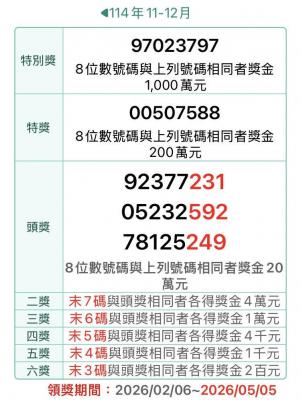
Seven of the 17 NT$10 million (US$311,604) winning receipts from the November-December uniform invoice lottery remain unclaimed as of today, the Ministry of Finance said, urging winners to redeem their prizes by May 5. The reminder comes ahead of the release of the winning numbers for the January-February lottery tomorrow. Among the unclaimed receipts was one for a NT$173 phone bill in Keelung, while others were for a NT$5,913 purchase at Costco in Taipei's Neihu District (內湖), a NT$49 purchase at a FamilyMart in New Taipei City's Tamsui District (淡水), and a NT$500 purchase at a tea shop in New Taipei City's
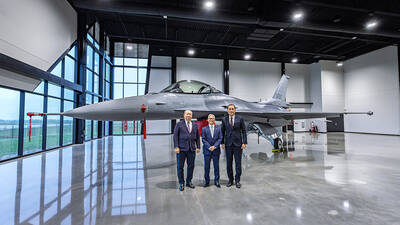
Taiwanese officials were shown the first of 66 F-16V fighter jets purchased by Taiwan from the United States, the Ministry of National Defense said yesterday, adding the aircraft has completed an initial flight test and is expected to be delivered later this year. A delegation led by Deputy Minister of National Defense Hsu Szu-chien (徐斯儉) visited Lockheed Martin’s F-16 C/D Block 70 (also known as F-16V) assembly line in South Carolina on March 16 to view the aircraft. The jet will undergo a final acceptance flight in the US before being delivered to Taiwan, the
Deliveries of delayed F-16V jets are expected to begin in September, Minister of National Defense Wellington Koo (顧立雄) said today, after senior defense officials visited the US last week. The US in 2019 approved a US$8 billion sale of Lockheed Martin F-16 jets to Taiwan, a deal that would take the nation’s F-16 fleet to more than 200 jets, but the project has been hit by issues including software problems. Koo appeared today before a meeting of the legislature’s Foreign Affairs and National Defense Committee, which is discussing different versions of the special defense budget this week. The committee is questioning officials today,
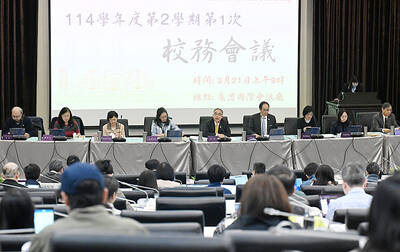
TALENT SCOUTING: The university is investing substantial funds in its future to bring in the kind of researchers that would keep the college internationally competitive National Taiwan University (NTU) plans to invest NT$2 billion (US$62.6 million) to launch two programs aimed at attracting and retaining top research talent, university president Chen Wen-chang (陳文章) said yesterday. The funding would support the “Palm Grove Scholars Project,” which targets academics aged 40 to 55. Up to 20 scholars would be selected, each receiving as much as NT$10 million annually, Chen said. The initiative is designed to attract leading researchers to Taiwan and strengthen NTU’s global competitiveness by fostering a more research-friendly environment and expanding international collaboration, he said. NTU is also introducing a “Hong Hu” chair grant, which would provide Palm


 RSS
RSS