


Taipei Mayor Ko Wen-je (柯文哲) yesterday in his Double Ten National Day message accused the Democratic Progressive Party government of inciting fear and anti-China sentiment, while making an appeal to Beijing to accept Taiwan’s existence.
After attending the morning celebrations outside the Presidential Office Building in Taipei, Ko, who is chairman of the Taiwan People’s Party (TPP), wrote on Facebook a “happy birthday” message to the Republic of China (ROC) in which he reflected on the nation’s values, and condemned partisan politics and Chinese aggression.
In the 110 years since Sun Yat-sen (孫逸仙) founded Asia’s first democratic republic, the ROC on Taiwan has developed a system that is truly of the people, by the people and for the people, Ko wrote.
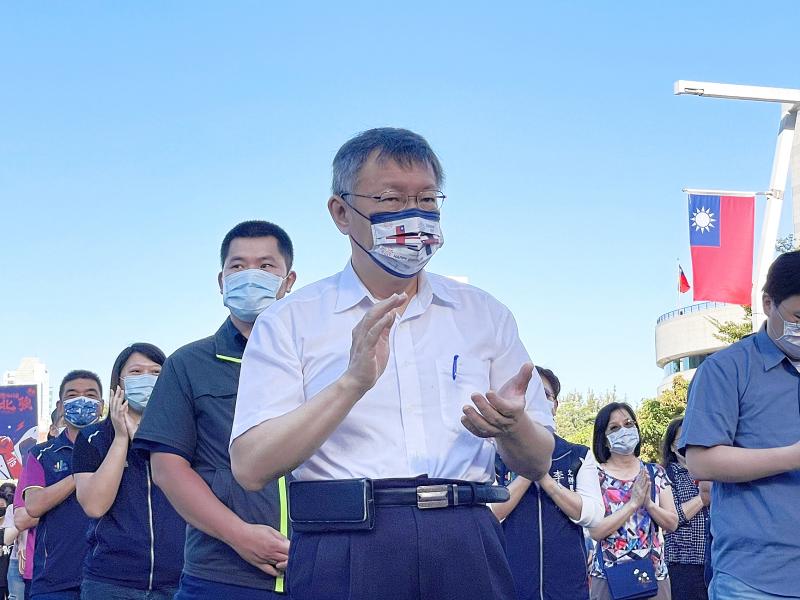
Photo: Cheng Ming-hsiang, Taipei Times
In this time, it has deepened the universal values of democracy, freedom, pluralism, human rights and rule of law to become the pride of all Taiwanese, he added.
Although the two sides of the Strait used to belong to one China, it is also a fact that they have been divided for more than 120 years, Ko wrote, adding that everyone, regardless of party affiliation, is proud of Taiwan’s resilience and achievements.
“However, the Chinese Communist Party’s frequent use of force to intimidate and suppress Taiwan is fundamentally against the expressed will of Taiwanese,” he said.
Referencing “The North Wind and the Sun,” an Aesop’s fable about the power of persuasion over force, Ko urged Beijing to embrace the universal values that Taiwan holds dear.
“We hope that China’s strength brings more prosperity to its people and respect internationally, as well as willingness to open peaceful dialogue rather than threatening force or denying the fundamental existence of the ROC and Taiwan, which will only make Taiwanese run further away,” he wrote.
He also took the opportunity to criticize the DPP leadership for refusing to work with their opponents.
“In the past few years, we have only seen the DPP manipulate people’s fears and anti-China sentiment to ineffectual result, constantly suppressing and branding its political opponents,” Ko wrote.
“We have seen no room for dialogue, both internally and externally,” he added.
Ko also criticized President Tsai Ing-wen’s (蔡英文) call for peaceful dialogue with China in her national day address yesterday, saying that mutual interaction is what makes change, not unending talk.
“We should of course band together with those who view us as equals in the world, but we should not put the safety and security of the people at risk by manipulating ideology for partisan political gain,” he said, adding that Taiwan can only move forward by overcoming ideological disputes and refraining from making enemies compatriots.
Meanwhile, the TPP, in its own National Day address, echoed Ko’s call for inclusivity while condemning the “domination of one voice” in government.
Especially with the prevalence of social media, politics has fallen victim to clickbait and bickering, the party said on Facebook, calling on those in power to stop using divisive hate speech, labeling their opponents as communist sympathizers and controlling the media.
“The crisis of governance begins when there is no voice of opposition,” it added.
Additional reporting by Hsieh Chun-lin

The Centers for Disease Control (CDC) yesterday reported the first case of a new COVID-19 subvariant — BA.3.2 — in a 10-year-old Singaporean girl who had a fever upon arrival in Taiwan and tested positive for the disease. The girl left Taiwan on March 20 and the case did not have a direct impact on the local community, it said. The WHO added the BA.3.2 strain to its list of Variants Under Monitoring in December last year, but this was the first imported case of the COVID-19 variant in Taiwan, CDC Deputy Director-General Lin Ming-cheng (林明誠) said. The girl arrived in Taiwan on

South Korea is planning to revise its controversial electronic arrival card, a step Taiwanese officials said prompted them to hold off on planned retaliatory measures, a South Korean media report said yesterday. A Yonhap News Agency report said that the South Korean Ministry of Foreign Affairs is planning to remove the “previous departure place” and “next destination” fields from its e-arrival card system. The plan, reached after interagency consultations, is under review and aims to simplify entry procedures and align the electronic form with the paper version, a South Korean ministry official said. The fields — which appeared only on the electronic form

The Ministry of Foreign Affairs (MOFA) is suspending retaliation measures against South Korea that were set to take effect tomorrow, after Seoul said it is updating its e-arrival system, MOFA said today. The measures were to be a new round of retaliation after Taiwan on March 1 changed South Korea's designation on government-issued alien resident certificates held by South Korean nationals to "South Korea” from the "Republic of Korea," the country’s official name. The move came after months of protests to Seoul over its listing of Taiwan as "China (Taiwan)" in dropdown menus on its new online immigration entry system. MOFA last week

A bipartisan group of US senators has introduced a bill to enhance cooperation with Taiwan on drone development and to reduce reliance on supply chains linked to China. The proposed Blue Skies for Taiwan Act of 2026 was introduced by Republican US senators Ted Cruz and John Curtis, and Democratic US senators Jeff Merkley and Andy Kim. The legislation seeks to ease constraints on Taiwan-US cooperation in uncrewed aerial systems (UAS), including dependence on China-sourced components, limited access to capital and regulatory barriers under US export controls, a news release issued by Cruz on Wednesday said. The bill would establish a "Blue UAS


 RSS
RSS