


The Central Epidemic Command Center (CECC) yesterday reported seven imported COVID-19 cases, but no locally transmitted infections or deaths.
The cases were Taiwanese, Burmese and Indonesian nationals, who arrived from Myanmar, Indonesia, Malaysia and Singapore between Sept. 27 and Friday, the CECC said in a news release.
It did not hold its daily news conference due to Double Ten National Day celebrations.
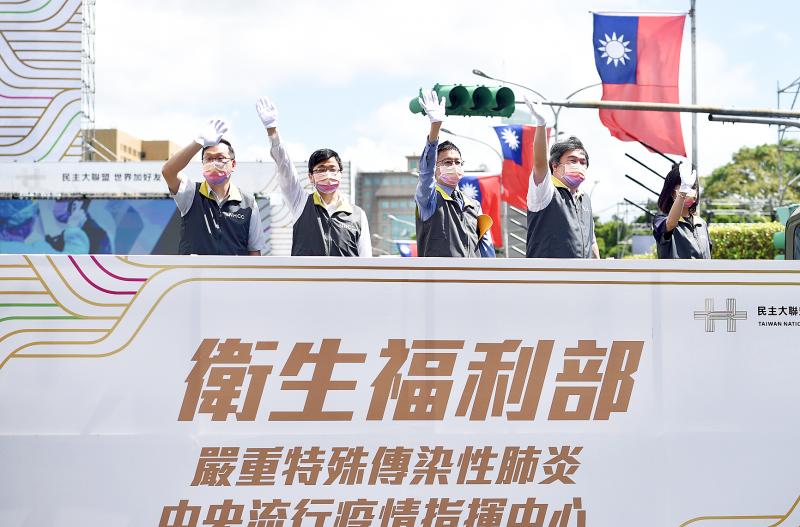
Photo: Peter Lo, Taipei Times
Meanwhile, there have been discussions about whether contact tracing should be conducted for cases with low viral loads and high levels of antibodies, which indicate that the infected person did not contract the disease recently.
Experts say that these cases are unlikely to be contagious.
The discussions emerged after the center on Saturday reported the first local COVID-19 case this month — a one-year-old girl who had COVID-19 antibodies and a cycle threshold value of 38, indicating that the child was not infected recently.
However, Linkou Chang Gung Memorial Hospital deputy superintendent Chiu Cheng-hsun (邱政洵) said that contract tracing should be conducted for such cases.
While there have been fewer domestic cases, regular testing is important to closely monitor the COVID-19 situation in communities, especially as the center gradually eases disease prevention rules, said Chiu, who also works as a physician in the hospital’s pediatric infection division.
The hospital tests about 600 to 700 people for COVID-19 every day, and occasionally as many as 1,000 people, Chiu said, adding that cases such as the infant’s are sometimes detected.
Contact tracing would also help confirm that the cases have not recently had contact with an infected person, he added.
Cases with low viral loads and high antibody levels pose a very low risk of spreading the virus, but people with compromised immune systems might still be at risk if they are in close contact with such a case, Chiu said.
Separately, Kaohsiung Municipal United Hospital on Saturday said that its deputy superintendent had been reprimanded after COVID-19 vaccines were given to 42 ineligible people who work for Taiwan High Speed Rail Corp (THSRC).
The superintendent has also asked the hospital to punish his deputy for failing to fulfill his supervisory responsibilities, it said, adding that the request would have to be approved by the Kaohsiung Department of Health.
Local media reported that the 42 THSRC employees on Sept. 22 asked to get inoculated with Moderna COVID-19 vaccines, claiming that they were in priority group 3 — frontline workers with a high contact risk — even though they were in group 7.
After hospital staff initially refused to vaccinate them, there was a dispute.
To end the standoff, the deputy superintendent reportedly ordered staff to vaccinate the 42.
THSRC on Oct. 1 said in a statement that employees who make false statements to get vaccinated would be punished.
Additional reporting by CNA

The Centers for Disease Control (CDC) yesterday reported the first case of a new COVID-19 subvariant — BA.3.2 — in a 10-year-old Singaporean girl who had a fever upon arrival in Taiwan and tested positive for the disease. The girl left Taiwan on March 20 and the case did not have a direct impact on the local community, it said. The WHO added the BA.3.2 strain to its list of Variants Under Monitoring in December last year, but this was the first imported case of the COVID-19 variant in Taiwan, CDC Deputy Director-General Lin Ming-cheng (林明誠) said. The girl arrived in Taiwan on

South Korea is planning to revise its controversial electronic arrival card, a step Taiwanese officials said prompted them to hold off on planned retaliatory measures, a South Korean media report said yesterday. A Yonhap News Agency report said that the South Korean Ministry of Foreign Affairs is planning to remove the “previous departure place” and “next destination” fields from its e-arrival card system. The plan, reached after interagency consultations, is under review and aims to simplify entry procedures and align the electronic form with the paper version, a South Korean ministry official said. The fields — which appeared only on the electronic form

The Ministry of Foreign Affairs (MOFA) is suspending retaliation measures against South Korea that were set to take effect tomorrow, after Seoul said it is updating its e-arrival system, MOFA said today. The measures were to be a new round of retaliation after Taiwan on March 1 changed South Korea's designation on government-issued alien resident certificates held by South Korean nationals to "South Korea” from the "Republic of Korea," the country’s official name. The move came after months of protests to Seoul over its listing of Taiwan as "China (Taiwan)" in dropdown menus on its new online immigration entry system. MOFA last week

A bipartisan group of US senators has introduced a bill to enhance cooperation with Taiwan on drone development and to reduce reliance on supply chains linked to China. The proposed Blue Skies for Taiwan Act of 2026 was introduced by Republican US senators Ted Cruz and John Curtis, and Democratic US senators Jeff Merkley and Andy Kim. The legislation seeks to ease constraints on Taiwan-US cooperation in uncrewed aerial systems (UAS), including dependence on China-sourced components, limited access to capital and regulatory barriers under US export controls, a news release issued by Cruz on Wednesday said. The bill would establish a "Blue UAS


 RSS
RSS