


Taiwan People’s Party (TPP) legislators yesterday urged the government to create a mechanism to negotiate with Beijing after 150 Chinese warplanes entered the nation’s air defense identification zone this month.
From Friday last week to Tuesday, 150 Chinese People’s Liberation Army aircraft entered the southwestern part of Taiwan’s air defense identification zone, Ministry of National Defense data showed.
TPP Legislator Jang Chyi-lu (張其祿) said that national defense spending this year increased to 23 percent of the general budget, which is in addition to extra defense spending over the next five years to be funded through debt.
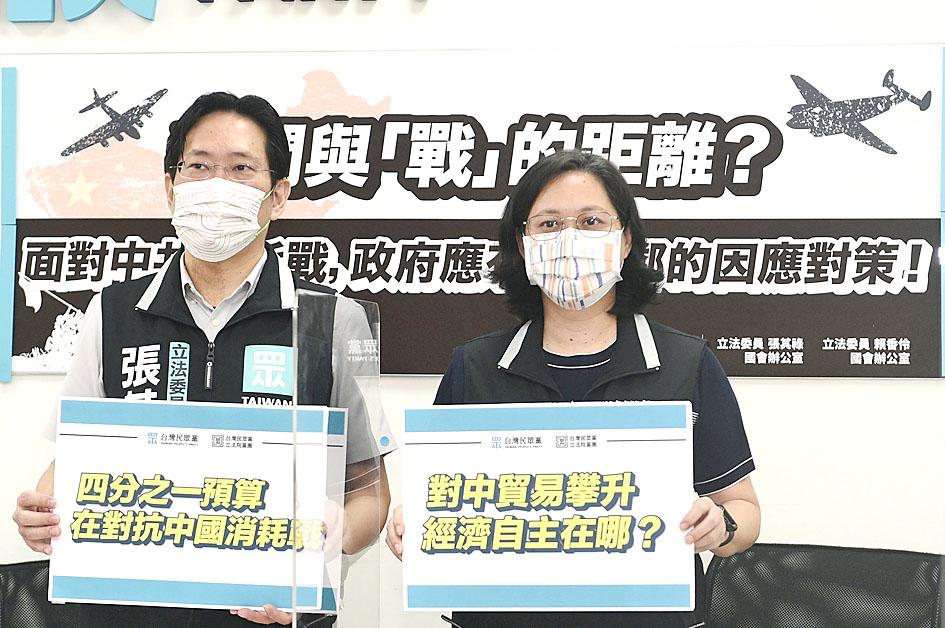
Photo: George Tsorng, Taipei Times
“Beyond raising military spending and issuing condemnations, President Tsai Ing-wen (蔡英文) should pursue other options, including creating a mechanism for conducting realistic negotiations with Beijing that would lower risks for both sides,” he told a news conference at the Legislative Yuan in Taipei.
“Taiwan needs some way to deal and coexist with China, our bad neighbor, since we cannot relocate to another place,” he said, adding that the nation must “avoid being entrapped by attrition.”
China is expected to wield threats to foil Taiwan’s attempt to reassert its sovereignty, and continue warplane flights near its airspace to wear down its air force, Jang said, citing Center for a New American Security researcher Jacob Stokes.
Chinese state media would continue to play up the activities of its air force around Taiwan to normalize acts of aggression it might take, he said.
TPP Legislator Lai Hsiang-ling (賴香伶) said that China aims to complete its military modernization by 2027, and its increasing dictatorial leadership indicates it is more willing to consider the use of military force than ever before.
Beijing has also ratcheted up diplomatic and economic pressure, such as by pre-empting Taiwan’s establishment of a trade office in Guyana, targeting Taiwanese professionals for recruitment and placing embargoes on Taiwanese fruit, she said.
The escalation of a US-China trade dispute has intensified Taiwan’s dependence on China-bound trade over the past two years, especially in the component packaging industry, Lai said.
Taiwan’s dependence on exports to China has increased yearly during Tsai’s second term in office, rising to 43.8 percent last year, she added.
“The Ministry of Economic Affairs knows full well whether China is dependent on imports from Taiwan or we are dependent on exports to that country,” she said.

NATIONAL SECURITY: Authorities are working to confirm the identities of the military personnel involved and investigating possible illegal conduct and regulatory violations Authorities are probing possible national security implications after Kinmen police and immigration officers on Sunday found a Chinese woman allegedly posing as a tourist while engaging in prostitution involving more than 10 military personnel. The woman, surnamed Chen (陳), has since been deported, authorities said, adding that investigators are still working to confirm the identities of those implicated, as the records only listed code names and aliases. The case stemmed from a report received by the Kinmen District Prosecutors’ Office on Friday last week from the Jinhu Precinct of the Kinmen County Police Bureau. On Sunday, police, along with the National Immigration

GLOBALGIVING: ‘ Caving to external pressure is not acceptable for an organization that has cultivated justice reform and human rights for 30 years,’ one NGO said A slew of non-government organizations (NGOs) have withdrawn from the GlobalGiving fundraising platform after it announced it would use “Chinese Taipei” instead of “Taiwan” from next month. The Taiwan Good Rice Association wrote on Facebook on Friday that it was informed on April 28 via a teleconference call of the change, which was made because the platform wanted to operate in China. Taiwan Good Rice is to terminate all cooperative relationships with GlobalGiving in response to the platform’s “unilateral and non-negotiable” decision to remove references to Taiwan, the NGO said. “Taiwan is in the official name of Taiwan Good Rice Association and the

HEAVY WEATHER: Typhoon Jangmi is due to crash straight into the Ryukyus as airlines look to shift flights to larger aircraft or cancel flights to Okinawa entirely Taiwan’s international air carriers announced flight adjustments over the weekend as Typhoon Jangmi is forecast to hit the Ryukyu Islands today and tomorrow. The Central Weather Administration (CWA) upgraded Jangmi from a tropical storm to a typhoon at 8am yesterday, with the eye located 580km south of Naha city. It was moving north at 19kph. Today, China Airlines’ CI-120, CI-121, CI-122 and CI-123 flights between Taoyuan and Naha, Okinawa, have been canceled as well as CI-132 and CI-133 between Kaohsiung and Naha. EVA Air’s BR-112, BR-113, BR-186 and BR-185 flights between Taoyuan and Naha are also canceled. Low-cost carrier Tigerair Taiwan canceled IT-230,
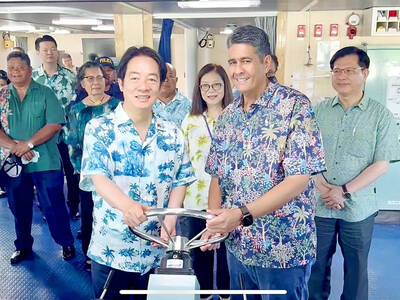
MULTIPRONGED APPROACH: China has sought to pressure Palau across a number of fronts, but the island nation has staunchly resisted overtures to ditch Taiwan Palau has been firm in backing Taiwan despite Chinese pressure that uses tourism economics, cyberattacks and criminal infiltration as tools to threaten the Pacific ally into renouncing its recognition of Taiwan as a sovereign state. The Presidential Office yesterday announced that Vice President Hsiao Bi-khim (蕭美琴) would visit Palau from Saturday to Wednesday next week at the invitation of Palauan President Surangel Whipps Jr. Whipps in April said in an interview that China had outspokenly asked Palau to “denounce Taiwan.” “And we have said: ‘We have no enemies, but nobody tells us who our friends are,’” he said. Whipps has told reporters multiple times


 RSS
RSS