


Efforts to improve Kaohsiung’s transportation infrastructure and other measures to retain local talent have drawn significant investment to the city over the past few years, Kaohsiung Mayor Chen Chi-mai (陳其邁) said on Friday.
“The year since I took office has been a race against time, but we have managed to draw lots of investors into the city,” he said in an interview with the Liberty Times (the Taipei Times’ sister newspaper).
During his time in office, state-run refiner CPC Corp, Taiwan started to process oil from Chad at its Kaohsiung facility and the newly opened Ciaotou Science Park has spurred interest from more than 20 manufacturers, Chen said, adding that the city has been receiving feedback from those businesses on issues to solve.
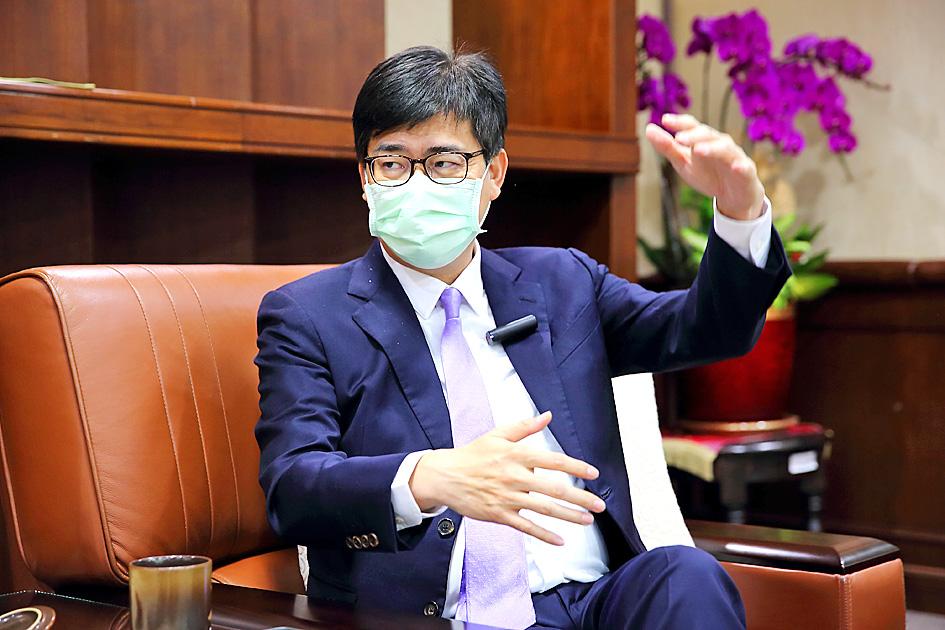
Photo: Lee Hui-chou, Taipei Times
Advanced Semiconductor Engineering Inc, Brogent Technologies Inc, Daxin Materials Corp and Huang Liang Technologies Co were among the manufacturers that opened facilities in the park, he said.
The Renwu Industrial Park in the city’s Renwu District (仁武) this year held an investors meeting that more than 300 businesses attended, he said, adding that as of July 15, the park had received lease applications from 60 businesses.
Meanwhile, four office buildings under construction in the city’s Asia New Bay Area (亞洲新灣區) are to offer more than 1,000 ping (3,305.8m2) floor space, he said.
Thirteen companies have thus far signed leases, he said, adding that most of them focus on Internet of Things and 5G applications.
“We want these companies to be happy, but at the same time, we also want talented people to stay in the city, so we are constantly upgrading transportation networks that link people’s workplaces and lifestyle places,” he said.
Citing an example, Chen said that there are four stations of the KMRT metro rail system covering metropolitan Kaohsiung near the CPC plant.
The plant is two stops from the city’s high-speed railway station and accessible from the Sun Yat-sen Freeway (Freeway No. 1) and National Freeway 10, he added.

The Centers for Disease Control (CDC) yesterday reported the first case of a new COVID-19 subvariant — BA.3.2 — in a 10-year-old Singaporean girl who had a fever upon arrival in Taiwan and tested positive for the disease. The girl left Taiwan on March 20 and the case did not have a direct impact on the local community, it said. The WHO added the BA.3.2 strain to its list of Variants Under Monitoring in December last year, but this was the first imported case of the COVID-19 variant in Taiwan, CDC Deputy Director-General Lin Ming-cheng (林明誠) said. The girl arrived in Taiwan on

South Korea is planning to revise its controversial electronic arrival card, a step Taiwanese officials said prompted them to hold off on planned retaliatory measures, a South Korean media report said yesterday. A Yonhap News Agency report said that the South Korean Ministry of Foreign Affairs is planning to remove the “previous departure place” and “next destination” fields from its e-arrival card system. The plan, reached after interagency consultations, is under review and aims to simplify entry procedures and align the electronic form with the paper version, a South Korean ministry official said. The fields — which appeared only on the electronic form

The Ministry of Foreign Affairs (MOFA) is suspending retaliation measures against South Korea that were set to take effect tomorrow, after Seoul said it is updating its e-arrival system, MOFA said today. The measures were to be a new round of retaliation after Taiwan on March 1 changed South Korea's designation on government-issued alien resident certificates held by South Korean nationals to "South Korea” from the "Republic of Korea," the country’s official name. The move came after months of protests to Seoul over its listing of Taiwan as "China (Taiwan)" in dropdown menus on its new online immigration entry system. MOFA last week

A bipartisan group of US senators has introduced a bill to enhance cooperation with Taiwan on drone development and to reduce reliance on supply chains linked to China. The proposed Blue Skies for Taiwan Act of 2026 was introduced by Republican US senators Ted Cruz and John Curtis, and Democratic US senators Jeff Merkley and Andy Kim. The legislation seeks to ease constraints on Taiwan-US cooperation in uncrewed aerial systems (UAS), including dependence on China-sourced components, limited access to capital and regulatory barriers under US export controls, a news release issued by Cruz on Wednesday said. The bill would establish a "Blue UAS


 RSS
RSS