


Democratic Progressive Party (DPP) officials and lawmakers yesterday condemned China’s sudden ban on imports of custard apples and wax apples from Taiwan as “obvious political retaliation,” while the opposition called for a scientific investigation into Beijing’s claim to have found pests in imports of the fruits.
China earlier yesterday announced a ban on the importation of the two fruits from today, citing repeated discoveries of Planococcus minor, a type of mealybug.
The announcement follows a similar ban on Taiwanese pineapples imposed in February.
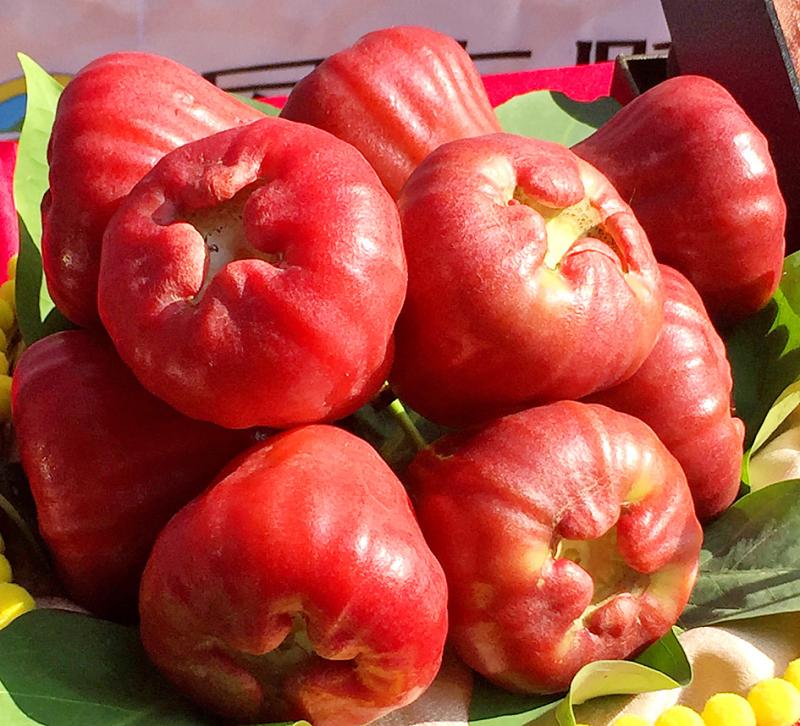
Photo: Luo Hsin-chen, Taipei Times
At least Beijing gave a few days’ notice when it banned pineapple imports, an unnamed government official said yesterday.
This time it was “announced today and banned tomorrow,” intentionally planned for the Mid-Autumn Festival to throw the government into chaos and prevent farmers from enjoying the holiday, the official said.
Beijing’s use of “cruel and crass means to target the most vulnerable” disproves its promise of beneficial integration, the official said, adding that it is obvious retaliation for recent improvements in Taiwan-US relations.
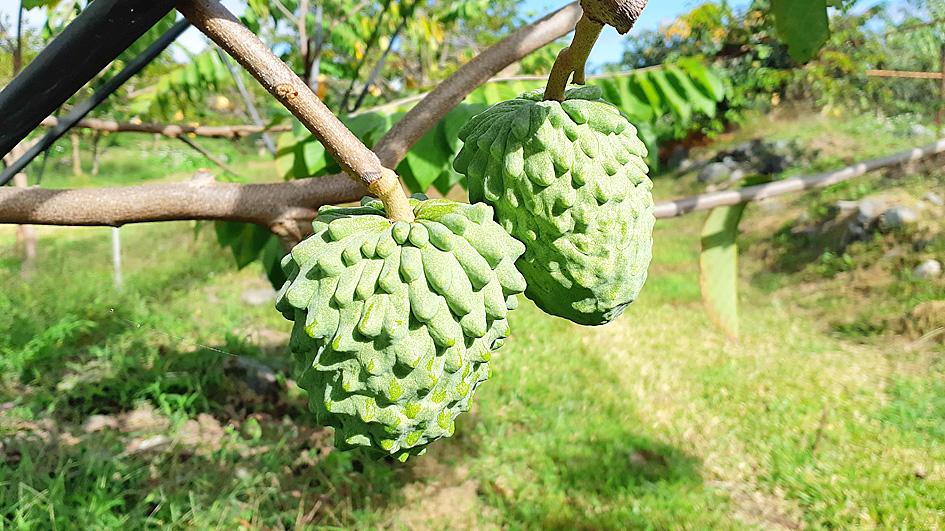
Photo: Huang Ming-tang, Taipei Times
Beijing always waits until Taiwanese crops are about to be in season to unilaterally announce that it has intercepted some sort of pest, using farmers as the scapegoat, DPP Legislator Chuang Jui-hsiung (莊瑞雄) said.
It is clearly a political attempt to suppress the development of Taiwanese agriculture, he said, decrying Beijing’s “disgraceful” tactic of using agriculture to subjugate the government and businesses to promote unification.
Chuang said he has already urged the government to take immediate countermeasures, including reducing the nation’s reliance on one market.
He also called on the public to use their pocketbooks to support local farmers.
DPP Legislator Wang Mei-hui (王美惠) also called foul, saying that China does not restrict other nations’ fruit imports.
The timing is especially suspicious, considering reports earlier this month that US lawmakers have called for renaming Taiwan’s Washington representative office to include the name “Taiwan,” she added.
Meanwhile, the Chinese Nationalist Party (KMT) called on the government to rectify the problem through concrete action and bilateral dialogue.
Council of Agriculture data show that 90 percent of all exported custard and wax apples go to China, the party said in a statement, adding that action is needed to make sure that “care for farmers” is not reduced to a mere slogan.
Scientific investigators should be sent to China to determine whether pests are present and whether they pose a threat, it said.
This could be achieved through a cross-strait mechanism set up under an earlier KMT administration on agricultural quarantine and inspection, which allows for timely cooperation on emergencies, it added.
Additional reporting by Hsieh Chun-lin

FUKUOKA SITUATION: Japanese media reported that the pathogen is expected to be identified by the summer, while the CDC downplayed the idea that it was hMPV A “mysterious cold-like illness” reported in Japan’s Fukuoka Prefecture does not seem to be a new disease, but Japanese authorities have been asked about the situation, the Centers for Disease Control (CDC) said yesterday. The Fukuoka Prefectural Medical Association on Wednesday told a news conference that a “mystery cold” that has become a hot topic on social media is “highly likely to be caused by some kind of viral infection,” Japan’s KBC News reported. “Many people are experiencing symptoms starting with a sore throat, followed by a runny nose, phlegm and a severe cough,” KBC News reported, citing association officials. Health authorities are

Nvidia Corp CEO Jensen Huang (黃仁勳) arrived in Taiwan yesterday ahead of upcoming AI and technology events, saying he plans to meet with clients and Taiwan Semiconductor Manufacturing Co Chairman C.C. Wei (魏哲家) during his visit. After landing at Taipei Songshan Airport, Huang posed for photos with fans and handed out Yakult drinks to reporters and supporters waiting at the scene, saying he has “a lot to do” during the trip. Asked about reports that Nvidia’s planned headquarters site in Taipei’s Beitou Shilin Technology Park could break ground on May 27, Huang said that if the company holds an event, he would

The Ministry of Finance this afternoon announced the winning numbers for the March-April uniform invoice lottery. The winning number for the NT$10 million (US$318,060) special prize is 19531471, and the winning number for the NT$2 million grand prize is 85941329. Three numbers were drawn for the NT$200,000 first prize: 07225810, 20231230 and 83518781. Those with receipts matching the last seven digits of any of the first-prize numbers will win the NT$40,000 second prize, while those matching the last six digits will win the NT$10,000 third prize. Those whose receipts match the last five digits of the first-prize numbers can claim the NT$4,000 fourth prize,
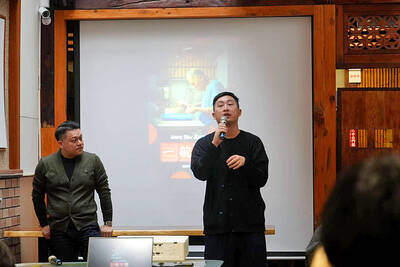
Taiwan Travelogue (臺灣漫遊錄), which earlier this week became the first Taiwanese novel to win the International Booker Prize, is to be adapted into a television series through a Taiwan-Japan coproduction, producer Chang Chen-yu (張辰漁) said yesterday. Chang, a producer at World Softest Production Film Co, wrote on Facebook that the company had been searching for projects with international appeal that retain a strong Taiwanese identity after colleagues and Japanese partners strongly recommended the novel. After reading the book, Chang said he immediately decided to pursue the screen rights. “A great story has the power to transcend time and borders, and connect countless people,”


 RSS
RSS