


Taiwan should join the Comprehensive and Progressive Agreement for Trans-Pacific Partnership (CPTPP) before China becomes a member of the trade group, Democratic Progressive Party (DPP) lawmakers said yesterday.
The successor to the Trans-Pacific Partnership that then-US president Donald Trump abandoned, CPTPP members include Japan, Singapore, Canada and Mexico, among many others.
Taiwan would lose its shot at joining if China joins the pact, DPP Legislator Chiu Chih-wei (邱志偉) told a news conference at the Legislative Yuan in Taipei.
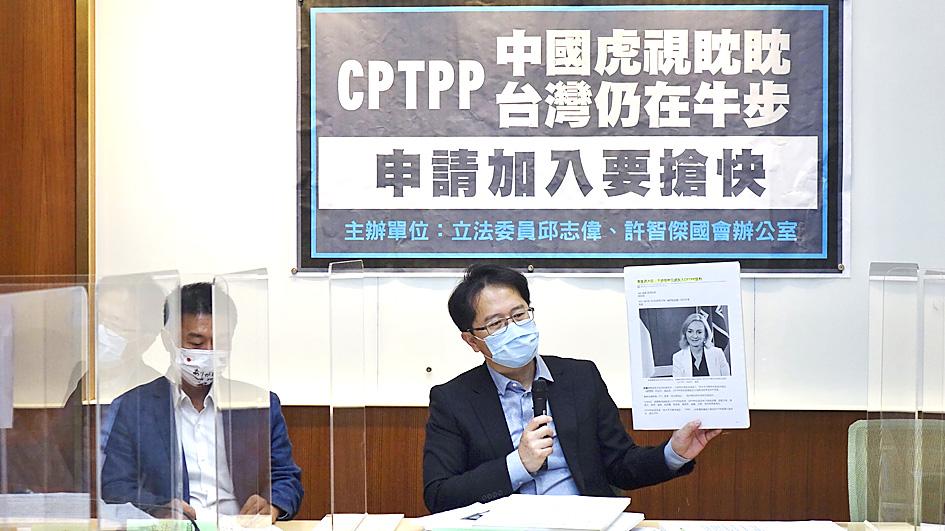
Photo: Tu Chien-jung, Taipei Times
Chinese President Xi Jinping (習近平) in November last year told an APEC summit that Beijing wants to join the pact.
The timing would be right for Taiwan to launch a bid now, as the world has a negative perception of China and Japan is chair of the CPTPP this year, Chiu said.
Singapore is to chair the trade pact next year, with Singaporean Minister of Foreign Affairs Vivian Balakrishnan tapped to take the post, he said, adding that Balakrishnan has voiced support for a Chinese bid.
Taiwan must prepare a bid by amending laws, mustering public support and lobbying foreign governments, Chiu said.
The Executive Yuan has yet to propose amendments that would bring the Patent Act (專利法), the Copyright Act (著作權法) and the Trademark Act (商標法) in line with CPTPP requirements, he said.
Additionally, government agencies should accelerate the drafting of the digital communications and broadcast bill, he said.
Japan chairing the CPTPP is an important, but fleeting advantage for Taiwan, as officials in the Japanese Ministry of Foreign Affairs and the Diet have said that the nation should be part of the trade pact, DPP Legislator Hsu Chih-chieh (許智傑) told the news conference.
Hsiao Chen-jung (蕭振榮), a senior negotiator at the Ministry of Foreign Affairs in Taipei, said that government efforts to join the CPTPP are being conducted in the way the lawmakers outlined.
The ministry is observing the UK’s bid to join to better understand the process and anticipate difficulties that might arise, Hsiao added.

The Centers for Disease Control (CDC) yesterday reported the first case of a new COVID-19 subvariant — BA.3.2 — in a 10-year-old Singaporean girl who had a fever upon arrival in Taiwan and tested positive for the disease. The girl left Taiwan on March 20 and the case did not have a direct impact on the local community, it said. The WHO added the BA.3.2 strain to its list of Variants Under Monitoring in December last year, but this was the first imported case of the COVID-19 variant in Taiwan, CDC Deputy Director-General Lin Ming-cheng (林明誠) said. The girl arrived in Taiwan on

South Korea is planning to revise its controversial electronic arrival card, a step Taiwanese officials said prompted them to hold off on planned retaliatory measures, a South Korean media report said yesterday. A Yonhap News Agency report said that the South Korean Ministry of Foreign Affairs is planning to remove the “previous departure place” and “next destination” fields from its e-arrival card system. The plan, reached after interagency consultations, is under review and aims to simplify entry procedures and align the electronic form with the paper version, a South Korean ministry official said. The fields — which appeared only on the electronic form

The Ministry of Foreign Affairs (MOFA) is suspending retaliation measures against South Korea that were set to take effect tomorrow, after Seoul said it is updating its e-arrival system, MOFA said today. The measures were to be a new round of retaliation after Taiwan on March 1 changed South Korea's designation on government-issued alien resident certificates held by South Korean nationals to "South Korea” from the "Republic of Korea," the country’s official name. The move came after months of protests to Seoul over its listing of Taiwan as "China (Taiwan)" in dropdown menus on its new online immigration entry system. MOFA last week

A bipartisan group of US senators has introduced a bill to enhance cooperation with Taiwan on drone development and to reduce reliance on supply chains linked to China. The proposed Blue Skies for Taiwan Act of 2026 was introduced by Republican US senators Ted Cruz and John Curtis, and Democratic US senators Jeff Merkley and Andy Kim. The legislation seeks to ease constraints on Taiwan-US cooperation in uncrewed aerial systems (UAS), including dependence on China-sourced components, limited access to capital and regulatory barriers under US export controls, a news release issued by Cruz on Wednesday said. The bill would establish a "Blue UAS


 RSS
RSS