


The Central Epidemic Command Center (CECC) yesterday reported one local and four imported COVID-19 cases and no deaths.
The local case is a woman who cleans airplane cabins at Taiwan Taoyuan International Airport and has been confirmed to have the Delta variant of SARS-CoV-2, the CECC said.
The woman, who is in her 20s, developed a runny nose and dizziness on Sunday. She tested positive for COVID-19 two days later as part of routine testing of airport staff, the center said.
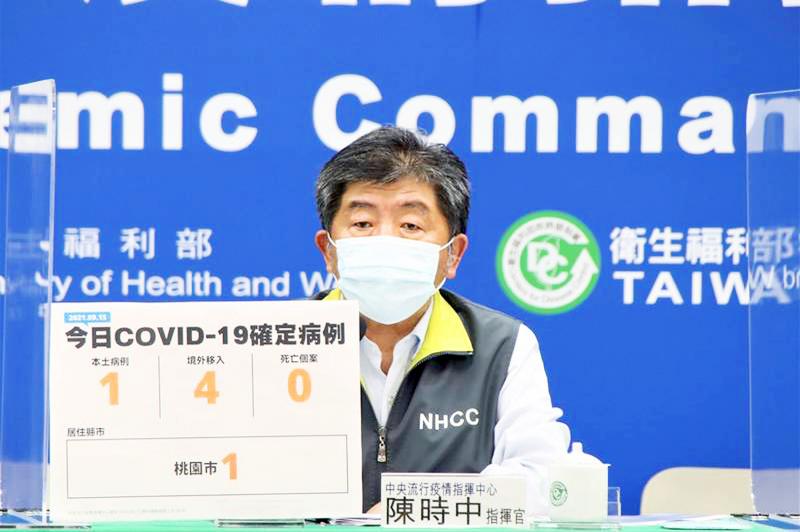
Photo courtesy of the CECC
Preliminary genome sequencing results show the woman has the Delta variant, but a more comprehensive analysis is needed to determine whether her case is connected to recent clusters involving the variant in Taiwan, said Centers for Disease Control Deputy Director-General Philip Lo (羅一鈞), who is the deputy head of the CECC’s medical response division.
As the woman cleans airplane cabins, the CECC is investigating whether she contracted the disease at work, he said.
The test results indicate she contracted the disease very recently, and 45 of her contacts are now in quarantine, the CECC said.
The woman received her first dose of the AstraZeneca COVID-19 vaccine in early June, it added.
At a separate press briefing, Taoyuan Mayor Cheng Wen-tsan (鄭文燦) said the city is testing employees at the company and its associated businesses, including China Pacific Catering Services.
Of the 42,827 people who work at the airport, about 95 percent have received one dose of a COVID-19 vaccine, while 74 percent have been fully vaccinated, he added.
Cheng said he would ask the CECC to allocate doses for airport employees to ensure their safety.
The woman visited two supermarkets in Taoyuan on Monday evening — a Pxmart on Fusing 2nd Road and a Carrefour on Wende 2nd Road, he said.
Among the four imported cases, three are Taiwanese who have returned from the US and the Philippines, and one is a French national traveling from France, the CECC said.
In other developments, New Taipei City Mayor Hou You-yi (侯友宜) yesterday said that starting today, restaurants in the city can resume dine-in services.
Public venues, including hot springs, swimming pools, libraries, night markets and fitness centers, can also resume normal operations, he said.
“The outbreak appears to be stabilizing and is moving in a positive direction ... but we must remain cautious and solemn — particularly with the Mid-Autumn Festival around the corner,” he said.
The city would remain at a level 2 COVID-19 alert with strengthened protective measures until Tuesday next week, he said.
That means visitations at long-term care facilities and retirement homes are to remain suspended, hospital patients are allowed only one visitor at a time, and gatherings are limited to 50 people indoors and 100 people outdoors, he said.
Additional reporting by Chou Hsiang-yun

The Centers for Disease Control (CDC) yesterday reported the first case of a new COVID-19 subvariant — BA.3.2 — in a 10-year-old Singaporean girl who had a fever upon arrival in Taiwan and tested positive for the disease. The girl left Taiwan on March 20 and the case did not have a direct impact on the local community, it said. The WHO added the BA.3.2 strain to its list of Variants Under Monitoring in December last year, but this was the first imported case of the COVID-19 variant in Taiwan, CDC Deputy Director-General Lin Ming-cheng (林明誠) said. The girl arrived in Taiwan on

South Korea is planning to revise its controversial electronic arrival card, a step Taiwanese officials said prompted them to hold off on planned retaliatory measures, a South Korean media report said yesterday. A Yonhap News Agency report said that the South Korean Ministry of Foreign Affairs is planning to remove the “previous departure place” and “next destination” fields from its e-arrival card system. The plan, reached after interagency consultations, is under review and aims to simplify entry procedures and align the electronic form with the paper version, a South Korean ministry official said. The fields — which appeared only on the electronic form

The Ministry of Foreign Affairs (MOFA) is suspending retaliation measures against South Korea that were set to take effect tomorrow, after Seoul said it is updating its e-arrival system, MOFA said today. The measures were to be a new round of retaliation after Taiwan on March 1 changed South Korea's designation on government-issued alien resident certificates held by South Korean nationals to "South Korea” from the "Republic of Korea," the country’s official name. The move came after months of protests to Seoul over its listing of Taiwan as "China (Taiwan)" in dropdown menus on its new online immigration entry system. MOFA last week

A bipartisan group of US senators has introduced a bill to enhance cooperation with Taiwan on drone development and to reduce reliance on supply chains linked to China. The proposed Blue Skies for Taiwan Act of 2026 was introduced by Republican US senators Ted Cruz and John Curtis, and Democratic US senators Jeff Merkley and Andy Kim. The legislation seeks to ease constraints on Taiwan-US cooperation in uncrewed aerial systems (UAS), including dependence on China-sourced components, limited access to capital and regulatory barriers under US export controls, a news release issued by Cruz on Wednesday said. The bill would establish a "Blue UAS


 RSS
RSS