


Democratic Progressive Party (DPP) legislators and city councilors yesterday called for mandatory contracts for new pet owners, to protect them from the purchase of unhealthy animals, and better management of pet breeders.
Citing numerous cases of people buying pets that died within a few days, the group called for the introduction of contracts between buyers and sellers that would hold the sellers responsible for pets determined to be unhealthy at the time of sale.
The authorities should also introduce a system to manage the origin of animals sold at pet shops, the group said.
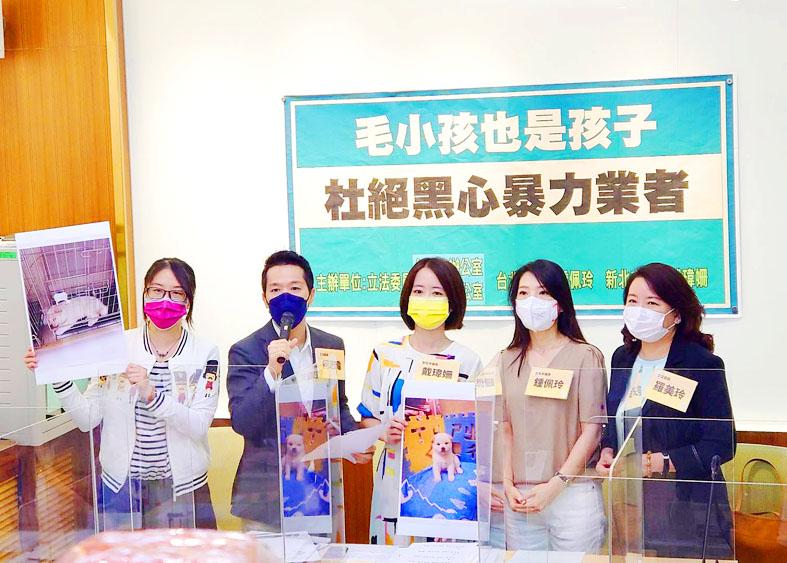
Photo: Yang Cheng-yu, Taipei Times
DPP legislators Mark Ho (何志偉) and Lo Mei-ling (羅美玲), along with New Taipei City Councilor Tai Wei-shan (戴瑋姍) and Taipei City Councilor Chung Pei-ling (鍾佩玲), discussed the issue at a news conference in Taipei.
Cases of pets dying soon after purchase raised questions about pet shops’ conditions and breeders’ practices, the group said.
“Some unscrupulous pet shop owners are just pumping these cats and dogs out, and keeping them in squalid conditions,” the group said.
For example, a pet shop in New Taipei City was in 2015 found to be keeping more than 200 cats and dogs in a 20 ping (66.12m2) space, and surgically altering the vocal cords of the female dogs used for breeding so that they could not bark, it added.
The animals’ enclosure was dirty and filled with cockroaches, and the animals were not fed, showered or deloused, it said.
“The city shut down the shop and fined the owner NT$130,000, but they just changed the owner and reopened under a different name,” it said. “Customers think they have a choice, but these shops are part of a group that has a monopoly — there is no choice for the consumer.”
Tai said that one pet shop was reported for selling 600 dogs in the first half of this year, which meant that the shop must be purchasing dogs from multiple breeders.
The authorities should investigate the breeders to ensure that they are keeping the animals under proper conditions, she said.
“One woman who bought a puppy from that shop on Aug. 15 said the dog kept falling asleep, and two days later coughed up a roundworm. She took it to the vet, but it died on Saturday,” she said, adding that the shop refused to take responsibility or compensate the customer.
The government should establish an oversight body under the Council of Agriculture that could inspect pet shops and breeders, the group said.
The Department of Animal Industry’s Animal Protection section chief Cheng Chu-ching (鄭祝菁) said that all puppies and kittens are required by law to undergo microchip registration.
People are strongly advised to examine the new pet’s registration documents and its breeding information, she said.
“We’ve made strides to crack down on illegal breeders over the past few years, but many of them search for potential buyers on social media, which makes enforcement more difficult,” she said, adding that the public is encouraged to report any suspicious breeders or sellers to the council.

Yangmingshan National Park authorities yesterday urged visitors to respect public spaces and obey the law after a couple was caught on a camera livestream having sex at the park’s Qingtiangang (擎天崗) earlier in the day. The Shilin Police Precinct in Taipei said it has identified a suspect and his vehicle registration number, and would summon him for questioning. The case would be handled in accordance with public indecency charges, it added. The couple entered the park at about 11pm on Thursday and began fooling around by 1am yesterday, the police said, adding that the two were unaware of the park’s all-day live

Fast food chain McDonald's is to raise prices by up to NT$5 on some products at its restaurants across Taiwan, starting on Wednesday next week, the company announced today. The prices of all extra value meals and sharing boxes are to increase by NT$5, while breakfast combos and creamy corn soup would go up by NT$3, the company said in a statement. The price of the main items of those meals, if ordered individually, would remain the same. Meanwhile, the price of a medium-sized lemon iced tea and hot cappuccino would rise by NT$3, extra dipping sauces for chicken nuggets would go up

Yangmingshan National Park’s Qingtiangang (擎天崗) nature area has gone viral after a park livestream camera observed a couple in the throes of intimate congress, which was broadcast live on YouTube, drawing large late-night crowds and sparking a backlash over noise, bright lights and disruption to wildlife habitat. The area’s livestream footage appeared to show a couple engaging in sexual activity on a picnic table in the park on Friday last week, with the uncensored footage streamed publicly online. The footage quickly spread across social media, prompting a tide of visitors to travel to the site to “check in” and recreate the

Minister of Digital Affairs Lin Yi-ching (林宜敬) yesterday cited regulatory issues and national security concerns as an expert said that Taiwan is among the few Asian regions without Starlink. Lin made the remarks on Facebook after funP Innovation Group chief executive officer Nathan Chiu (邱繼弘) on Friday said Taiwan and four other countries in Asia — China, North Korea, Afghanistan and Syria — have no access to Starlink. Starlink has become available in 166 countries worldwide, including Ukraine, Malaysia, the Philippines and Vietnam, in the six years since it became commercial, he said. While China and North Korea block Starlink, Syria is not


 RSS
RSS