


Democratic Progressive Party (DPP) lawmakers yesterday accused the Taiwan People’s Party (TPP) and Chinese Nationalist Party (KMT) of attempting to derail production of Medigen Vaccine Biologics Corp’s COVID-19 vaccine, most recently by demanding that the Ministry of Health and Welfare and three other agencies issue reports on its authorization process.
The TPP is following the KMT’s path by playing partisan politics and casting doubt on the process by which the domestic Medigen vaccine was granted emergency use authorization, in order to hamper its production, DPP legislative caucus secretary-general Lo Chih-cheng (羅致政) told a media briefing at the Legislative Yuan in Taipei.
Lo showed an official document, bearing the TPP legislative caucus letterhead and dated yesterday, which asked four government ministries and agencies to each table a report on the emergency use authorization process for the Medigen vaccine.
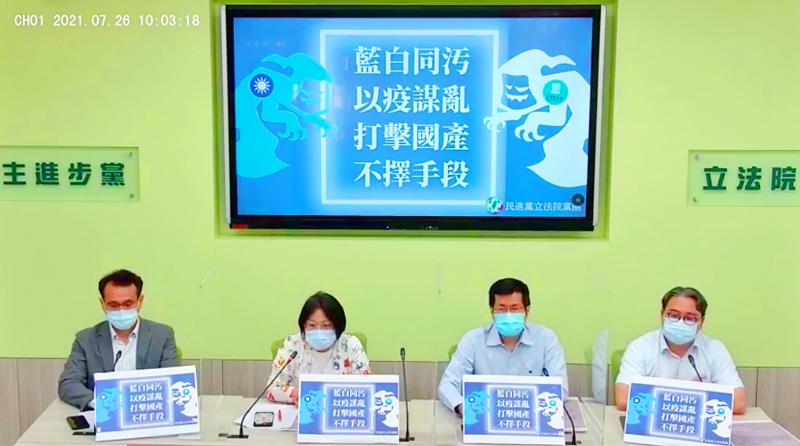
Photo: Hsieh Chun-lin, Taipei Times
The document specifically asked the Financial Supervisory Commission and the Ministry of Justice to present independent reports at an online meeting on Monday next week on the “stock price fluctuations of Taiwanese vaccine developers when the Ministry of Health and Welfare granted the emergency use authorization.”
The TPP also asked the health ministry and the Ministry of Foreign Affairs to each present a report at the same meeting to explain the reasons for granting a domestic vaccine emergency use authorization, “but not needing to conform to international standards,” and to explain “the Ministry of Foreign Affairs having issued fake news to endorse a certain Taiwanese vaccine developer before its test results were released.”
The letter said the meeting would be convened by TPP Legislator Lai Hsiang-ling (賴香伶) and asked that the official representatives of each of the four government agencies present the reports.
The TPP asked to be provided with a list of attendees by 10am tomorrow.
“The TPP is plotting to derail domestic vaccine production, just like the KMT is doing,” Lo said. “It is preposterous for the TPP to do so by contravening the legislature’s rules, by issuing a letter to demand that these government bodies present reports when the legislature is in recess.”
Legislators should exercise their authority when the legislature is in session, and deliberations by political parties regarding oversight of government bodies are conducted at legislative committee meetings, Lo said.
He called on the four agencies not to respond to the TPP’s requests.
Lo said that the KMT has spread misinformation about the Medigen vaccine to mislead the public.
“The KMT has filed a lawsuit with the Taipei District Court, and has also requested that the Control Yuan conduct a probe into wrongdoing by government officials during the process,” Lo said. “We ask opposition parties to let science do the talking and not obstruct Taiwan’s vaccine production.”
“The KMT is colluding with the Chinese government, by helping China’s attempts at blockading us,” DPP Legislator Cheng Yun-peng (鄭運鵬) said.
“We urge KMT Chairman Johnny Chiang (江啟臣) to refrain from the extreme tactics used by his party’s members, and instead provide suggestions on how to help Taiwan to fight the domestic [COVID-19] situation,” Cheng said.
“We ask Chiang to use reason. By filing a judicial complaint against Minister of Health and Welfare Chen Shih-chung (陳時中), the KMT is obstructing the efforts of Chen and medical professionals working diligently to fight the [COVID-19] pandemic,” Cheng said.

Considering that most countries issue more than five denominations of banknotes, the central bank has decided to redesign all five denominations, the bank said as it prepares for the first major overhaul of the banknotes in more than 24 years. Central bank Governor Yang Chin-lung (楊金龍) is expected to report to the Legislative Yuan today on the bank’s operations and the redesign’s progress. The bank in a report sent to the legislature ahead of today’s meeting said it had commissioned a survey on the public’s preferences. Survey results showed that NT$100 and NT$1,000 banknotes are the most commonly used, while NT$200 and NT$2,000

The Centers for Disease Control (CDC) yesterday reported the first case of a new COVID-19 subvariant — BA.3.2 — in a 10-year-old Singaporean girl who had a fever upon arrival in Taiwan and tested positive for the disease. The girl left Taiwan on March 20 and the case did not have a direct impact on the local community, it said. The WHO added the BA.3.2 strain to its list of Variants Under Monitoring in December last year, but this was the first imported case of the COVID-19 variant in Taiwan, CDC Deputy Director-General Lin Ming-cheng (林明誠) said. The girl arrived in Taiwan on

South Korea is planning to revise its controversial electronic arrival card, a step Taiwanese officials said prompted them to hold off on planned retaliatory measures, a South Korean media report said yesterday. A Yonhap News Agency report said that the South Korean Ministry of Foreign Affairs is planning to remove the “previous departure place” and “next destination” fields from its e-arrival card system. The plan, reached after interagency consultations, is under review and aims to simplify entry procedures and align the electronic form with the paper version, a South Korean ministry official said. The fields — which appeared only on the electronic form

The Ministry of Foreign Affairs (MOFA) is suspending retaliation measures against South Korea that were set to take effect tomorrow, after Seoul said it is updating its e-arrival system, MOFA said today. The measures were to be a new round of retaliation after Taiwan on March 1 changed South Korea's designation on government-issued alien resident certificates held by South Korean nationals to "South Korea” from the "Republic of Korea," the country’s official name. The move came after months of protests to Seoul over its listing of Taiwan as "China (Taiwan)" in dropdown menus on its new online immigration entry system. MOFA last week


 RSS
RSS