


The first person to be tried under Hong Kong’s sweeping National Security Law was yesterday found guilty of secessionism and terrorism, in a ruling closely watched for indications of how the law would be applied as China tightens its grip on the territory long known for its freedoms.
Tong Ying-kit (唐英杰) was charged with inciting secession and terrorism for driving his motorcycle into a group of police officers last year while carrying a flag bearing the banned protest slogan “Liberate Hong Kong, revolution of our times.”
Rights groups condemned his conviction, and many are bracing for further such trials as more than 100 people have been arrested under the legislation — part of Beijing’s increasing crackdown on dissent in Hong Kong following months of anti-government protests in 2019.
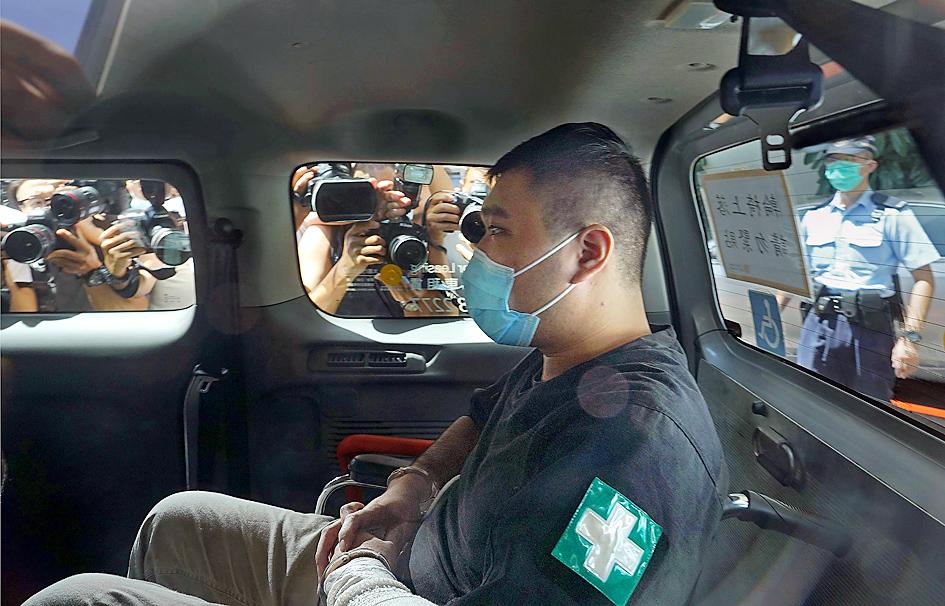
Photo: AP
Tong, a 24-year-old restaurant worker, pleaded not guilty to the charges, arguing the slogan itself does not call for secession.
He now faces a maximum sentence of life imprisonment, but his lawyers are expected to argue for a lighter punishment at his sentencing hearing tomorrow.
The National Security Law not only resulted in the charges against Tong, but it also spelled out how the trial would be conducted. The proceedings, which ended on Tuesday last week, were held in the Hong Kong High Court with no jury, under rules allowing the exception from Hong Kong’s common law system if state secrets need to be protected, foreign forces are involved or if the personal safety of jurors needs to be protected. Trials are presided over by judges handpicked by Hong Kong Chief Executive Carrie Lam (林鄭月娥).
Reading the verdict, Justice Esther Toh (杜麗冰) said that Tong “committed terrorist activities causing or intended to cause grave harm to the society” in pursuit of a political agenda.
His behavior was an act of violence aimed at coercing the central and Hong Kong governments, and intimidating the public and carrying the flag constituted an act of incitement to secession, she said.
Tong did not speak during the reading of the verdict. He waved to his parents and others in the gallery as he was escorted from the chamber.
Tong’s defense lawyer has said it is impossible to prove that Tong was inciting secession merely by having used the slogan.
The defense also said there is no evidence that Tong committed the act deliberately, that he tried to avoid crashing into officers and that his actions could not be considered terrorism as there was no serious violence or harm to society.
The verdict was immediately condemned by Amnesty International, which called it “the beginning of the end for freedom of expression in Hong Kong.”
“People should be free to use political slogans during protests, and Tong Ying-kit should not be punished for exercising his right to free speech,” Asia-Pacific Regional Director Yamini Mishra said in an e-mailed statement. “It is particularly clear that he should never have been charged with a ‘national security’ offense carrying a possible life sentence.”
Beijing has dismissed criticisms, saying it is merely restoring order to the territory and instituting they same type of national security protections found in other countries.

The Legislative Yuan’s Finance Committee yesterday approved proposed amendments to the Amusement Tax Act (娛樂稅法) that would abolish taxes on films, cultural activities and competitive sporting events, retaining the fee only for dance halls and golf courses. The proposed changes would set the maximum tax rate for dance halls and golf courses at 50 and 20 percent respectively, with local governments authorized to suspend the levies. Article 2 of the act says that “amusement tax shall be levied on tickets sold or fees charged by amusement places, facilities or activities” in six categories: “Cinema; professional singing, story-telling, dancing, circus, magic show, acrobatics

Tainan, Taipei and New Taipei City recorded the highest fines nationwide for illegal accommodations in the first quarter of this year, with fines issued in the three cities each exceeding NT$7 million (US$220,639), Tourism Administration data showed. Among them, Taipei had the highest number of illegal short-term rental units, with 410. There were 3,280 legally registered hotels nationwide in the first quarter, down by 14 properties, or 0.43 percent, from a year earlier, likely indicating operators exiting the market, the agency said. However, the number of unregistered properties rose to 1,174, including 314 illegal hotels and 860 illegal short-term rental
INFLATION UP? The IMF said CPI would increase to 1.5 percent this year, while the DGBAS projected it would rise to 1.68 percent, with GDP per capita of US$44,181 The IMF projected Taiwan’s real GDP would grow 5.2 percent this year, up from its 2.1 percent outlook in January, despite fears of global economic disruptions sparked by the US-Iran conflict. Taiwan’s consumer price index (CPI) is projected to increase to 1.5 percent, while unemployment would be 3.4 percent, roughly in line with estimates for Asia as a whole, the international body wrote in its Global Economic Outlook Report published in the US on Monday. The figures are comparatively better than the IMF outlook for the rest of the world, which pegged real GDP growth at 3.1 percent, down from 3.3 percent

ECONOMIC COERCION: Such actions are often inconsistently applied, sometimes resumed, and sometimes just halted, the Presidential Office spokeswoman said The government backs healthy and orderly cross-strait exchanges, but such arrangements should not be made with political conditions attached and never be used as leverage for political maneuvering or partisan agendas, Presidential Office spokeswoman Karen Kuo (郭雅慧) said yesterday. Kuo made the remarks after China earlier in the day announced 10 new “incentive measures” for Taiwan, following a landmark meeting between Chinese President Xi Jinping (習近平) and Chinese Nationalist Party (KMT) Chairwoman Cheng Li-wun (鄭麗文) in Beijing on Friday. The measures, unveiled by China’s Xinhua news agency, include plans to resume individual travel by residents of Shanghai and China’s Fujian


 RSS
RSS