


The Control Yuan yesterday censured the Taipei City Government for its cursory response to reports of an unregistered nursing home, saying that its negligence resulted in a missed opportunity to prevent a fire that killed three residents last year.
An investigation by Control Yuan members Wang Yu-ling (王幼玲), Su Li-chung (蘇麗瓊) and Tsai Chung-yi (蔡崇義) found that the facility in a residential building in the city’s Neihu District (內湖) was unregistered.
The owner, surnamed Ting (丁), took three physically disabled people under her care, despite not having a nursing license, they said.
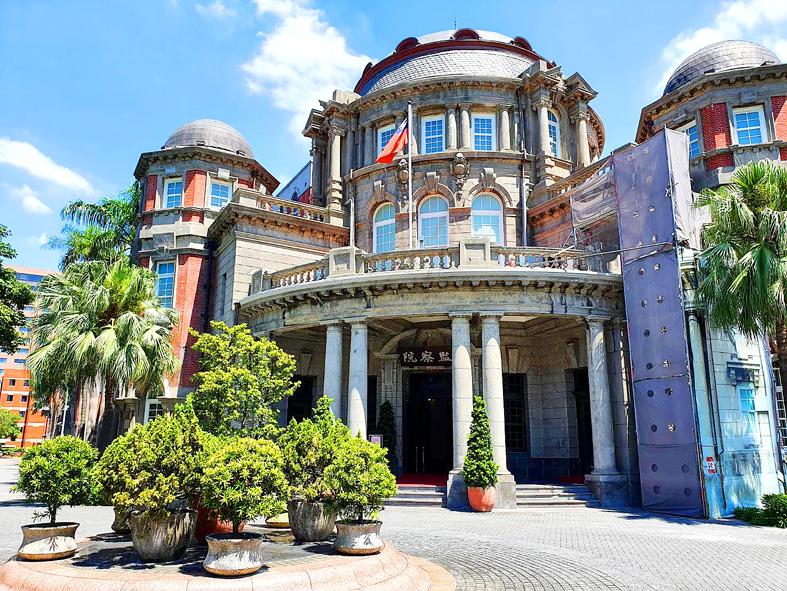
Photo: Hsieh Chun-lin, Taipei Times
After the fire broke out at the facility on Sept. 22 last year, three residents were found alone inside, the Taipei Fire Department said at the time.
All three were later pronounced dead at a nearby hospital.
The Control Yuan investigation found that the warden of Ziyun Borough (紫雲), where the building is located, called the 1999 Taipei Citizen Hotline twice in August and September 2019 to ask if the facility was licensed, Wang said.
The first call was forwarded to the Taipei Department of Social Welfare, but since it was closed for the afternoon, the call did not go through, she said.
The second call was transferred to the Taipei Department of Health, which sent an inspector to investigate, she added.
As the inspector found no evidence of wrongdoing and no sign of imminent danger, and since the borough warden asked the hotline operator not to record the call, no record of the case was kept, Wang said.
During questioning by Control Yuan investigators, Taipei Deputy Mayor Vivian Huang (黃珊珊) acknowledged that the procedure for following up on inspections of unlicensed facilities is not thorough enough, Wang said.
“The person in charge, Ting, always used the back entrance, so there was no way of telling of the operation from the front,” Wang quoted Huang as saying. “There was also no sound, and the metal security shutters were always closed.”
Its registration would have been checked, but police give priority to maintaining law and order, she added.
An inspector was sent according to follow-up procedure, but they did not find evidence of wrongdoing and did not make any further inspections, Huang said.
Based on their investigation and Huang’s statement, Wang said that the Control Yuan found Taipei’s process for handling reports of unlicensed facilities insufficient.
Without the proper procedures, the city was unable to take the opportunity afforded by the borough warden’s two reports to identify the unregistered nursing home, Wang said.
The health department inspection was also haphazard, leading to the deaths of three people, she added.
In addition, two of the residents formerly received welfare payments when living in another private care facility in the district, Wang said.
As the Taipei City Government has no procedures for tracking welfare recipients after the facility in which they reside closes, it was not able to ensure the two residents’ safe placement in another facility, she said.
As the Neihu District Office also failed in its duty to check on low-income residents, it also failed to notice that the residents were transferred to an unregistered facility, she added.

The Centers for Disease Control (CDC) yesterday reported the first case of a new COVID-19 subvariant — BA.3.2 — in a 10-year-old Singaporean girl who had a fever upon arrival in Taiwan and tested positive for the disease. The girl left Taiwan on March 20 and the case did not have a direct impact on the local community, it said. The WHO added the BA.3.2 strain to its list of Variants Under Monitoring in December last year, but this was the first imported case of the COVID-19 variant in Taiwan, CDC Deputy Director-General Lin Ming-cheng (林明誠) said. The girl arrived in Taiwan on

South Korea is planning to revise its controversial electronic arrival card, a step Taiwanese officials said prompted them to hold off on planned retaliatory measures, a South Korean media report said yesterday. A Yonhap News Agency report said that the South Korean Ministry of Foreign Affairs is planning to remove the “previous departure place” and “next destination” fields from its e-arrival card system. The plan, reached after interagency consultations, is under review and aims to simplify entry procedures and align the electronic form with the paper version, a South Korean ministry official said. The fields — which appeared only on the electronic form

A bipartisan group of US senators has introduced a bill to enhance cooperation with Taiwan on drone development and to reduce reliance on supply chains linked to China. The proposed Blue Skies for Taiwan Act of 2026 was introduced by Republican US senators Ted Cruz and John Curtis, and Democratic US senators Jeff Merkley and Andy Kim. The legislation seeks to ease constraints on Taiwan-US cooperation in uncrewed aerial systems (UAS), including dependence on China-sourced components, limited access to capital and regulatory barriers under US export controls, a news release issued by Cruz on Wednesday said. The bill would establish a "Blue UAS

The Ministry of Foreign Affairs (MOFA) is suspending retaliation measures against South Korea that were set to take effect tomorrow, after Seoul said it is updating its e-arrival system, MOFA said today. The measures were to be a new round of retaliation after Taiwan on March 1 changed South Korea's designation on government-issued alien resident certificates held by South Korean nationals to "South Korea” from the "Republic of Korea," the country’s official name. The move came after months of protests to Seoul over its listing of Taiwan as "China (Taiwan)" in dropdown menus on its new online immigration entry system. MOFA last week


 RSS
RSS