


Democratic Progressive Party (DPP) officials yesterday urged opposition parties to put aside partisanship and fight the domestic COVID-19 outbreak together.
The call followed accusations that Ministry of Health and Welfare agencies had received excessive COVID-19 vaccine doses for their personnel at the expense of the public.
The number of local infections has been falling for the past few days, with many regions reporting zero cases, and only a few cities and counties have to work hard to control the situation, DPP legislative caucus whip Liu Shyh-fang (劉世芳) told a news conference.
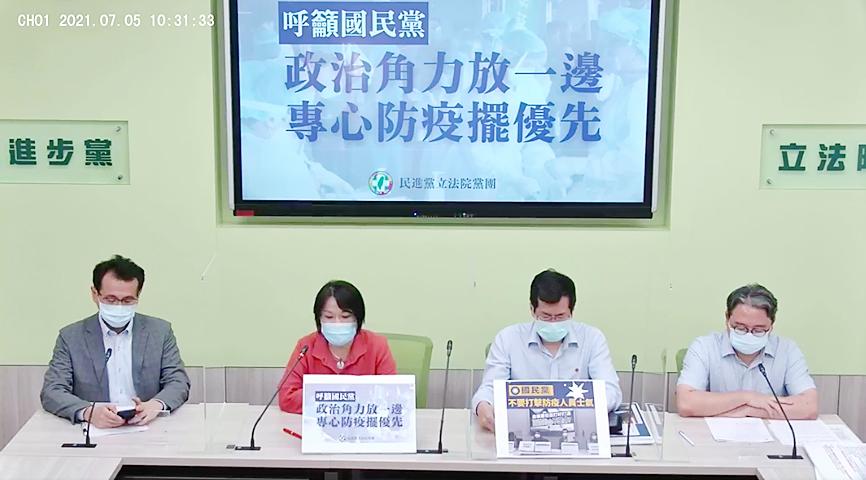
“The Central Epidemic Command Center [CECC] has implemented a vaccine rollout program for groups on the vaccine priority list to receive their shots, while the government has been successful in procuring vaccines from abroad, so the situation in Taiwan is stabilizing and we are gradually bringing the domestic outbreak under control,” she said.
It is unfortunate that the Chinese Nationalist Party (KMT) is deliberately creating conflict and division within Taiwan by playing up certain issues in trying to score political points, Liu said.
The whole nation should cooperate to fight the outbreak for the benefit of all of society, she said.
She was referring to KMT allegation yesterday of contraventions by the Food and Drug Administration (FDA) and the Centers for Disease Control (CDC).
KMT lawmakers said they had obtained information that the FDA and the CDC had been given excessive numbers of shots.
The doses given to the FDA allegedly translated into an inoculation rate of 169 percent, more than enough for personnel at both agencies, they said.
DPP legislative caucus secretary-general Lo Chih-cheng (羅致政) said that “the KMT, with such baseless accusations, will harm the confidence and morale of medical personnel who have spent tremendous effort to combat the COVID-19 outbreak.”
The KMT’s allegation aims to shift the focus away from its own officials using their “special privilege” to receive shots ahead of other people, Lo said.
“We urge KMT lawmakers to stop vilifying the hardworking medical personnel at the CDC and the FDA, and cease partisan politicking,” he said.
Government ministries have personnel working within their departments, in addition to those at branch offices, temporary hires and contract workers, who are hired when needed, Lo said.
“There is a cap on the total number of civil servants working at the government. Although these workers are listed outside of regular personnel, most of them have duties and workloads almost identical to regular staff,” Lo added.
The FDA in a statement yesterday said that its staff are among the health ministry’s leading personnel controlling local COVID-19 cases.
“Overall, we had 1,794 people working at the FDA put on the list for being eligible to receive vaccine shots, which is all the regular staff, plus temporary hires and contract workers,” the statement said.
“Of the total, only 1,089 have received a shot, or about 61 percent,” it said. The FDA so far had three confirmed COVID-19 cases among its personnel and they are receiving treatment in isolation, it said.
It is necessary to prevent further infection, which could disrupt the FDA’s work, so there is an urgent need for all frontline personnel to get vaccinated as soon as possible, it said.

Considering that most countries issue more than five denominations of banknotes, the central bank has decided to redesign all five denominations, the bank said as it prepares for the first major overhaul of the banknotes in more than 24 years. Central bank Governor Yang Chin-lung (楊金龍) is expected to report to the Legislative Yuan today on the bank’s operations and the redesign’s progress. The bank in a report sent to the legislature ahead of today’s meeting said it had commissioned a survey on the public’s preferences. Survey results showed that NT$100 and NT$1,000 banknotes are the most commonly used, while NT$200 and NT$2,000

The Centers for Disease Control (CDC) yesterday reported the first case of a new COVID-19 subvariant — BA.3.2 — in a 10-year-old Singaporean girl who had a fever upon arrival in Taiwan and tested positive for the disease. The girl left Taiwan on March 20 and the case did not have a direct impact on the local community, it said. The WHO added the BA.3.2 strain to its list of Variants Under Monitoring in December last year, but this was the first imported case of the COVID-19 variant in Taiwan, CDC Deputy Director-General Lin Ming-cheng (林明誠) said. The girl arrived in Taiwan on

South Korea is planning to revise its controversial electronic arrival card, a step Taiwanese officials said prompted them to hold off on planned retaliatory measures, a South Korean media report said yesterday. A Yonhap News Agency report said that the South Korean Ministry of Foreign Affairs is planning to remove the “previous departure place” and “next destination” fields from its e-arrival card system. The plan, reached after interagency consultations, is under review and aims to simplify entry procedures and align the electronic form with the paper version, a South Korean ministry official said. The fields — which appeared only on the electronic form

The Ministry of Foreign Affairs (MOFA) is suspending retaliation measures against South Korea that were set to take effect tomorrow, after Seoul said it is updating its e-arrival system, MOFA said today. The measures were to be a new round of retaliation after Taiwan on March 1 changed South Korea's designation on government-issued alien resident certificates held by South Korean nationals to "South Korea” from the "Republic of Korea," the country’s official name. The move came after months of protests to Seoul over its listing of Taiwan as "China (Taiwan)" in dropdown menus on its new online immigration entry system. MOFA last week


 RSS
RSS