


With more people wearing goggles to protect themselves against COVID-19, experts warned that wearing ill-fitting goggles could cause headaches.
Sui Shan-chung (隋善中), a doctor at Nantou Hospital, said that pericranial soft tissues are repeatedly squeezed or pulled whenever a person wears a hat, helmet, face shield or goggles, which could lead to supraorbital neuralgia, also known as “goggle headaches.”
People experience “goggle headaches” after swimming if they wear ill-fitting goggles, Sui said, adding that the symptoms ease when they take off the goggles.
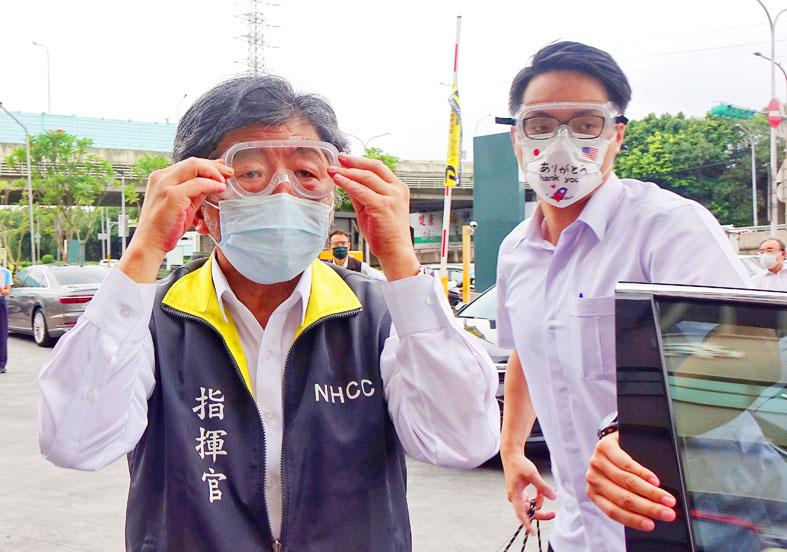
Photo: Liu Hsin-de, Taipei Times
“When people buy protective or swimming goggles, they should check if the goggles are too tight to wear, which could squeeze nerves and subsequently cause headaches. Should the headaches persist, they would need to take painkillers,” Sui said.
If patients continue experiencing headaches after taking painkillers, they can be treated with nerve hydrodissection, he said.
Meanwhile, the Food and Drug Administration also advised people on the correct way to wear a mask to avoid damaging the skin.
Wearing a mask with too many layers would leave marks on the face and irritate the skin, the agency said, adding that people should use medical masks that are certified as safe to use.
To avoid chafing behind the ears, people should apply petroleum jelly and cover the skin behind ears with gauze before putting on a mask, it said.
People should refrain from repeatedly removing their mask and putting it back on, and touching their face with their hands, the agency said, adding that they should also avoid wearing thick makeup or using oily skincare products if they have to wear a mask for a long time.
People should wear a new mask if their mask becomes damaged or tainted, it said.
Non-medical workers should not wear an N95 mask, as it could cause a reddened and oily face, it added.
People should quickly remove their mask and clean their face thoroughly when they return home, the agency said, adding that they should consult a dermatologist if wearing a mask causes pimples, skin infections or allergies.

The Centers for Disease Control (CDC) yesterday reported the first case of a new COVID-19 subvariant — BA.3.2 — in a 10-year-old Singaporean girl who had a fever upon arrival in Taiwan and tested positive for the disease. The girl left Taiwan on March 20 and the case did not have a direct impact on the local community, it said. The WHO added the BA.3.2 strain to its list of Variants Under Monitoring in December last year, but this was the first imported case of the COVID-19 variant in Taiwan, CDC Deputy Director-General Lin Ming-cheng (林明誠) said. The girl arrived in Taiwan on

South Korea is planning to revise its controversial electronic arrival card, a step Taiwanese officials said prompted them to hold off on planned retaliatory measures, a South Korean media report said yesterday. A Yonhap News Agency report said that the South Korean Ministry of Foreign Affairs is planning to remove the “previous departure place” and “next destination” fields from its e-arrival card system. The plan, reached after interagency consultations, is under review and aims to simplify entry procedures and align the electronic form with the paper version, a South Korean ministry official said. The fields — which appeared only on the electronic form

A bipartisan group of US senators has introduced a bill to enhance cooperation with Taiwan on drone development and to reduce reliance on supply chains linked to China. The proposed Blue Skies for Taiwan Act of 2026 was introduced by Republican US senators Ted Cruz and John Curtis, and Democratic US senators Jeff Merkley and Andy Kim. The legislation seeks to ease constraints on Taiwan-US cooperation in uncrewed aerial systems (UAS), including dependence on China-sourced components, limited access to capital and regulatory barriers under US export controls, a news release issued by Cruz on Wednesday said. The bill would establish a "Blue UAS

The Ministry of Foreign Affairs (MOFA) is suspending retaliation measures against South Korea that were set to take effect tomorrow, after Seoul said it is updating its e-arrival system, MOFA said today. The measures were to be a new round of retaliation after Taiwan on March 1 changed South Korea's designation on government-issued alien resident certificates held by South Korean nationals to "South Korea” from the "Republic of Korea," the country’s official name. The move came after months of protests to Seoul over its listing of Taiwan as "China (Taiwan)" in dropdown menus on its new online immigration entry system. MOFA last week


 RSS
RSS