


Home-care services providers for new mothers, children, the elderly and people with mobility impairment on Wednesday urged the government to prioritize their employees for COVID-19 vaccination, saying that their work puts them at risk of infection.
As their work requires frequent, close interaction with people in their homes, they are at high risk of contracting COVID-19, Peng Wan-ru Foundation chief executive officer Wang Chao-ching (王兆慶) said.
The foundation employs 1,152 women to provide home-care services in Taipei and New Taipei City, servicing 7,462 homes, he said.
It also employs 64 women who provide postpartum services, he said, adding that 562 new mothers in the two cities last year booked its services.
Wang Pin (王品), an assistant professor in National Taipei University’s social work department said that “when Sweden began vaccinating its population in December last year, they included home-care providers in the first priority group.”
“Anyone who worked with the elderly, or in in-patient and out-patient care, was vaccinated first,” he added
The Netherlands also prioritized workers who provide care services in people’s homes or deliver food, he said.
Echoing Wang Pin, Taiwan Labour Front secretary-general Son Yu-liam (孫友聯) said: “Of course you need to protect people who work in other people’s homes, because they come in close contact with so many of them. There is no way for this type of work to be done remotely.”
Vaccinating home-care service workers would not only offer them protection, but also stabilize employment in the sector, Son said.
Awakening Foundation secretary-general Chyn Yu-rung (覃玉蓉) said that people “with serious illnesses or disabilities need these workers to come to their homes to clean, care for them and accompany them.”
“New mothers also need postpartum care,” Chyn said. “If these workers can’t get vaccinated, they might have to stop providing these important services.”
If home-care services were unavailable, especially women with family members in need of care would have to quit their jobs to stay home and care for them, she said.
Social worker Chien Yu-jen (簡鈺人) said that her work includes visits to 11 households where she provides meals and cleans.
“I’ve had both my vaccine shots now, but I’m still only at half of my regular work capacity,” she said. “What can those who haven’t been vaccinated do? They might have zero income.”
Many workers in the sector are older women, she said, adding that they came out of retirement and rely on the income from their home-care jobs.
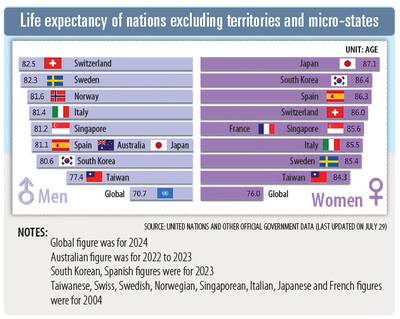
STATS: Taiwan’s average life expectancy of 80.77 years was lower than that of Japan, Singapore and South Korea, but higher than in China, Malaysia and Indonesia Taiwan’s average life expectancy last year increased to 80.77 years, but was still not back to its pre-COVID-19 pandemic peak of 81.32 years in 2020, the Ministry of the Interior said yesterday. The average life expectancy last year increased the 0.54 years from 2023, the ministry said in a statement. For men and women, the average life expectancy last year was 77.42 years and 84.30 years respectively, up 0.48 years and 0.56 years from the previous year. Taiwan’s average life expectancy peaked at 81.32 years in 2020, as the nation was relatively unaffected by the pandemic that year. The metric

Taiwan High Speed Rail Corp. (THSRC) plans to ease strained capacity during peak hours by introducing new fare rules restricting passengers traveling without reserved seats in 2026, company Chairman Shih Che (史哲) said Wednesday. THSRC needs to tackle its capacity issue because there have been several occasions where passengers holding tickets with reserved seats did not make it onto their train in stations packed with individuals traveling without a reserved seat, Shih told reporters in a joint interview in Taipei. Non-reserved seats allow travelers maximum flexibility, but it has led to issues relating to quality of service and safety concerns, especially during
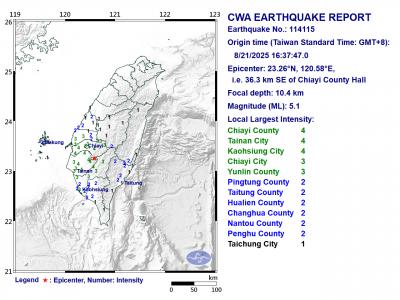
A magnitude 5.1 earthquake struck Chiayi County at 4:37pm today, the Central Weather Administration (CWA) said. The hypocenter was 36.3km southeast of Chiayi County Hall at a depth of 10.4km, CWA data showed. There were no immediate reports of damage resulting from the quake. The intensity of the quake, which gauges the actual effect of a seismic event, measured 4 in Chiayi County, Tainan and Kaohsiung on Taiwan's seven-tier intensity scale, the data showed. The quake had an intensity of 3 in Chiayi City and Yunlin County, while it was measured as 2 in Pingtung, Taitung, Hualien, Changhua, Nantou and Penghu counties, the data
The Supreme Court today rejected an appeal filed by former Air Force officer Shih Chun-cheng (史濬程), convicted of Chinese Communist Party (CCP) espionage, finalizing his sentence at two years and two months for contravening the National Security Act (國家安全法). His other ruling, a ten-month sentence for an additional contravention, was meanwhile overturned and sent to the Taichung branch of the High Court for retrial, the Supreme Court said today. Prosecutors have been notified as Shih is considered a flight risk. Shih was recruited by Chinese Communist Party (CCP) intelligence officials after his retirement in 2008 and appointed as a supervisor


 RSS
RSS