


The Taipei District Prosecutors’ Office yesterday opened an investigation into the Taipei-based Good Liver Clinic after allegations that it gave free COVID-19 vaccine shots to people not in groups eligible to receive them.
Prior to Wednesday, the Central Epidemic Command Center (CECC) had only authorized three groups of people in Taipei to receive shots: The first priority group, composed of registered healthcare workers and other non-healthcare workers at healthcare facilities; the second priority group, composed of central and local government disease prevention personnel; and the third priority group, composed of frontline workers with high infection risk exposure, such as flight or ship crew members, and disease prevention taxi drivers.
However, a Good Liver Clinic branch was on Tuesday found to have a long line for vaccinations.
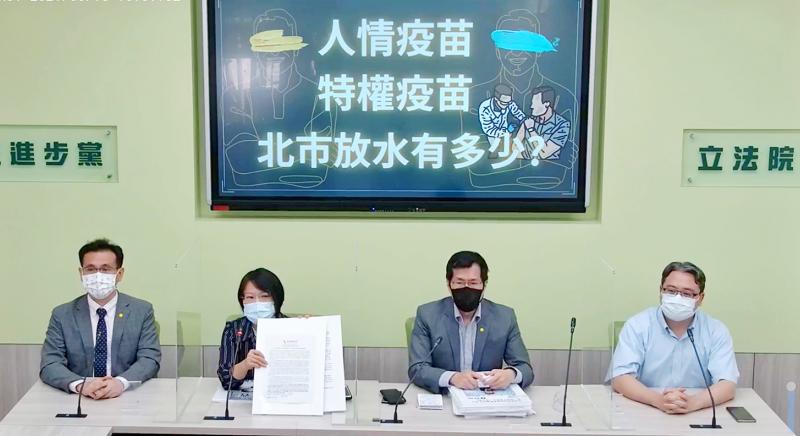
Photo: Chien Hui-ju, Taipei Times
Media reports said that 1,285 people received shots, even though most of them were ineligible, including electricians, plumbers and clinic volunteers, sparking controversy over whether people with privilege have greater vaccine access.
Some have speculated that the clinic had an “inside connection” to obtain “extra vaccines” because clinic director Sheu Jin-chuan (許金川) was a medical school professor when Taipei Mayor Ko Wen-je (柯文哲) took his training at National Taiwan University Hospital.
Yesterday, Premier Su Tseng-chang (蘇貞昌) told a Cabinet meeting: “Vaccines are precious right now because of their limited supply, so administering them must follow the CECC’s rollout protocols. When people fail to comply and give shots to ineligible persons, an investigation will be conducted and those responsible will be punished for breaking the law.”
Prosecutors — armed with search warrants and in coordination with the Ministry of Justice Investigation Bureau, the Agency Against Corruption, and Taipei Police Department units — searched the clinic and offices of the Taipei Department of Health, taking with them documents for the investigation.
They questioned Sheu and other people embroiled in the case via videoconferencing.
The Democratic Progressive Party legislative caucus questioned whether the city government had distributed vaccines based on privilege or favors to friends, and demanded that Ko verify on what basis the vaccines were distributed to the clinic.
“It is very unfair because many frontline medical personnel have not yet gotten vaccinated,” DPP Legislator Liu Shyh-fang (劉世芳) said. “So far, the Taipei City Government has not clearly explained its disbursement procedure, and whether the vaccines were allotted to the clinic based only on privilege or special connections.”
Separately yesterday afternoon, members of the Taiwan Republic Office filed a complaint at the Taipei District Prosecutors’ Office, requesting that Ko’s “illegal activities” be investigated and accusing Ko of having a major role in deciding which clinics received vaccines.
Additional reporting by CNA

The Centers for Disease Control (CDC) yesterday reported the first case of a new COVID-19 subvariant — BA.3.2 — in a 10-year-old Singaporean girl who had a fever upon arrival in Taiwan and tested positive for the disease. The girl left Taiwan on March 20 and the case did not have a direct impact on the local community, it said. The WHO added the BA.3.2 strain to its list of Variants Under Monitoring in December last year, but this was the first imported case of the COVID-19 variant in Taiwan, CDC Deputy Director-General Lin Ming-cheng (林明誠) said. The girl arrived in Taiwan on

South Korea is planning to revise its controversial electronic arrival card, a step Taiwanese officials said prompted them to hold off on planned retaliatory measures, a South Korean media report said yesterday. A Yonhap News Agency report said that the South Korean Ministry of Foreign Affairs is planning to remove the “previous departure place” and “next destination” fields from its e-arrival card system. The plan, reached after interagency consultations, is under review and aims to simplify entry procedures and align the electronic form with the paper version, a South Korean ministry official said. The fields — which appeared only on the electronic form

A bipartisan group of US senators has introduced a bill to enhance cooperation with Taiwan on drone development and to reduce reliance on supply chains linked to China. The proposed Blue Skies for Taiwan Act of 2026 was introduced by Republican US senators Ted Cruz and John Curtis, and Democratic US senators Jeff Merkley and Andy Kim. The legislation seeks to ease constraints on Taiwan-US cooperation in uncrewed aerial systems (UAS), including dependence on China-sourced components, limited access to capital and regulatory barriers under US export controls, a news release issued by Cruz on Wednesday said. The bill would establish a "Blue UAS

The Ministry of Foreign Affairs (MOFA) is suspending retaliation measures against South Korea that were set to take effect tomorrow, after Seoul said it is updating its e-arrival system, MOFA said today. The measures were to be a new round of retaliation after Taiwan on March 1 changed South Korea's designation on government-issued alien resident certificates held by South Korean nationals to "South Korea” from the "Republic of Korea," the country’s official name. The move came after months of protests to Seoul over its listing of Taiwan as "China (Taiwan)" in dropdown menus on its new online immigration entry system. MOFA last week


 RSS
RSS