


The government should test all migrant workers for COVID-19 using rapid screening tests and take blood samples monthly to check whether they have COVID-19 antibodies, National Taiwan University Children’s Hospital superintendent Huang Li-min (黃立民) said yesterday.
Huang’s comment came after three infection clusters involving mostly migrant workers were last week found at manufacturers in Hsinchu City and Miaoli County, where many of Taiwan’s largest technology companies have facilities.
The government must take full advantage of virus detection technology and available disease prevention staff to “get a handle on” the movements and health conditions of migrant workers, Huang said.
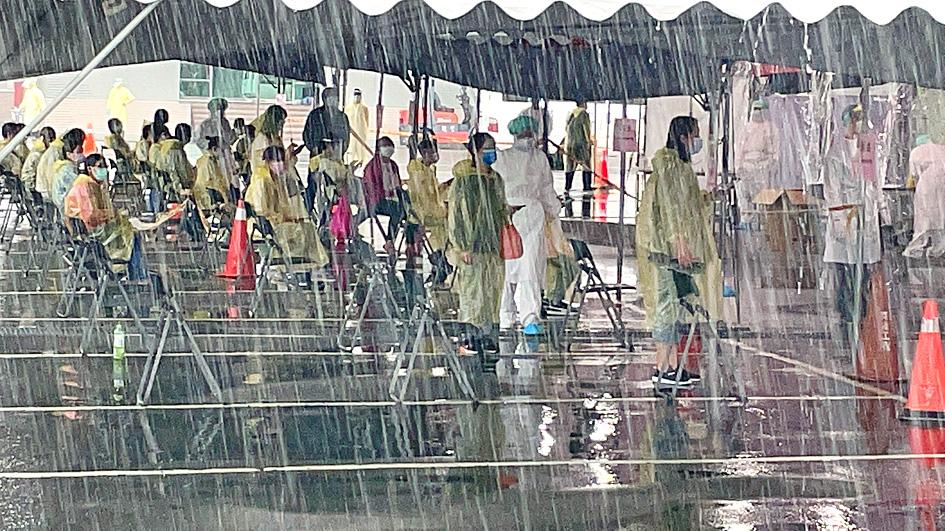
Photo: Tsai Cheng-min, Taipei Times
“It will also be important to conduct frequent testing on migrant workers, as they share dorm rooms,” he said.
Migrant workers are very important to the country’s production capacity, but so far only migrant caretakers who are in contact with elderly Taiwanese are eligible for COVID-19 vaccination, he said.
“Companies should have a strong interest in funding the vaccination of their migrant workers, which would ensure that production lines can operate uninterrupted,” he said.
Lin Meng-chih (林孟志), a physician at Kaohsiung Chang Gung Memorial Hospital, said that local governments must help companies communicate pandemic measures and regulations to migrant workers, as there might be communication problems between workers and the company management due to lack of a common language.
Companies must also ensure that the measures are properly enforced, including mask wearing inside factories and offices, dividers on tables at company lunch rooms, and social distancing on company property, he said.
“Given the large number of migrant workers, the best option might be for local governments to take the initiative and match up companies with quarantine hotels for workers,” he said.
Meanwhile, Hsinchu Mayor Lin Chih-chien (林智堅) yesterday said that the city would work with the Buddhist Compassion Relief Tzu Chi Foundation to set up rapid testing stations in Hsinchu and Miaoli County.
Companies in the city have been ordered to stop housing 100 or more workers in the same dormitory, and are prohibited from moving workers between factories, districts, shifts, counties or cities, he said.
Separately yesterday, Taoyuan Mayor Cheng Wen-tsan (鄭文燦) said that Taoyuan plans to “build a line of defense” against the spread of COVID-19, adding that the city is between virus hot spots in Taipei and New Taipei City, and Hsinchu and Miaoli.
Taoyuan has implemented new guidelines to manage the more than 116,000 migrant workers there, including 25,000 caregivers, he said.
The guidelines follow measures that the Ministry of Labor introduced on Saturday, Cheng said.
The measures include the suspension of transfers of migrant workers to different factories or employers, as well staggered working hours, and schedules for meals and personal hygiene, he said.
The Taoyuan Department of Labor would within the next five days inspect whether companies are following the guidelines.
The city government would also help the 16 firms in the city that employ 500 or more migrant workers organize rapid screening for them, he said, adding that the testing would be paid for by the companies.
Taoyuan would also set up rapid screening sites at its industrial parks, after similar sites were set up at the Hsinchu Science Park on Saturday, Cheng said.
Seperately yesterday, Tainan Mayor Huang Wei-che (黃偉哲) said that rapid screening stations with a capacity of 1,500 tests per day would tomorrow be set up at the Southern Taiwan Science Park.
Dorms for migrant workers at 652 companies would be inspected, he said.
Additional reporting by Tsai Chang-sheng, Tsai Wen-chu and CNA

The Centers for Disease Control (CDC) yesterday reported the first case of a new COVID-19 subvariant — BA.3.2 — in a 10-year-old Singaporean girl who had a fever upon arrival in Taiwan and tested positive for the disease. The girl left Taiwan on March 20 and the case did not have a direct impact on the local community, it said. The WHO added the BA.3.2 strain to its list of Variants Under Monitoring in December last year, but this was the first imported case of the COVID-19 variant in Taiwan, CDC Deputy Director-General Lin Ming-cheng (林明誠) said. The girl arrived in Taiwan on

South Korea is planning to revise its controversial electronic arrival card, a step Taiwanese officials said prompted them to hold off on planned retaliatory measures, a South Korean media report said yesterday. A Yonhap News Agency report said that the South Korean Ministry of Foreign Affairs is planning to remove the “previous departure place” and “next destination” fields from its e-arrival card system. The plan, reached after interagency consultations, is under review and aims to simplify entry procedures and align the electronic form with the paper version, a South Korean ministry official said. The fields — which appeared only on the electronic form

A bipartisan group of US senators has introduced a bill to enhance cooperation with Taiwan on drone development and to reduce reliance on supply chains linked to China. The proposed Blue Skies for Taiwan Act of 2026 was introduced by Republican US senators Ted Cruz and John Curtis, and Democratic US senators Jeff Merkley and Andy Kim. The legislation seeks to ease constraints on Taiwan-US cooperation in uncrewed aerial systems (UAS), including dependence on China-sourced components, limited access to capital and regulatory barriers under US export controls, a news release issued by Cruz on Wednesday said. The bill would establish a "Blue UAS

The Ministry of Foreign Affairs (MOFA) is suspending retaliation measures against South Korea that were set to take effect tomorrow, after Seoul said it is updating its e-arrival system, MOFA said today. The measures were to be a new round of retaliation after Taiwan on March 1 changed South Korea's designation on government-issued alien resident certificates held by South Korean nationals to "South Korea” from the "Republic of Korea," the country’s official name. The move came after months of protests to Seoul over its listing of Taiwan as "China (Taiwan)" in dropdown menus on its new online immigration entry system. MOFA last week


 RSS
RSS