


The New Taipei City Government must present concrete COVID-19 prevention measures to curb local infections and not hesitate to ask the central government for help, Democratic Progressive Party (DPP) caucus secretary-general Lo Chih-cheng (羅致政) said yesterday.
Lo has been keeping an eye on the performance of New Taipei City Mayor Hou You-yi (侯友宜), after he last month called for a lockdown and more radical measures to address a COVID-19 outbreak in the city.
After 310 COVID-19 infections were reported in the city on Wednesday, Lo told a news conference in Taipei that the Chinese Nationalist Party (KMT) mayor’s measures to respond to the virus — listing certain areas as hot spots and placing people on watch lists — was vague and insufficient.
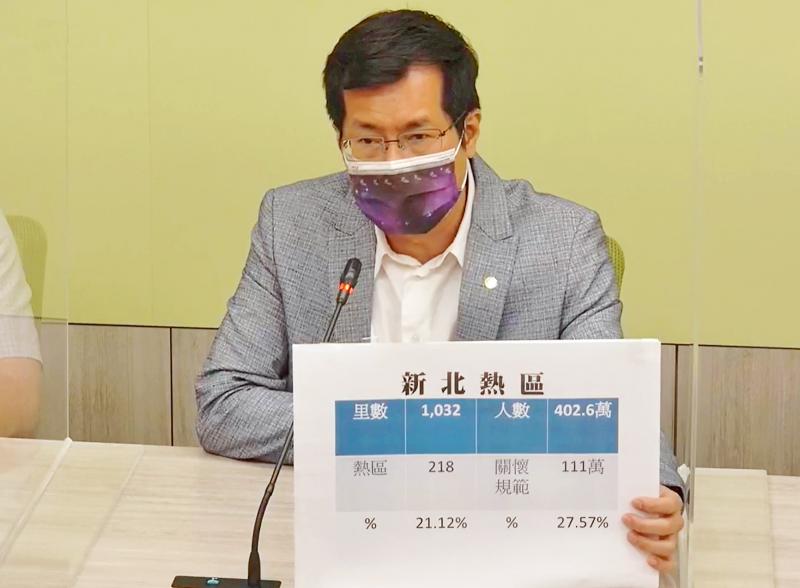
Photo: Chien Hui-ju, Taipei Times
DPP Legislator Cheng Yun-peng (鄭運鵬) said that New Taipei City is talking a lot, but doing little, which shows that it is becoming fatigued from dealing with COVID-19.
As of Wednesday, New Taipei City had recorded 3,947 confirmed COVID-19 cases, of which Banciao District (板橋), with 885 cases, is one of the hardest-hit areas in the city, Lo said.
Lo was elected in Banciao, which is connected by bridges to Taipei’s Wanhua District (萬華), another hot spot of domestic infection.
New Taipei City has done almost nothing, except to list seven boroughs in Banciao as “severe hot spots,” serving no end except to create more panic among residents, Lo said.
It is astonishing to see the official numbers released by the New Taipei City Government, with 218 of 1,032, or 21.12 percent, boroughs deemed hot spots, Lo said.
The 1.11 million residents placed on “watch lists” represent 27.57 percent of the city’s population, Lo said, adding that the city government does not specify what it means to be on such a list.
The city government should offer tangible measures to address the situation, Lo said.
Hou’s calls for residents in hot spots to receive virus screening as soon as possible, while urging everyone not to leave their residences unless necessary, were contradictory, Lo added.
Lo called on the New Taipei City Government to offer tangible measures and concrete instructions to prevent panic.
Separately yesterday, Hou called on the central government to allocate more vaccine doses to people working at long-term care centers.
There are 12,000 caregivers working at such centers in New Taipei City, almost double the number in Taipei, Hou said, urging the central government to arrange for inoculations to prevent cluster infections in care facilities.
Additional reporting by Ho Yu-hua


South Korea is planning to revise its controversial electronic arrival card, a step Taiwanese officials said prompted them to hold off on planned retaliatory measures, a South Korean media report said yesterday. A Yonhap News Agency report said that the South Korean Ministry of Foreign Affairs is planning to remove the “previous departure place” and “next destination” fields from its e-arrival card system. The plan, reached after interagency consultations, is under review and aims to simplify entry procedures and align the electronic form with the paper version, a South Korean ministry official said. The fields — which appeared only on the electronic form
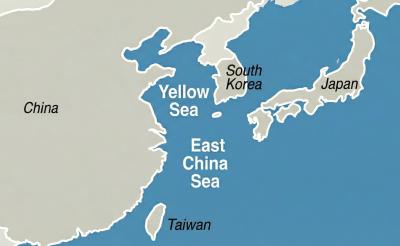
China has reserved offshore airspace in the Yellow Sea and East China Sea from March 27 to May 6, issuing alerts usually used to warn of military exercises, although no such exercises have been announced, the Wall Street Journal (WSJ) reported yesterday. Reserving such a large area for 40 days without explanation is an “unusual step,” as military exercises normally only last a few days, the paper said. These alerts, known as Notice to Air Missions (Notams), “are intended to inform pilots and aviation authorities of temporary airspace hazards or restrictions,” the article said. The airspace reserved in the alert is

A bipartisan group of US senators has introduced a bill to enhance cooperation with Taiwan on drone development and to reduce reliance on supply chains linked to China. The proposed Blue Skies for Taiwan Act of 2026 was introduced by Republican US senators Ted Cruz and John Curtis, and Democratic US senators Jeff Merkley and Andy Kim. The legislation seeks to ease constraints on Taiwan-US cooperation in uncrewed aerial systems (UAS), including dependence on China-sourced components, limited access to capital and regulatory barriers under US export controls, a news release issued by Cruz on Wednesday said. The bill would establish a "Blue UAS
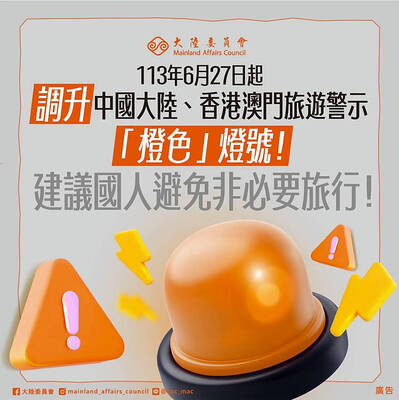
More than 6,000 Taiwanese students have participated in exchange programs in China over the past two years, despite the Mainland Affairs Council’s (MAC) “orange light” travel advisory, government records showed. The MAC’s publicly available registry showed that Taiwanese college and university students who went on exchange programs across the Strait numbered 3,592 and 2,966 people respectively. The National Immigration Agency data revealed that 2,296 and 2,551 Chinese students visited Taiwan for study in the same two years. A review of the Web sites of publicly-run universities and colleges showed that Taiwanese higher education institutions continued to recruit students for Chinese educational programs without


 RSS
RSS