


The Chinese Nationalist Party (KMT) yesterday asked people to change their Facebook profile pictures to an image with the words “Taiwan Needs Vaccines” as KMT Chairman Johnny Chiang (江啟臣) questioned the government’s COVID-19 vaccine policy.
“People are worried and afraid, and they have many more questions in their hearts to ask” President Tsai Ing-wen (蔡英文), Chiang told an online news conference at the KMT’s headquarters in Taipei.
The primary question is: “Where is your vaccine policy?” Chiang said.
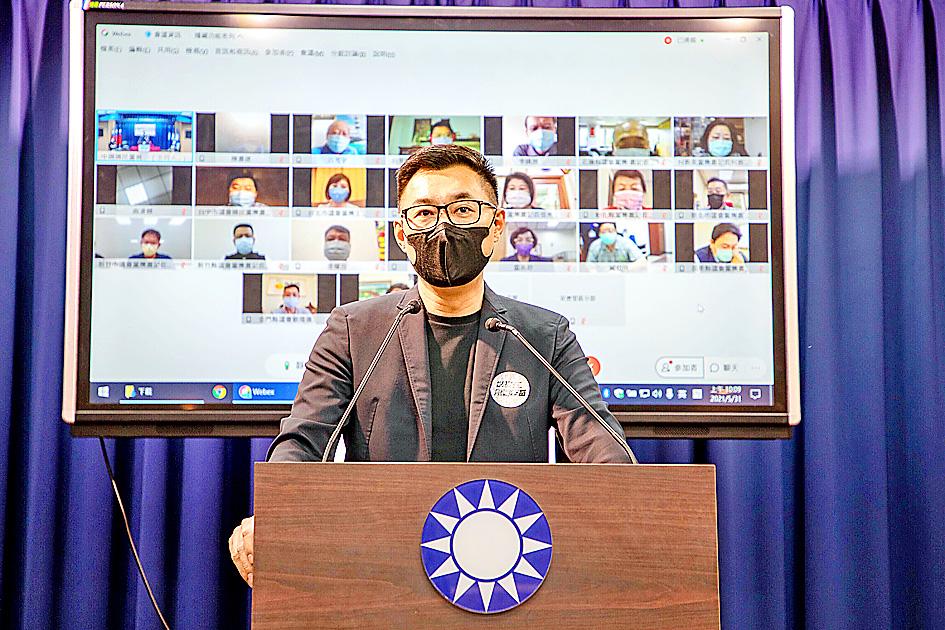
Photo: CNA
With more than 6,000 people confirmed to have COVID-19 in a short period, Tsai should tell the public when they can expect at least 70 percent of the population to be fully vaccinated against the virus, he said.
Chiang said he believes that as long as the nation has access to doses of COVID-19 vaccines, it is capable of administering them “in the shortest time,” citing the speed with which the government-funded influenza vaccination program was carried out last year.
“The government’s arrogance, complacency and incorrect policy have caused our national crisis today,” he said.
Tsai should commit to allowing all Taiwanese to receive the COVID-19 vaccine free of charge, he said.
He added that while he was not opposed to locally manufactured vaccines, he wondered whether people would feel comfortable receiving any vaccine that had not first obtained international certification.
The KMT has asked KMT deputy secretary-general Lee Yen-hsiu (李彥秀) to form a “vaccine countermeasures committee” to integrate all the channels within the party through which COVID-19 vaccines can be sought, and seek opportunities to obtain vaccines and resources used for disease prevention, Chiang said.
He and other party members wore black to the news conference to mourn the loss of more than 100 Taiwanese to COVID-19, he added.
The party chairman and KMT Culture and Communications Committee director-general Alicia Wang (王育敏) attended the event in person, while representatives from the KMT’s caucuses in 22 city and county councils joined them virtually in calling for vaccines.
The KMT urged the public to take action, starting by changing their Facebook profile pictures to an image of black text in English and Chinese reading: “Taiwan Needs Vaccines,” on a white background.
The purpose is to show the world, and the government, “the people’s most pressing need,” the party said.
The KMT asked people to hang a yellow ribbon in a window or from their balcony as a plea to the government, and to wear a “Taiwan Needs Vaccines” sticker on their clothes, or to place it on their vehicle or other surfaces, to spread the message.
People can share photographs of themselves taking part in the campaign on the KMT’s Facebook page, Wang said.
Chiang and Lee posed for photographs at the news conference giving the “V” sign.
The KMT on Twitter urged people to join its “V-Sign Movement,” saying that the “V” represents “vaccines, vaccination and victory over the pandemic.”

The Centers for Disease Control (CDC) yesterday reported the first case of a new COVID-19 subvariant — BA.3.2 — in a 10-year-old Singaporean girl who had a fever upon arrival in Taiwan and tested positive for the disease. The girl left Taiwan on March 20 and the case did not have a direct impact on the local community, it said. The WHO added the BA.3.2 strain to its list of Variants Under Monitoring in December last year, but this was the first imported case of the COVID-19 variant in Taiwan, CDC Deputy Director-General Lin Ming-cheng (林明誠) said. The girl arrived in Taiwan on

South Korea is planning to revise its controversial electronic arrival card, a step Taiwanese officials said prompted them to hold off on planned retaliatory measures, a South Korean media report said yesterday. A Yonhap News Agency report said that the South Korean Ministry of Foreign Affairs is planning to remove the “previous departure place” and “next destination” fields from its e-arrival card system. The plan, reached after interagency consultations, is under review and aims to simplify entry procedures and align the electronic form with the paper version, a South Korean ministry official said. The fields — which appeared only on the electronic form

A bipartisan group of US senators has introduced a bill to enhance cooperation with Taiwan on drone development and to reduce reliance on supply chains linked to China. The proposed Blue Skies for Taiwan Act of 2026 was introduced by Republican US senators Ted Cruz and John Curtis, and Democratic US senators Jeff Merkley and Andy Kim. The legislation seeks to ease constraints on Taiwan-US cooperation in uncrewed aerial systems (UAS), including dependence on China-sourced components, limited access to capital and regulatory barriers under US export controls, a news release issued by Cruz on Wednesday said. The bill would establish a "Blue UAS

The Ministry of Foreign Affairs (MOFA) is suspending retaliation measures against South Korea that were set to take effect tomorrow, after Seoul said it is updating its e-arrival system, MOFA said today. The measures were to be a new round of retaliation after Taiwan on March 1 changed South Korea's designation on government-issued alien resident certificates held by South Korean nationals to "South Korea” from the "Republic of Korea," the country’s official name. The move came after months of protests to Seoul over its listing of Taiwan as "China (Taiwan)" in dropdown menus on its new online immigration entry system. MOFA last week


 RSS
RSS