


The Central Epidemic Command Center (CECC) yesterday announced four strategies that would enable healthcare facilities to better maintain adequate capacity for treating COVID-19.
CECC specialist advisory panel convener Chang Shan-chwen (張上淳) said that while COVID-19 case numbers are growing fast, the panel suggests that all healthcare facilities “reduce their operational load.”
For example, Internet-based consultations or telemedicine can be used for follow-ups with patients with a stable chronic disease and for prescriptions, while non-urgent or unnecessary surgeries, examinations and other medical services should be postponed, he said.
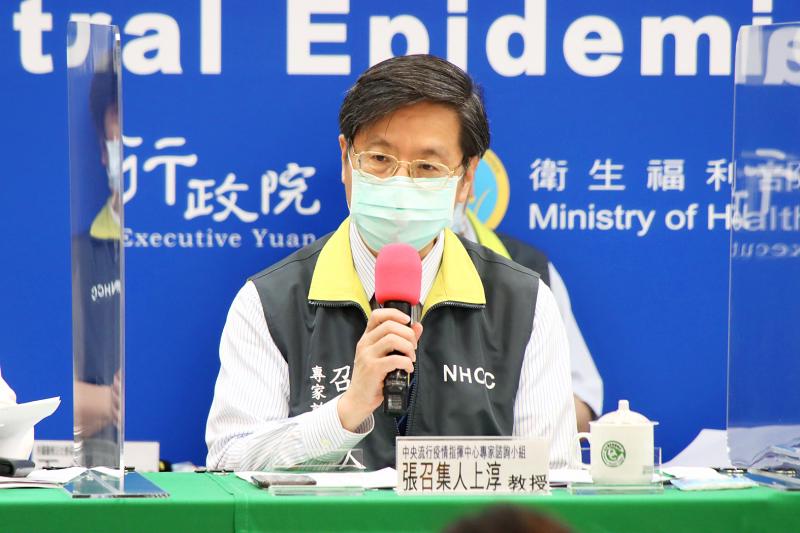
Photo courtesy of the CECC
The panel suggests “enhancing the COVID-19 reporting and testing mechanism,” not only by setting up testing stations outside hospitals, but also by testing all people who are about to be admitted, to ensure that they have not contracted the virus, Chang said.
Healthcare facilities should monitor patients’ condition even if they tested negative, as they might have been in a pre-symptomatic stage when tested, the center said, adding that they should be tested for COVID-19 immediately if they have a fever, experience respiratory symptoms, lose their sense of taste or smell, or have diarrhea during their hospitalization.
Healthcare facilities must “enhance the health monitoring of employees, including daily body temperature measurement, and immediately test employees who have developed suspicious symptoms, Chang said.
The panel also suggests that healthcare personnel in areas of high risk for contracting the virus, such as emergency rooms, intensive care units or designated COVID-19 wards, get tested for COVID-19 regularly — every five to seven days — either with a nasopharyngeal swab or saliva-based testing, he said.
Medical services for foreign nationals, with the exception of emergency or special cases, should be suspended, he added.
“As the COVID-19 situation is relatively severe now, individuals, businesses and government agencies should all carry out adequate disease prevention measures,” said Minister of Health and Welfare Chen Shih-chung (陳時中), who heads the center.
Companies could refer to the business continuity guidelines released by the CECC in March last year, Chen added.
As some are concerned about what measures to implement, Deputy Minister of Health and Welfare Shih Chung-liang (石崇良) said that the center is emphasizing some of the guidelines:
All businesses should increase cleaning and disinfecting for employees and the workplace, including monitoring the health of their employees and allowing more flexible sick leave.
If a company has employees who must travel between an area with a level 3 alert — Taipei and New Taipei City — and a level 2 alert — all other cities and counties — it should reconsider, allowing the employees to work from home or separate offices instead, Shi said.
Social distancing should be implemented at the workplace or employees should wear masks at all times, he said, adding that a staff cafeteria should comply with the rules for restaurants, including keeping tables at least 1.5m apart or using table dividers.
Companies should hold meetings online instead of in-person, ask employees not to attend events with large gatherings of people, and allow employees to take family care leave with greater flexibility if their child’s class has been suspended due to the COVID-19 situation, Shi added.
Firms must thoroughly implement measures and make it easier for employees to take sick leave, because a sick employee who is afraid to take leave puts the workplace in serious risk of further infections, Chen added.

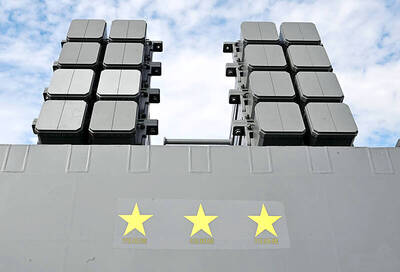
UPGRADE: The Kang Ding-class frigate is replacing its Chaparall missiles with Tien Chien II and Hua Yang VLS, which would provide it with long-range, 360° air defense Taiwan plans to produce 1,200 to 1,376 Hai Chien II missiles (海劍二, Sea Sword II) — also known as TC-2N — to serve as the standard air defense system of the navy’s surface combatant fleet, a source said yesterday. Last week, the Hai Chien II, the naval version of the Tien Kung II missile (天劍二, Sky Sword II), completed a live-fire test in waters off the National Chungshan Institute of Science and Technology’s Jiupeng facility (九鵬) in Pingtung County’s Manjhou Township (滿州). The MIM72 Chaparral and other dated air defense missiles that currently arm Taiwanese ships have inadequate range to combat Chinese

REASONS FOR TRAVEL: An assistant professor said that proposed amendments to penalize drivers if they used drugs overseas would not deter people from traveling People who operate a motor vehicle under the influence of marijuana would have their driver’s license revoked, even if they used the substance while overseas, the Ministry of Transportation and Communications said yesterday, citing proposed amendments to the Road Traffic Management and Penalty Act (道路交通管理處罰條例). The amendments would also authorize the government to revoke the licenses of people determined to have used Category 1 or Category 2 narcotics, even if they were not operating a vehicle while under the influence of drugs, as well as ban them from taking the license test for three years, the ministry said. People aged 18 or
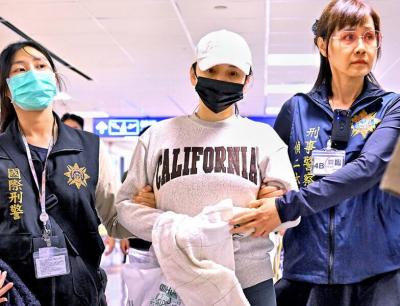
Johanne Liou (劉喬安), a Taiwanese woman who shot to unwanted fame during the Sunflower movement protests in 2014, returned to Taiwan last night after being deported from the US. She is to stand trial in Taiwan for charges involving embezzlement, fraud and drug crimes. The Criminal Investigation Bureau (CIB) said it took her into custody at Taiwan Taoyuan International Airport and would first question her before transferring her to the New Taipei District Prosecutors’ Office. She was arrested upon disembarking a flight from San Francisco that landed shortly before 7pm. Liou absconded to the US in 2019 after jumping bail
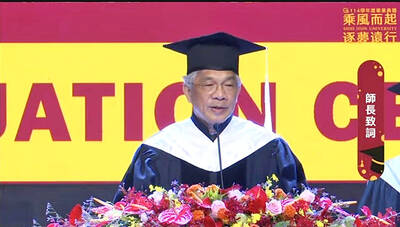
Shih Hsin University President Chen Ching-he (陳清河) yesterday issued a public apology for comments made in his commencement speech last week, stating that he has asked the school to suspend his duties and halt his wages for two months as a show of contrition. At the commencement ceremony on May 30, Chen said, “If you don’t manage your time well, or your own emotions, or your health, then I am telling every one of you — put a quick end to ‘you,’ because the world has no need for ‘you.’” The comments have sparked significant controversy online, and Chen through an open


 RSS
RSS