


Members of the Puyuma people yesterday urged the Taitung County Government to scrap plans for a solar power plant on a 161 hectare plot of land near the estuary of the Jhihben River (知本溪).
Taitung City Councilor Chen Cheng-tsung (陳政宗), acting head of the Mafaliu branch of Taitung County’s Aboriginal Katatipul community, accused the county government of hastily passing an ill-designed project while excluding Aborigines from the negotiating process.
The land was, in 2018 when the county government was discussing the project, mostly traditional Aboriginal land, Chen said.
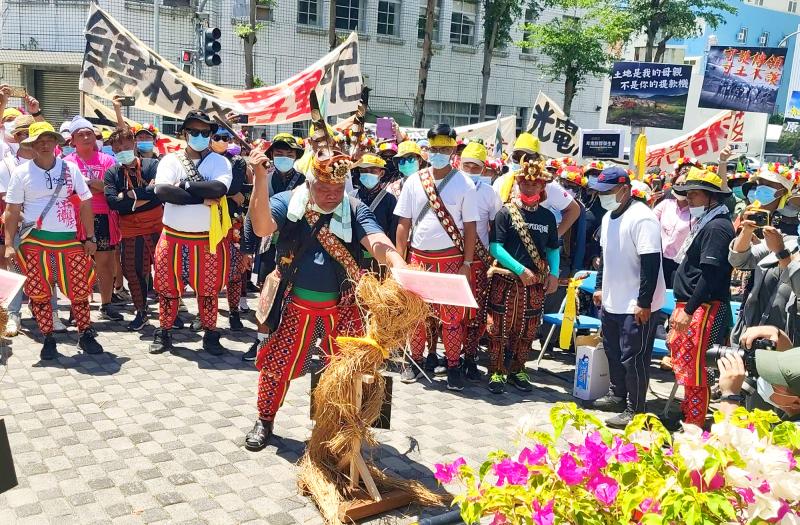
Photo: CNA
Chen said that the questions in a vote held on June 1, 2019, soliciting the opinions of Aborigines were poorly designed.
The vote passed 187-173, with one abstention.
However, those opposed to the project have questioned the validity of the vote, saying that many people voted on behalf of those not present.
Members of the Mafaliu, Pakaruku and Ruvaniaw branches of the Katatipul community yesterday protested in front of the Taichung County Government building, demanding that the county government respect traditional Aboriginal land and cancel the project.
Aborigines were never consulted about the contract for the project, as it was handled by the county government and the contractor, demonstrating an utter lack of respect for local Aborigines, Chen said.
The county government has also handed the contractor powers that, by law, only Aborigines have the right to exercise, he said.
Over the past three years, local Aborigines have voiced their opposition to the project many times, but the county government has not only ignored their opinions, but has also facilitated the contractor’s efforts to persuade villagers to agree to the project, representatives of the Katatipul community said.
The protesters said that if they did not take a stand and voice their discontent, their autonomy, opinions and rights would be ignored by the county government.
In response, the county government said that it remains committed to the solar power plant, but that it respects the opinions of the local Aborigines and would ensure that the project proceeds according to the law.

Fast food chain McDonald's is to raise prices by up to NT$5 on some products at its restaurants across Taiwan, starting on Wednesday next week, the company announced today. The prices of all extra value meals and sharing boxes are to increase by NT$5, while breakfast combos and creamy corn soup would go up by NT$3, the company said in a statement. The price of the main items of those meals, if ordered individually, would remain the same. Meanwhile, the price of a medium-sized lemon iced tea and hot cappuccino would rise by NT$3, extra dipping sauces for chicken nuggets would go up

FUKUOKA SITUATION: Japanese media reported that the pathogen is expected to be identified by the summer, while the CDC downplayed the idea that it was hMPV A “mysterious cold-like illness” reported in Japan’s Fukuoka Prefecture does not seem to be a new disease, but Japanese authorities have been asked about the situation, the Centers for Disease Control (CDC) said yesterday. The Fukuoka Prefectural Medical Association on Wednesday told a news conference that a “mystery cold” that has become a hot topic on social media is “highly likely to be caused by some kind of viral infection,” Japan’s KBC News reported. “Many people are experiencing symptoms starting with a sore throat, followed by a runny nose, phlegm and a severe cough,” KBC News reported, citing association officials. Health authorities are

Nvidia Corp CEO Jensen Huang (黃仁勳) arrived in Taiwan yesterday ahead of upcoming AI and technology events, saying he plans to meet with clients and Taiwan Semiconductor Manufacturing Co Chairman C.C. Wei (魏哲家) during his visit. After landing at Taipei Songshan Airport, Huang posed for photos with fans and handed out Yakult drinks to reporters and supporters waiting at the scene, saying he has “a lot to do” during the trip. Asked about reports that Nvidia’s planned headquarters site in Taipei’s Beitou Shilin Technology Park could break ground on May 27, Huang said that if the company holds an event, he would

Carrefour Taiwan is to begin using a new name from the start of July, but it cannot divulge the name until then, the chairman of the supermarket chain's parent company said today. President Chain Store Co chairman Lo Chih-hsien (羅智先) was asked by reporters after a shareholders' meeting to confirm whether the company has settled on a new name for the supermarket brand. In March, the government-registered name of two Carrefour Taiwan branches was quietly changed to "Le Chia Kang" (樂家康) in Chinese, raising speculation that has been selected as the name. Lo said that because of local regulations and contractual obligations, the


 RSS
RSS