


Chinese Nationalist Party (KMT) Legislator Liao Wan-ju (廖婉汝) yesterday called off a legislative committee session after Representative to Japan Frank Hsieh (謝長廷) did not attend.
The legislature’s Foreign Affairs and National Defense Committee was four minutes into its session on the future of Taiwan-Japan relations when Liao, its convenor, terminated the proceedings, with Hsieh not in attendance either in person or virtually.
KMT lawmakers had ordered Hsieh to appear at the committee after he sparked controversy with remarks about Japan’s plans to discharge water from the Fukushima Dai-ichi nuclear power plant.
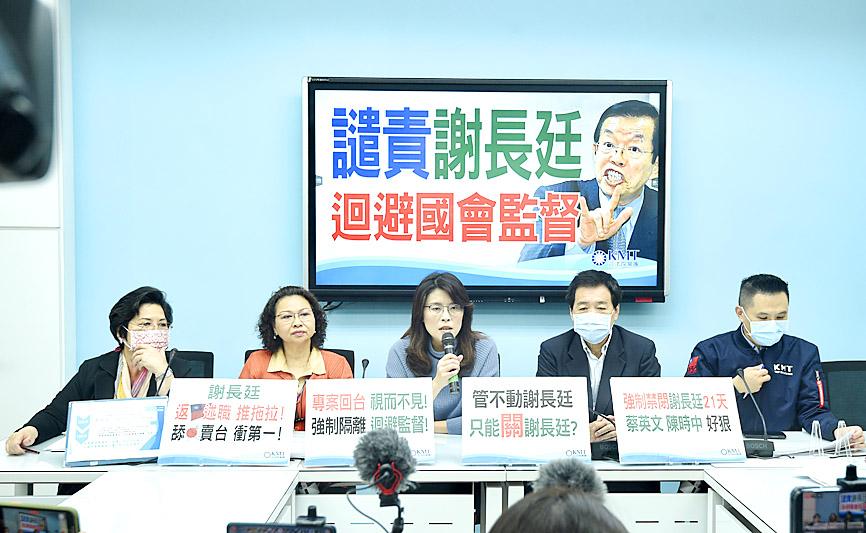
Photo: Peter Lo, Taipei Times
Liao said that lawmakers had the previous day received a note from the Ministry of Foreign Affairs saying that Hsieh would not attend due to quarantine protocols.
The ministry must inform Hsieh that he is to return to Taiwan by Sunday so he can complete his period of isolation before reporting to the committee when it convenes again on May 24, she said.
The deadline was issued after consultations with the Ministry of Health and Welfare about how much time Hsieh would need, Liao said.
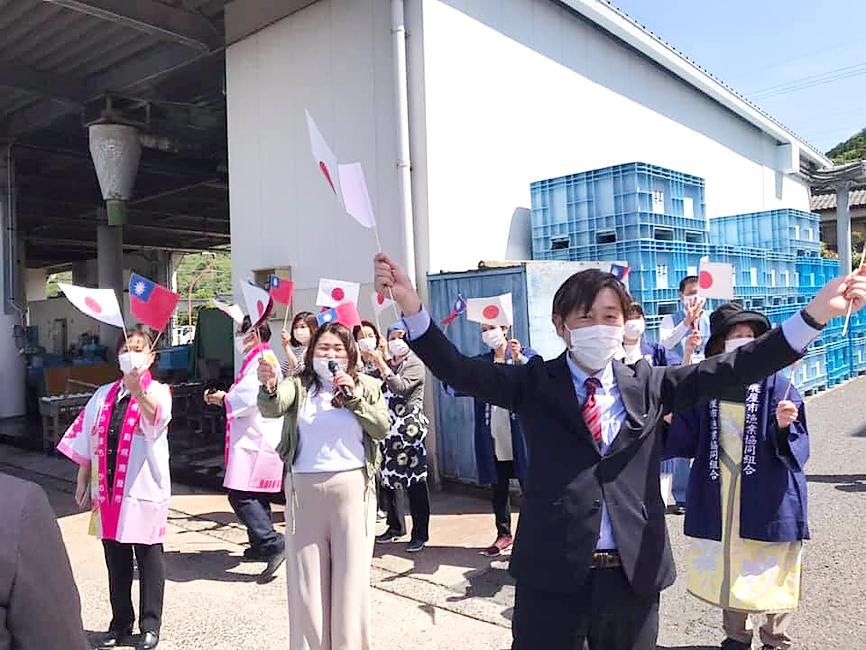
Photo: Screen grab from Facebook
Minister of Foreign Affairs Joseph Wu (吳釗燮) told the committee that Hsieh would be informed, but did not clarify whether Hsieh would return to Taiwan.
Separately yesterday, the KMT legislative caucus accused Hsieh of avoiding lawmakers.
Hsieh’s behavior makes people think that he “is a traitor to the Han people, Taiwan and the country,” KMT Legislator Alex Fai (費鴻泰) told a news conference, adding that he must resign.
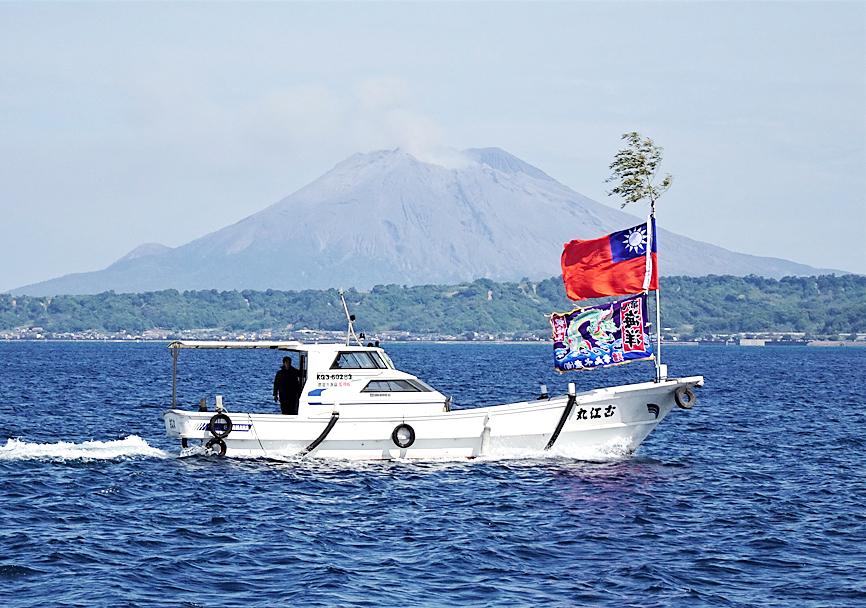
Photo: CNA
President Tsai Ing-wen (蔡英文) must apologize for appointing an undeserving person to represent the country, Fai said.
Taiwan is “not some barbarian colony of Japan’s,” he said.
Hsieh on Tuesday wrote on Facebook that he had conducted a two-day tour of Kagoshima
Prefecture, where he met with Kagoshima Governor Koichi Shiota, and attended the signing of a memorandum between Pingtung County and the prefecture.
The flag of the Republic of China put up by local friends of Taiwan could be seen throughout the prefecture and on many fishing boats, Hsieh said before thanking the prefecture’s residents.
“Our national flag is a sensitive object in Japan and people who fly it — including the harbor workers’ union — have been threatened over it,” Hsieh said.
“Their friendship toward Taiwan dispelled their fear, and we are thankful for their passion and spirit,” he said.

China has reserved offshore airspace in the Yellow Sea and East China Sea from March 27 to May 6, issuing alerts usually used to warn of military exercises, although no such exercises have been announced, the Wall Street Journal (WSJ) reported yesterday. Reserving such a large area for 40 days without explanation is an “unusual step,” as military exercises normally only last a few days, the paper said. These alerts, known as Notice to Air Missions (Notams), “are intended to inform pilots and aviation authorities of temporary airspace hazards or restrictions,” the article said. The airspace reserved in the alert is

South Korea is planning to revise its controversial electronic arrival card, a step Taiwanese officials said prompted them to hold off on planned retaliatory measures, a South Korean media report said yesterday. A Yonhap News Agency report said that the South Korean Ministry of Foreign Affairs is planning to remove the “previous departure place” and “next destination” fields from its e-arrival card system. The plan, reached after interagency consultations, is under review and aims to simplify entry procedures and align the electronic form with the paper version, a South Korean ministry official said. The fields — which appeared only on the electronic form

More than 6,000 Taiwanese students have participated in exchange programs in China over the past two years, despite the Mainland Affairs Council’s (MAC) “orange light” travel advisory, government records showed. The MAC’s publicly available registry showed that Taiwanese college and university students who went on exchange programs across the Strait numbered 3,592 and 2,966 people respectively. The National Immigration Agency data revealed that 2,296 and 2,551 Chinese students visited Taiwan for study in the same two years. A review of the Web sites of publicly-run universities and colleges showed that Taiwanese higher education institutions continued to recruit students for Chinese educational programs without

A bipartisan group of US senators has introduced a bill to enhance cooperation with Taiwan on drone development and to reduce reliance on supply chains linked to China. The proposed Blue Skies for Taiwan Act of 2026 was introduced by Republican US senators Ted Cruz and John Curtis, and Democratic US senators Jeff Merkley and Andy Kim. The legislation seeks to ease constraints on Taiwan-US cooperation in uncrewed aerial systems (UAS), including dependence on China-sourced components, limited access to capital and regulatory barriers under US export controls, a news release issued by Cruz on Wednesday said. The bill would establish a "Blue UAS


 RSS
RSS