


Democratic Progressive Party (DPP) legislators in Taipei yesterday showed their support for Uighurs by wearing jackets and shirts of apparel brands facing Chinese boycotts for their statements on rights abuses in Xinjiang.
China’s state-owned media have called for a boycott of Swedish fashion retailer H&M after social media users last week circulated a statement made by the company last year that it was “deeply concerned” about reports of forced labor in Xinjiang and that it would no longer source cotton from the region.
Several other global retail giants, including Adidas, Nike, Puma and Uniqlo, also face boycotts in China over the issue.
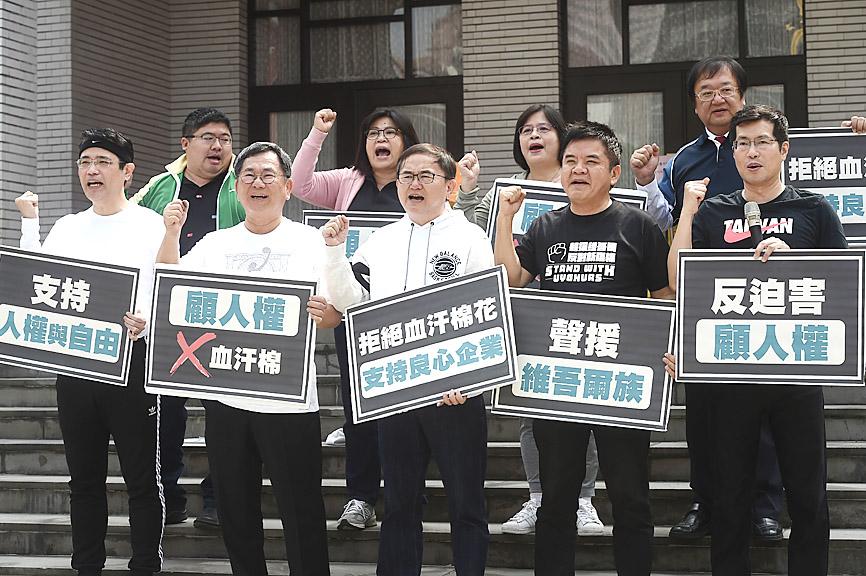
Photo: Chien Jung-fong, Taipei Times
At a news conference outside the legislative chamber, nine DPP lawmakers, many wearing black and white clothing, held signs that read: “support Uighurs,” “uphold human rights” and “refuse blood cotton.”
“We are here to call attention to China’s concentration camp treatment of Uighurs in Xinjiang, to boycott ‘blood cotton’ apparel, and to defend human rights and other universal values for Uighurs,” DPP Legislator Liu Chao-hao (劉櫂豪) said.
China uses images and statistics to tell the world that no human rights abuses are occurring, “but the best way is to allow the international community to freely enter, to observe and better understand the actual situation in Xinjiang,” DPP Legislator Lo Chih-cheng (羅致政) said.
“Defending justice cannot be done by Uighurs alone, they need international support. Today, what I wear represents our fight to uphold human rights, resist dictatorship and support those firms that stand up for democratic values. As consumers, Taiwanese can choose the clothing they buy and have the right to choose what to wear,” DPP Legislator Chuang Jui-hsiung (莊瑞雄) said.

Considering that most countries issue more than five denominations of banknotes, the central bank has decided to redesign all five denominations, the bank said as it prepares for the first major overhaul of the banknotes in more than 24 years. Central bank Governor Yang Chin-lung (楊金龍) is expected to report to the Legislative Yuan today on the bank’s operations and the redesign’s progress. The bank in a report sent to the legislature ahead of today’s meeting said it had commissioned a survey on the public’s preferences. Survey results showed that NT$100 and NT$1,000 banknotes are the most commonly used, while NT$200 and NT$2,000

The Centers for Disease Control (CDC) yesterday reported the first case of a new COVID-19 subvariant — BA.3.2 — in a 10-year-old Singaporean girl who had a fever upon arrival in Taiwan and tested positive for the disease. The girl left Taiwan on March 20 and the case did not have a direct impact on the local community, it said. The WHO added the BA.3.2 strain to its list of Variants Under Monitoring in December last year, but this was the first imported case of the COVID-19 variant in Taiwan, CDC Deputy Director-General Lin Ming-cheng (林明誠) said. The girl arrived in Taiwan on

South Korea is planning to revise its controversial electronic arrival card, a step Taiwanese officials said prompted them to hold off on planned retaliatory measures, a South Korean media report said yesterday. A Yonhap News Agency report said that the South Korean Ministry of Foreign Affairs is planning to remove the “previous departure place” and “next destination” fields from its e-arrival card system. The plan, reached after interagency consultations, is under review and aims to simplify entry procedures and align the electronic form with the paper version, a South Korean ministry official said. The fields — which appeared only on the electronic form

The Ministry of Foreign Affairs (MOFA) is suspending retaliation measures against South Korea that were set to take effect tomorrow, after Seoul said it is updating its e-arrival system, MOFA said today. The measures were to be a new round of retaliation after Taiwan on March 1 changed South Korea's designation on government-issued alien resident certificates held by South Korean nationals to "South Korea” from the "Republic of Korea," the country’s official name. The move came after months of protests to Seoul over its listing of Taiwan as "China (Taiwan)" in dropdown menus on its new online immigration entry system. MOFA last week


 RSS
RSS