


The Changhua County Government has cut short a reward scheme aimed at reducing the lychee giant stink bug population after it reached double its goal in little over one month.
To control the major agricultural pest, county governments every year offer money for the capture and return of stink bug eggs.
In Changhua County, officials offered NT$5 for each leaf returned that contained at least 10 to 14 eggs.
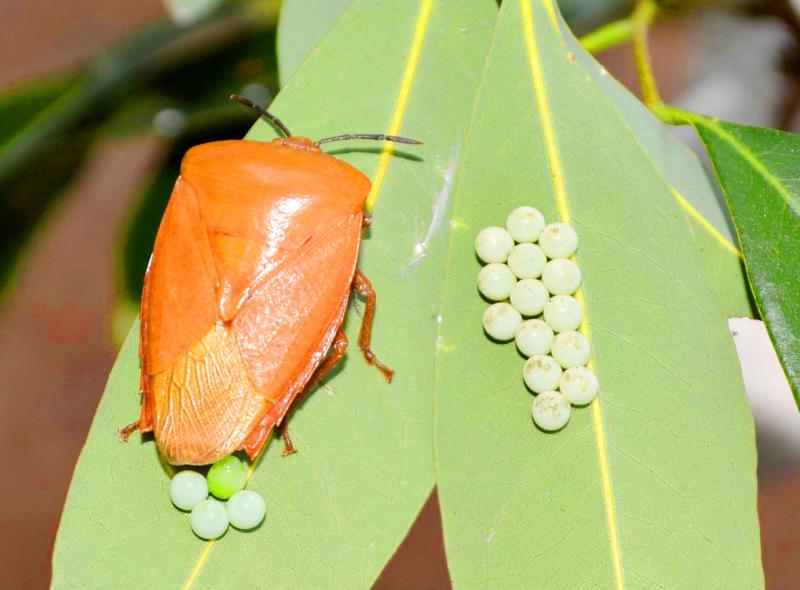
Photo courtesy of Changhua County Government
The county government had planned to collect 132,000 leaves from the start of the program on Feb. 18 to its end on May 27, but by Friday had already surpassed 260,000 leaves, it said.
In light of the enthusiastic response, the Bureau of Animal and Plant Health Inspection and Quarantine on Friday ordered local governments to cease all reward schemes.
Changhua County gave residents until 4pm yesterday to collect their money and until today to drop off stink bug eggs.
In Fenyuan Township (芬園), which has more than 400 hectares of lychee fields, about a dozen people arrived at the township office early yesterday to collect their rewards before the deadline.
Of them, three brought bags containing at least 1,000 leaves each, earning them NT$5,000.
The township has led the county two years in a row, turning in 53,000 leaves last year and more than 50,000 this year as of Sunday.
Largely to thank for the record numbers is one local woman, who contributed half of the township’s entire haul.
Local officials said the woman, surnamed Chang (張), would keep returning with full bags, earning NT$150,000 after turning in 30,000 leaves.
However, Chang was not the only expert stink bug bounty hunter.
Data from the county’s Department of Agriculture showed that more than NT$350,000 in rewards were distributed in 2019 for stink bug eggs, more than NT$50,000 of which went to one person.
Last year, a collector earned nearly NT$100,000 from the scheme, data showed.
Meanwhile in Taichung, the Taiping District Office on Sunday said it plans to release a natural enemy of the lychee giant stink bug in Yongcheng Park (永成公園) in a bid to control their population.
There are a number of ways to eradicate the stink bugs, including pesticides, pruning, and other physical and biological measures, office Director Hsu Kuei-fang (許貴芳) said.
One method involves releasing the ant-like Anastatus formosanus, a species of wasp endemic to Taiwan that is parasitic to agricultural pests such as the lychee stink bug, but does not sting or bite humans, Hsu said.
The wasp lays its eggs in stink bug eggs, feeding on the nutrients inside before splitting them open to escape after gestation, keeping the stink bug eggs from maturing.
The office plans to release more than 7,000 of the wasps in three stages, Hsu said.
Hopefully through this method, visitors would be able to enjoy the park without the risk of encountering stink bugs, Hsu added.
Additional reporting by Tang Shih-ming and Chen Chien-chih

FUKUOKA SITUATION: Japanese media reported that the pathogen is expected to be identified by the summer, while the CDC downplayed the idea that it was hMPV A “mysterious cold-like illness” reported in Japan’s Fukuoka Prefecture does not seem to be a new disease, but Japanese authorities have been asked about the situation, the Centers for Disease Control (CDC) said yesterday. The Fukuoka Prefectural Medical Association on Wednesday told a news conference that a “mystery cold” that has become a hot topic on social media is “highly likely to be caused by some kind of viral infection,” Japan’s KBC News reported. “Many people are experiencing symptoms starting with a sore throat, followed by a runny nose, phlegm and a severe cough,” KBC News reported, citing association officials. Health authorities are

Nvidia Corp CEO Jensen Huang (黃仁勳) arrived in Taiwan yesterday ahead of upcoming AI and technology events, saying he plans to meet with clients and Taiwan Semiconductor Manufacturing Co Chairman C.C. Wei (魏哲家) during his visit. After landing at Taipei Songshan Airport, Huang posed for photos with fans and handed out Yakult drinks to reporters and supporters waiting at the scene, saying he has “a lot to do” during the trip. Asked about reports that Nvidia’s planned headquarters site in Taipei’s Beitou Shilin Technology Park could break ground on May 27, Huang said that if the company holds an event, he would

The Ministry of Finance this afternoon announced the winning numbers for the March-April uniform invoice lottery. The winning number for the NT$10 million (US$318,060) special prize is 19531471, and the winning number for the NT$2 million grand prize is 85941329. Three numbers were drawn for the NT$200,000 first prize: 07225810, 20231230 and 83518781. Those with receipts matching the last seven digits of any of the first-prize numbers will win the NT$40,000 second prize, while those matching the last six digits will win the NT$10,000 third prize. Those whose receipts match the last five digits of the first-prize numbers can claim the NT$4,000 fourth prize,
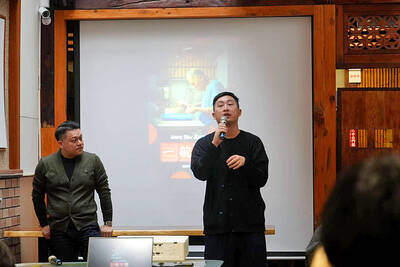
Taiwan Travelogue (臺灣漫遊錄), which earlier this week became the first Taiwanese novel to win the International Booker Prize, is to be adapted into a television series through a Taiwan-Japan coproduction, producer Chang Chen-yu (張辰漁) said yesterday. Chang, a producer at World Softest Production Film Co, wrote on Facebook that the company had been searching for projects with international appeal that retain a strong Taiwanese identity after colleagues and Japanese partners strongly recommended the novel. After reading the book, Chang said he immediately decided to pursue the screen rights. “A great story has the power to transcend time and borders, and connect countless people,”


 RSS
RSS