


The National Communications Commission (NCC) yesterday gave conditional approval for Asia Pacific Telecom Co (APT) to share Far EasTone Telecommunications Co’s (FET) 5G bandwidth and use the network it has built, the first instance of such an arrangement since the Telecommunications Management Act (電信管理法) began to be implemented last year.
The commission approved the application provided that two conditions are met, NCC Vice Chairman and spokesman Wong Po-tsung (翁柏宗) said.
First, the two firms have committed to building 2,000 more base stations to expand their 5G coverage, Wong said.
FET is to build 500 5G and 1,000 4G base stations within one to two years, while APT is to build 500 4G base stations.
The telecoms are offering a 5G service under a “non-standalone” model, meaning that part of the service is still provided via 4G base stations, he said.
The firms’ subscribers must have equal access to the shared bandwidth on the 3.5 gigahertz (GHz) band, he added.
As FET’s deployment of its 4G system differs from APT’s, the quality of FET’s and APT’s 5G services would also differ, Wong said, adding that the telecoms should voluntarily disclose such information to prospective subscribers.
Second, the two companies are to set up a task force to ensure that both have the ability to control the 5G network and monitor information security issues, Wong said, adding that the task force would hold regular meetings and submit meeting records to the commission.
In the nation’s first 5G auction, between December 2019 and February last year, FET obtained 80 megahertz (MHz) on the 3.5GHz band, while APT obtained 400MHz on the 28GHz band.
The Telecommunications Management Act, which allows carriers to share bandwidth and networks, began to be implemented last year, and FET shocked the market by announcing two months later that it would form a partnership with APT.
The agreement gives APT access to FET’s bandwidth on the 3.5GHz band for 20 years. In return, APT has agreed to pay about NT$9.47 billion (US$335.13 million), or the equivalent of two-ninths of the network deployment costs.
Receiving the partnership application on Dec. 9 last year, the NCC reviewed it based on criteria in the Telecommunications Management Act and the Regulations Governing the Use of Radio Frequencies (無線電頻率使用管理辦法), including ensuring efficient frequency use, facilitating market competition and protecting consumer interests, Wong said.
Asked how the commission’s ruling on the application might affect the 5G market, Wong said that while different forms of partnerships might help telecoms reduce network deployment costs, they need to strike a balance between the need to save costs and enhancing subscribers’ 5G experience.
“The Telecommunications Management Act allows telecoms to build networks together and permits a more flexible use of frequencies, which is expected to bring unprecedented changes to the telecommunications market,” he said. “We will closely monitor those changes and soon entrust a research institution with the task of studying relevant issues.”

Considering that most countries issue more than five denominations of banknotes, the central bank has decided to redesign all five denominations, the bank said as it prepares for the first major overhaul of the banknotes in more than 24 years. Central bank Governor Yang Chin-lung (楊金龍) is expected to report to the Legislative Yuan today on the bank’s operations and the redesign’s progress. The bank in a report sent to the legislature ahead of today’s meeting said it had commissioned a survey on the public’s preferences. Survey results showed that NT$100 and NT$1,000 banknotes are the most commonly used, while NT$200 and NT$2,000

The Centers for Disease Control (CDC) yesterday reported the first case of a new COVID-19 subvariant — BA.3.2 — in a 10-year-old Singaporean girl who had a fever upon arrival in Taiwan and tested positive for the disease. The girl left Taiwan on March 20 and the case did not have a direct impact on the local community, it said. The WHO added the BA.3.2 strain to its list of Variants Under Monitoring in December last year, but this was the first imported case of the COVID-19 variant in Taiwan, CDC Deputy Director-General Lin Ming-cheng (林明誠) said. The girl arrived in Taiwan on

ANNUAL EVENT: Two massive Pokemon balloons are to be set up in Daan Park, with an event zone operating from 10am to 6pm This year’s Taipei Floral Picnic is to be held at Daan Park today and tomorrow, featuring an exclusive Pokemon Go event, a themed food market, a coffee rave picnic area and stage performances, the Taipei Department of Information and Tourism said yesterday. Two massive Pokemon balloons are to be set up in the park as attractions, with an exclusive event zone operating from 10am to 6pm, it said. Participants who complete designated tasks on-site would have a chance to receive limited-edition souvenirs, it added. People could also try the newly launched game Pokemon Pokopia in the trial area, the department said. Three PokeStops are
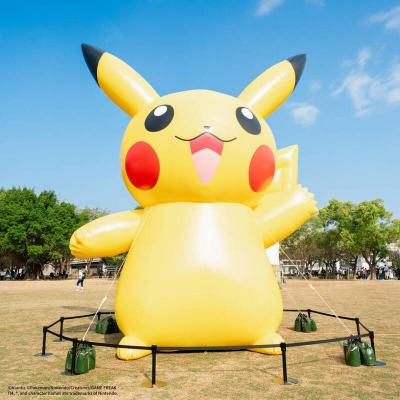
This year’s Taipei Floral Picnic is to be held at Daan Park this weekend, featuring an exclusive Pokemon Go event, a theme food market, a coffee rave picnic area and stage performances. Pokemon Go Two massive Pokemon balloons are to be set up in the park as photo attractions, with an exclusive event zone operating from 10am to 6pm. Participants who complete designated tasks on-site would have a chance to receive limited-edition souvenirs. Pokemon trainers could also experience the newly launched game Pokemon Pokopia in the trial area. Three PokeStops are to be set up in the park. Trainers are invited to take


 RSS
RSS