


The Chinese Nationalist Party (KMT) is this year setting its sights on young, moderate voters by focusing on policy issues such as animal protection and housing, and offering trendy merchandise, the party’s youth director said on Saturday last week.
To boost waning support for the KMT among young voters after last year’s general election, the party first focused on reaching out to people already within the pan-blue camp, KMT Youth Department director Chen Kuan-an (陳冠安) said.
This year, the party is to target people without such ingrained ideologies through methods that would better appeal to them, Chen said, adding that the strategy is showing initial success.

Photo: Liao Chen-huei, Taipei Times
The first half of last year was the toughest for the KMT, especially among young people, whose support for the party fell to single-digit percentage points, Chen said.
The KMT has worked to bring young supporters back into the fold, he said, adding that it largely met that goal by the end of the year.
This year, to attract moderate voters, the party needs to adopt a more policy-centric approach, he said.
It is launching a “youth think tank,” which is to focus on a few key issues, such as animal protection, housing, diversity, higher education, creative opportunities and public employment, he said.
Eventually, the youth wing is to also attach greater importance to labor rights, he added.
Another task for the department is to design merchandise, Chen said.
The party has sold a few hundred thousand New Taiwan dollars of merchandise since setting up an online shopping portal in November last year, he said.
Although most of the income is turned over to the KMT Administration and Management Committee, 40 percent is earmarked for the youth department, he added.
Last year, 3,545 people aged 20 to 29 joined the KMT, while support for the party among young people rose to 14 percent, Chen said, adding that it is already closing the gap with the Democratic Progressive Party.
Ultimately, the KMT’s entire promotional system needs to be rebuilt, Chen said.
This should start with systematizing talent selection to help young people obtain party titles, such as deputy director or spokesperson, he said.
The party should then increase their media exposure and help them manage fan pages, so that even if they leave after a year, they would still have the resources to maintain a public presence, he added.
No matter where they go on to work, these people could serve as a voice for the pan-blue camp, as well as capable policy researchers, he said.
However, many young pan-blue supporters are not enthusiastic about working in politics due to the party’s opaque promotion system, he added.

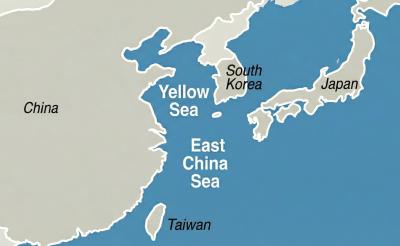
China has reserved offshore airspace in the Yellow Sea and East China Sea from March 27 to May 6, issuing alerts usually used to warn of military exercises, although no such exercises have been announced, the Wall Street Journal (WSJ) reported yesterday. Reserving such a large area for 40 days without explanation is an “unusual step,” as military exercises normally only last a few days, the paper said. These alerts, known as Notice to Air Missions (Notams), “are intended to inform pilots and aviation authorities of temporary airspace hazards or restrictions,” the article said. The airspace reserved in the alert is

NAMING SPAT: The foreign ministry called on Denmark to propose an acceptable solution to the erroneous nationality used for Taiwanese on residence permits Taiwan has revoked some privileges for Danish diplomatic staff over a Danish permit that lists “Taiwan” as “China,” Eric Huang (黃鈞耀), head of the Ministry of Foreign Affairs’ Department of European Affairs, told a news conference in Taipei yesterday. Reporters asked Huang whether the Danish government had responded to the ministry’s request that it correct the nationality on Danish residence permits of Taiwanese, which has been listed as “China” since 2024. Taiwan’s representative office in Denmark continues to communicate with the Danish government, and the ministry has revoked some privileges previously granted to Danish representatives in Taiwan and would continue to review

More than 6,000 Taiwanese students have participated in exchange programs in China over the past two years, despite the Mainland Affairs Council’s (MAC) “orange light” travel advisory, government records showed. The MAC’s publicly available registry showed that Taiwanese college and university students who went on exchange programs across the Strait numbered 3,592 and 2,966 people respectively. The National Immigration Agency data revealed that 2,296 and 2,551 Chinese students visited Taiwan for study in the same two years. A review of the Web sites of publicly-run universities and colleges showed that Taiwanese higher education institutions continued to recruit students for Chinese educational programs without
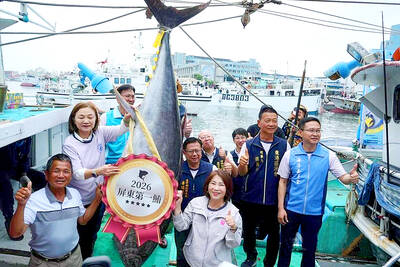
The first bluefin tuna of the season, brought to shore in Pingtung County and weighing 190kg, was yesterday auctioned for NT$10,600 (US$333.5) per kilogram, setting a record high for the local market. The auction was held at the fish market in Donggang Fishing Harbor, where the Siaoliouciou Island-registered fishing vessel Fu Yu Ching No. 2 delivered the “Pingtung First Tuna” it had caught for bidding. Bidding was intense, and the tuna was ultimately jointly purchased by a local restaurant and a local company for NT$10,600 per kilogram — NT$300 ,more than last year — for a total of NT$2.014 million. The 67-year-old skipper


 RSS
RSS