


The Control Yuan yesterday told judicial agencies to conduct a more thorough probe into allegations of corruption against former Supreme Court judge Shih Mu-chin (石木欽) and Chia Her Industrial Co (佳和集團) president Weng Mao-chung (翁茂鍾).
Legal experts and media reports have called the case they are involved in “the biggest corruption scandal in the history of Taiwan’s judiciary,” due to allegations of widespread bribe-taking, abuse of authority, conflict of interest and other illicit activities by more than 200 judicial and government officials, including judges, prosecutors, investigators, military and police officials, and some political figures, to whom Shih reportedly introduced Weng.
Control Yuan members Kao Yung-cheng (高涌誠), Wang Mei-yu (王美玉) and Tsai Chung-yi (蔡崇義) said that they found omissions regarding the roles played by some judicial officials and inconsistencies in their overview of the government-mandated report on the scandal presented to them by the Ministry of Justice on Monday.
Among their main recommendations, Kao said they would request that the Taiwan High Prosecutors’ Office, which conducted an earlier investigation into Shih’s alleged corruption and Weng’s lawsuits, declassify all the relevant court files and evidence for judicial investigators and prosecutors to re-examine.
The information should be declassified “to ensure fairness, openness and uphold justice, as new investigations ... are being undertaken,” Kao said. “It is to restore honor and public trust in our justice system.”
Kao and Tsai pointed in particular to deficiencies in the report on former Ministry of Justice Investigation Bureau Taipei Field Station section chief Chin Tai-sheng (秦台生), saying that there were omissions regarding investigation findings.
They alleged that the ministry report was trying to protect Chin.
The ministry “report presented findings, which stated that Chin did not engage in wrongdoing, had no conflict of interest regarding his roles in Weng’s lawsuits... However, in the report’s later sections, it stated that … Chin was likely involved in conflict of interest, meddling in prosecutions, and was suspected of buying company stocks through Weng, and became a Chia Her Industrial board member after his retirement,” Kao said.
He also pointed to other deficiencies in the ministry report regarding how ministry officials allegedly received expensive shirts as gifts from Weng, some more than 20 times, as Chia Her Industrial Co is a leading textile and clothing manufacturer in Tainan, and omissions regarding how Weng treated officials to expensive banquets and gave them gifts.
The Control Yuan members said that a more thorough and detailed report would be needed from ministry officials, and more time would be needed to assess the report, as the ministry and Judicial Yuan only had one day in September last year to examine the materials and court files made available by prosecutors.
Minister of Justice Tsai Ching-hsiang (蔡清祥) said that his ministry would present further information and rectify the deficiencies and omissions, after receiving an official request from the Control Yuan.
“Our investigators did their best for the mandated report. A number of prosecutors ... assessed the materials themselves, although the probe into bureau officials was indeed carried out by the bureau itself. Therefore we respect the recommendation by the Control Yuan and will re-examine the report,” Tsai said.
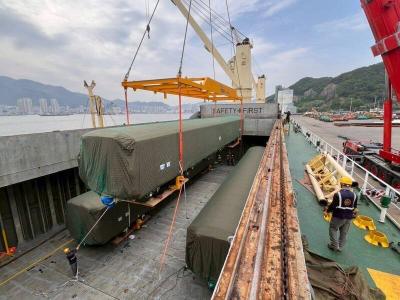
The first of 10 new high-capacity trains purchased from South Korea’s Hyundai Rotem arrived at the Port of Taipei yesterday to meet the demands of an expanding metro network, Taipei Rapid Transit Corp (TRTC) said yesterday. The train completed a three-day, 1,200km voyage from the Port of Masan in South Korea, the company said. Costing NT$590 million (US$18.79 million) each, the new six-carriage trains feature a redesigned interior based on "human-centric" transportation concepts, TRTC said. The design utilizes continuous longitudinal seating to widen the aisles and optimize passenger flow, while also upgrading passenger information displays and driving control systems for a more comfortable
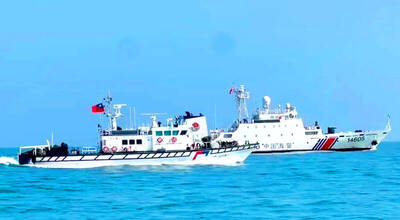
Instead of focusing solely on the threat of a full-scale military invasion, the US and its allies must prepare for a potential Chinese “quarantine” of Taiwan enforced through customs inspections, Stanford University Hoover fellow Eyck Freymann said in a Foreign Affairs article published on Wednesday. China could use various “gray zone” tactics in “reconfiguring the regional and ultimately the global economic order without a war,” said Freymann, who is also a nonresident research fellow at the US Naval War College. China might seize control of Taiwan’s links to the outside world by requiring all flights and ships entering or leaving Taiwan
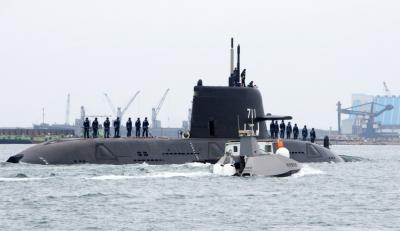
Taiwan's first indigenous defense submarine, the SS-711 Hai Kun (海鯤, or Narwhal), departed for its 13th sea trial at 7am today, marking its seventh submerged test, with delivery to the navy scheduled for July. The outing also marked its first sea deployment since President William Lai (賴清德) boarded the submarine for an inspection on March 19, drawing a crowd of military enthusiasts who gathered to show support. The submarine this morning departed port accompanied by CSBC Corp’s Endeavor Manta (奮進魔鬼魚號) uncrewed surface vessel and a navy M109 assault boat. Amid public interest in key milestones such as torpedo-launching operations and overnight submerged trials,
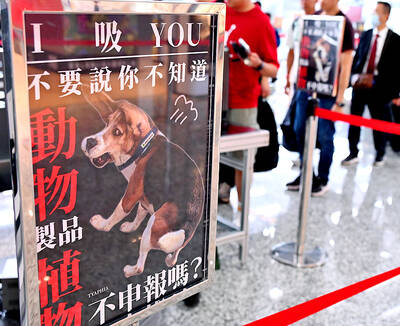
Quarantine awareness posters at Taiwan Taoyuan International Airport have gone viral for their use of wordplay. Issued by the airport branch of the Animal and Plant Health Inspection Agency, the posters feature sniffer dogs making a range of facial expressions, paired with advisory messages built around homophones. “We update the messages for holidays and campaign needs, periodically refreshing materials to attract people’s attention,” quarantine officials said. “The aim is to use the dogs’ appeal to draw focus to quarantine regulations.” A Japanese traveler visiting Taiwan has posted a photo on X of a poster showing a quarantine dog with a


 RSS
RSS