


Hong Kongers Alan and Joys created a YouTube channel about their two cats’ move to Taiwan after the couple relocated in July.
Store Meow TV (士多貓TV) has racked up more than 11,000 subscribers who tune in to hear the couple talk about the dilemmas facing many other Hong Kongers as they debate whether to relocate following China’s passage of a National Security Law for the territory in June.
National Immigration Agency data earlier this month showed that the number of Hong Kongers applying for residency in Taiwan skyrocketed 71.7 percent in the first 10 months of this year compared with a year earlier.
Photo courtesy of New Taipei City Government’s Tourism and Travel Department
Many Hong Kongers are choosing to settle in New Taipei City’s Tamsui District (淡水), Mainland Affairs Council Minister Chen Ming-tong (陳明通) said.
Alan taught middle-school mathematics in Hong Kong, and ran a cram school, while Joys was an editor and reporter at a parenting magazine. Now Alan is editing course material and tutoring online.
The couple said they fell in love with Taiwan more than a decade ago and had visited many times.
Joys attended Tunghai University in Taichung as an exchange student.
They said they had considered moving to Taiwan in 2015, but decided to act this year after the passage of the security law, applying for investment visas.
They said they chose Tamsui due to its similarities to Hong Kong and proximity to Taipei, settling in the Tamhai New Town (淡海新市鎮) neighborhood, where they love to visit the beach.
Seeing the fireworks earlier this year reminded them of New Year’s Eve fireworks over Victoria Harbour, they said.
“We originally just planned to rent, but we heard that Taiwanese landlords do not like to rent to older people, so we decided to buy,” said Alan, who is in his 30s. “Since we just moved to Taiwan, we wanted to get to know different neighborhoods before buying.”
Joys said that their salaries were high in Hong Kong, but so were expenses, which added to their stress.
However, in Taiwan, “the quality of life is high, there is space and housing is comfortable,” she said.
The Danhai Light Rail Transit system and Taipei MRT system are very convenient, she said, adding that the couple plan to take the exams to obtain a scooter license and are considering buying a car.
The couple were also excited to apply for citizenship so they can vote for president, saying: “This is something we have never experienced in Hong Kong.”
However, they remain concerned about the situation back home, which is getting worse by the day, Joys said.
The territory is already unrecognizable as the Hong Kong they once knew, she added.
Although it often seems like she is not doing anything to help, Joys said she can still encourage her fellow transplants to live good lives wherever they end up, keep speaking Cantonese and try to preserve their culture.
This way, “Hong Kong will not disappear,” she said.
Stella, a 29-year-old artist, is another Hong Konger who has relocated to Taiwan.
She said she was used to traveling the world for her work, but after the COVID-19 pandemic hit, she and her boyfriend decided in April to get married and settle in Taiwan.
Tamsui is beautiful and offers a pleasant living environment that is hard to find in bustling Hong Kong, she said.
Money is the hardest challenge in life, Stella said, as she has to take on multiple jobs and invest to maintain a steady income.
Alan, Joys and Stella said that many Hong Kongers like to go to Lion Rock Cafe (獅子山下冰室) in Tamsui, which features Hong Kong-style food, but they do not go out of their way to eat there or at restaurants opened by their compatriots, since Taiwanese food is delicious and diverse.
There is also a Facebook group for Hong Kongers living in Tamsui, where members share their experiences living in Taiwan, they added.
Meanwhile, 55-year-old Muk Muk (木木) said that her immigration story started three years ago, when she came to Taiwan on an investment visa with her mother.
Since she planned to return to Hong Kong on a monthly basis, she picked New Taipei City’s Linkou District (林口) to live, as it is conveniently situated between Taiwan Taoyuan International Airport and Taipei.
Muk Muk received her Republic of China citizenship last year.
She has also taken to YouTube and Facebook to share immigration tips through the account Wood Loves Taiwan (台灣是咁的).
Taiwan has relatively cheap real estate and a culture similar to that of Hong Kong, Muk Muk said, adding that she likes to go to cafes to edit her videos and respond to questions from other Hong Kongers.
She also likes to travel around Taiwan and has yet to visit a place that was not welcoming, she added.
Hong Kong has over the past few years been overtaken by China, Muk Muk said.
Acting on the feeling that the territory would soon change, she three years ago decided to find a safe place for her mother and herself to settle down.
“Hurry up and get out of there” was Muk Muk’s advice for fellow Hong Kongers, adding that the situation would only get worse, with the territory at risk of becoming the next Xinjiang.
She said that she was worried that the territory’s government would use the pandemic as an excuse to restrict activity and set up a so-called “health code” that functions the same as China’s social credit system and keeps people from moving abroad.
Muk Muk said that she has helped more than 400 Hong Kongers move to Taiwan so far.
“The vigilance and national character of Taiwanese have created a free society that is the envy of many,” she said. “I am also grateful for the Taiwanese government’s acceptance and inclusion of Hong Kongers.”

NATIONAL SECURITY: Authorities are working to confirm the identities of the military personnel involved and investigating possible illegal conduct and regulatory violations Authorities are probing possible national security implications after Kinmen police and immigration officers on Sunday found a Chinese woman allegedly posing as a tourist while engaging in prostitution involving more than 10 military personnel. The woman, surnamed Chen (陳), has since been deported, authorities said, adding that investigators are still working to confirm the identities of those implicated, as the records only listed code names and aliases. The case stemmed from a report received by the Kinmen District Prosecutors’ Office on Friday last week from the Jinhu Precinct of the Kinmen County Police Bureau. On Sunday, police, along with the National Immigration
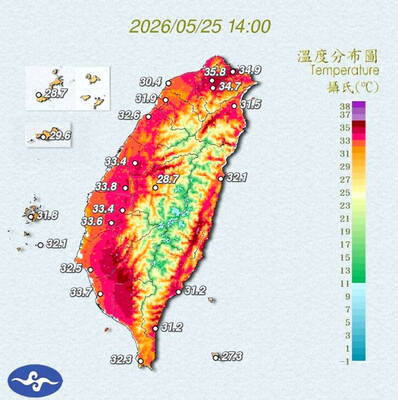
STAY COOL: The HPA recommended that people stay hydrated, use air-conditioning or fans while indoors, wear loose-fitting clothes and walk in the shade while outdoors Employers must implement measures such as installing cooling equipment, and providing drinking water and rest breaks for outdoor workers starting from Monday next week, the Taipei Department of Labor said on Sunday. Employers who fail to comply could face fines of NT$30,000 to NT$300,000 under the Occupational Safety and Health Act (職業安全衛生法), the department said. Businesses in Taipei employing fewer than 100 workers, as well as registered self-employed workers with labor insurance coverage, could receive on-site assessments and guidance from occupational safety consultants to help them apply for central government subsidies to implement or improve heat-protection measures, it said. Under the Ministry of

GLOBALGIVING: ‘ Caving to external pressure is not acceptable for an organization that has cultivated justice reform and human rights for 30 years,’ one NGO said A slew of non-government organizations (NGOs) have withdrawn from the GlobalGiving fundraising platform after it announced it would use “Chinese Taipei” instead of “Taiwan” from next month. The Taiwan Good Rice Association wrote on Facebook on Friday that it was informed on April 28 via a teleconference call of the change, which was made because the platform wanted to operate in China. Taiwan Good Rice is to terminate all cooperative relationships with GlobalGiving in response to the platform’s “unilateral and non-negotiable” decision to remove references to Taiwan, the NGO said. “Taiwan is in the official name of Taiwan Good Rice Association and the

Chinese Nationalist Party (KMT) Chairwoman Cheng Li-wun (鄭麗文) yesterday briefed her party’s Central Standing Committee regarding her scheduled visit to the US between Monday next week and June 16, saying that her purpose would be to persuade the US that the Republic of China (ROC) Constitution was a “one China” constitution that would foster stable and peaceful cross-strait relations. The ROC Constitution is the most important defense for all Taiwanese citizens, as it upholds our democracy and has contributed to our robust economy, which aligns with international and US interests, she said. “We would not be troublemakers and drag the US under,”


 RSS
RSS