


Democratic Progressive Party (DPP) Legislator Hung Sun-han (洪申翰) and civic groups yesterday introduced a draft act on climate change, urging the government to work with like-minded partners to advance climate action.
Such legislation is key to improving the nation’s global participation as well as local governance, Hung told a news conference in Taipei.
The goal is for the proposed rules to replace the Greenhouse Gas Reduction and Management Act (溫室氣體減量及管理法), which has proven to be incapable of curbing greenhouse gas emissions since its implementation in 2015, he said.
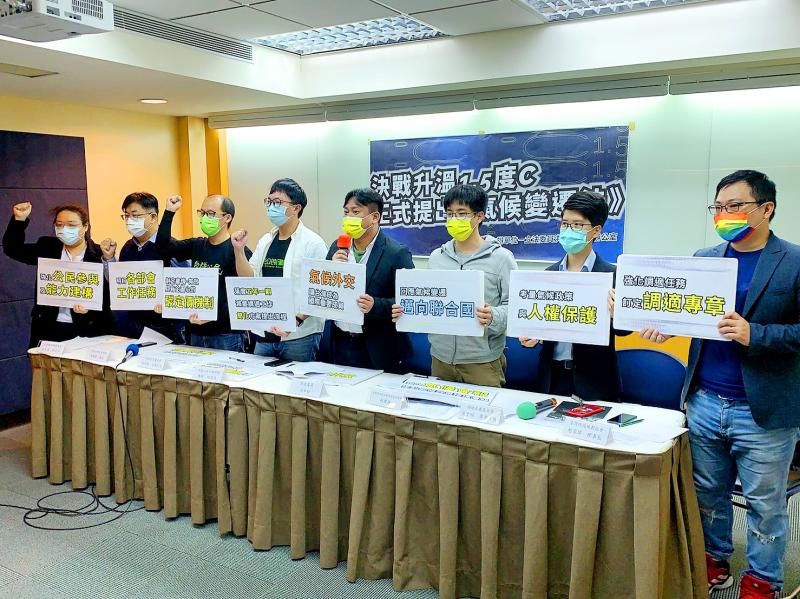
Photo courtesy of Hung Sun-han’s office
If promulgated, the bill would push the government to pledge to achieve net zero greenhouse gas emissions by 2050, instead of just halving the 2005 level as stipulated in the act.
It says that the government should impose a “carbon levy” and promote incentives for reducing carbon emissions.
The government should also establish a board at the Executive Yuan chaired by the premier that would oversee climate action at government agencies, the proposal says.
Record-high temperatures in Taiwan in July and water shortages that have affected agricultural irrigation highlight the urgency of a policy program that better addresses extreme weather events, Taiwan Environment and Planning Association chairman Chao Chia-wei (趙家緯) said.
The draft, which has a chapter on adaptation to climate change, promotes bottom-up and community-based action and policymaking grounded on scientific evidence, while clarifying the responsibilities of government agencies, Chao said.
The bill is not merely for environmental protection, but also to stimulate economic growth, Citizen of the Earth, Taiwan deputy executive director Tsai Chung-yueh (蔡中岳) said.
The EU’s carbon border adjustment mechanism would soon come into force and US president-elect Joe Biden is likely to follow suit, Tsai said, urging the government to join the trend, especially as the nation is blocked from the Regional Comprehensive Economic Partnership.
A carbon levy could assist with industrial transformation and aid people affected by the transformation, Tsai said.
Four other DPP lawmakers — Su Chiao-hui (蘇巧慧), Saidhai Tahovecahe, Chuang Ching-cheng (莊競程) and Lai Pin-yu (賴品妤) — who attended a news conference with Hung last month — have expressed support for the cause, Hung said, adding that he would rally more support from other lawmakers to arrange a review for the bill soon.
Hung echoed President Tsai Ing-wen’s (蔡英文) appeal for Taiwan to join the UN’s COP26 convention to be hosted by the UK in November next year.
Tsai Ing-wen, at a meeting with British Representative to Taiwan Catherine Nettleton at the Presidential Office in Taipei on Tuesday, expressed hope that the UK would support Taiwan’s bid to join the COP26.
Taiwan should seek to join as a signatory party, instead of just sending non-governmental organization representatives as it has done previously, Hung said.
The goal is politically challenging, but the government should let the world know that “Taiwan can help” rings true not just in curbing the COVID-19 pandemic, but in climate action as well, he said.

UPGRADE: The Kang Ding-class frigate is replacing its Chaparall missiles with Tien Chien II and Hua Yang VLS, which would provide it with long-range, 360° air defense Taiwan plans to produce 1,200 to 1,376 Hai Chien II missiles (海劍二, Sea Sword II) — also known as TC-2N — to serve as the standard air defense system of the navy’s surface combatant fleet, a source said yesterday. Last week, the Hai Chien II, the naval version of the Tien Kung II missile (天劍二, Sky Sword II), completed a live-fire test in waters off the National Chungshan Institute of Science and Technology’s Jiupeng facility (九鵬) in Pingtung County’s Manjhou Township (滿州). The MIM72 Chaparral and other dated air defense missiles that currently arm Taiwanese ships have inadequate range to combat Chinese

REASONS FOR TRAVEL: An assistant professor said that proposed amendments to penalize drivers if they used drugs overseas would not deter people from traveling People who operate a motor vehicle under the influence of marijuana would have their driver’s license revoked, even if they used the substance while overseas, the Ministry of Transportation and Communications said yesterday, citing proposed amendments to the Road Traffic Management and Penalty Act (道路交通管理處罰條例). The amendments would also authorize the government to revoke the licenses of people determined to have used Category 1 or Category 2 narcotics, even if they were not operating a vehicle while under the influence of drugs, as well as ban them from taking the license test for three years, the ministry said. People aged 18 or
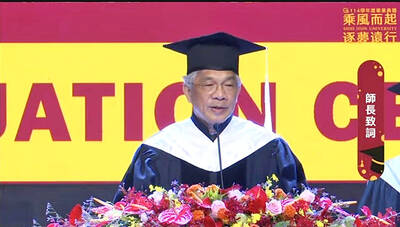
Shih Hsin University President Chen Ching-he (陳清河) yesterday issued a public apology for comments made in his commencement speech last week, stating that he has asked the school to suspend his duties and halt his wages for two months as a show of contrition. At the commencement ceremony on May 30, Chen said, “If you don’t manage your time well, or your own emotions, or your health, then I am telling every one of you — put a quick end to ‘you,’ because the world has no need for ‘you.’” The comments have sparked significant controversy online, and Chen through an open
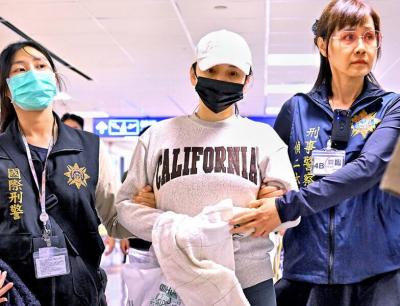
Johanne Liou (劉喬安), a Taiwanese woman who shot to unwanted fame during the Sunflower movement protests in 2014, returned to Taiwan last night after being deported from the US. She is to stand trial in Taiwan for charges involving embezzlement, fraud and drug crimes. The Criminal Investigation Bureau (CIB) said it took her into custody at Taiwan Taoyuan International Airport and would first question her before transferring her to the New Taipei District Prosecutors’ Office. She was arrested upon disembarking a flight from San Francisco that landed shortly before 7pm. Liou absconded to the US in 2019 after jumping bail


 RSS
RSS