


Authorities yesterday searched the office and residence of Chinese Nationalist Party (KMT) Legislator Wu I-ding (吳怡玎) in Kaohsiung, along with those of her family, as part of an investigation into alleged securities fraud, with investors in Pharmally International Holding Co losing an estimated NT$1.5 billion (US$52.05 million) after its stock price collapsed.
Phamally chairman Tony Huang (黃文烈), 59, has fled Taiwan and is reportedly hiding in Singapore, investigators said.
Huang is suspected of colluding with Chinese businesspeople to falsify company accounts and financial statements.
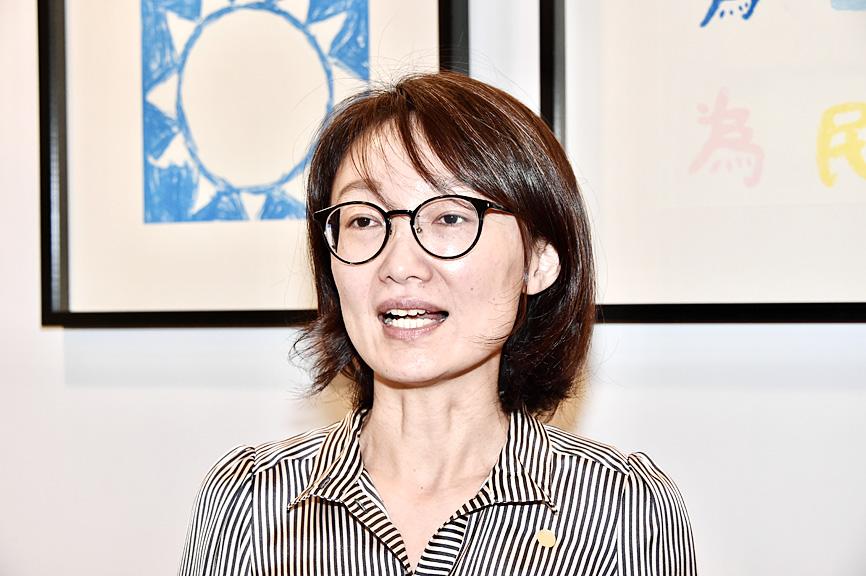
Photo: Tu Chien-jung, Taipei Times
Taipei prosecutors coordinated with Ministry of Justice Investigation Bureau (MJIB) units to carry out the searches, including the homes of Wu’s father, former KMT legislator Wu Kuang-hsun (吳光訓), her sister Wu Yi-li (吳怡利) and her brother Wu Yu-chan (吳郁展).
The investigators said that the Wu family is listed among the biotech firm’s top 10 shareholders.
It was the third round of searches and six people were summoned, with investigators focusing on Wu Kuang-hsun, who is suspected of using Wu Yi-li and Wu Yu-chan as dummy accounts to purchase Pharmally shares and warrants for stock speculation, prosecutors said.
They said they have evidence of Wu Kuang-hsun’s involvement, having uncovering falsified documents of him purchasing large numbers of Pharmally shares and warrants from Sept. 1 to Oct. 20, 2018, driving up the share price from NT$300 to NT$500, creating a deceptive impressive of a hot stock, then making a killing by selling before the price collapsed.
Another prominent figure summoned for questioning was Chen Yu-lien (陳玉蓮), a board member of Sanyo Whisbih Group, the manufacturer of the popular local tonic alcoholic drink Whisbih.
The suspects are facing charges of manipulating stock prices and contravening the Securities and Exchange Act (證券交易法).
The investigation was launched in August, with 14 people summoned for questioning at the time, while an international warrant has been issued for Huang’s arrest.
Huang touted Pharmally as a leading pharmaceutical and biotech business, but investigators said he worked with accountants to produce falsified records and financial reports to deceive investors, as well as the Financial Supervisory Commission.
Prosecutors alleged that Huang illegally transfered NT$700 million into his personal bank accounts, which have affected four of his lenders — Entie Commercial Bank, Far Eastern International Bank, Hua Nan Bank and Bank SinoPac.

Considering that most countries issue more than five denominations of banknotes, the central bank has decided to redesign all five denominations, the bank said as it prepares for the first major overhaul of the banknotes in more than 24 years. Central bank Governor Yang Chin-lung (楊金龍) is expected to report to the Legislative Yuan today on the bank’s operations and the redesign’s progress. The bank in a report sent to the legislature ahead of today’s meeting said it had commissioned a survey on the public’s preferences. Survey results showed that NT$100 and NT$1,000 banknotes are the most commonly used, while NT$200 and NT$2,000

The Centers for Disease Control (CDC) yesterday reported the first case of a new COVID-19 subvariant — BA.3.2 — in a 10-year-old Singaporean girl who had a fever upon arrival in Taiwan and tested positive for the disease. The girl left Taiwan on March 20 and the case did not have a direct impact on the local community, it said. The WHO added the BA.3.2 strain to its list of Variants Under Monitoring in December last year, but this was the first imported case of the COVID-19 variant in Taiwan, CDC Deputy Director-General Lin Ming-cheng (林明誠) said. The girl arrived in Taiwan on

South Korea is planning to revise its controversial electronic arrival card, a step Taiwanese officials said prompted them to hold off on planned retaliatory measures, a South Korean media report said yesterday. A Yonhap News Agency report said that the South Korean Ministry of Foreign Affairs is planning to remove the “previous departure place” and “next destination” fields from its e-arrival card system. The plan, reached after interagency consultations, is under review and aims to simplify entry procedures and align the electronic form with the paper version, a South Korean ministry official said. The fields — which appeared only on the electronic form

The Ministry of Foreign Affairs (MOFA) is suspending retaliation measures against South Korea that were set to take effect tomorrow, after Seoul said it is updating its e-arrival system, MOFA said today. The measures were to be a new round of retaliation after Taiwan on March 1 changed South Korea's designation on government-issued alien resident certificates held by South Korean nationals to "South Korea” from the "Republic of Korea," the country’s official name. The move came after months of protests to Seoul over its listing of Taiwan as "China (Taiwan)" in dropdown menus on its new online immigration entry system. MOFA last week


 RSS
RSS