


Taiwanese movie and television personalities have lost their competitiveness in China due to restrictions on creative expression there, a report commissioned by the Mainland Affairs Council said.
The council on Wednesday last week released the findings of the report, which examined the experiences of Taiwanese working in the movie and film industry who signed contracts in China in the past few years, following Beijing’s incentives to attract Taiwanese talent.
They were required to practice self-censorship and generally encountered difficulties in producing creative content in the face of restrictions imposed by the Chinese government, the report said.
In 2018, Beijing removed limits on the number of Taiwanese who could star in, or be involved in the production of, movies and TV series produced in China, as well as the limits on what percentage of the investment in such productions could come from Taiwanese investors.
China also introduced favorable employment terms for Taiwanese who traveled to China to work on such productions, the council said.
However, at the same time, China introduced restrictions that prohibited movies and TV shows from displaying certain things, such as “bizarre” crimes, “abnormal” sexual behavior, cigarette smoking and alcohol consumption, brawling and materialistic behavior, among other types of content, it said.
China also claimed to have eased the restrictions on the importation of Taiwanese movie and TV content, but in practice it allowed very few films and programs to be imported, it said.
Beijing also restricted the percentage of TV content produced outside of China that could be streamed online there to 30 percent.
Taiwanese traveling to China for work should be aware of the risks posed by China’s tightening of restrictions on expression, it said, citing singers A-mei (阿妹), Deserts Chang (張懸) and Chou Tzu-yu (周子瑜) as examples of Taiwanese artists who have been blacklisted in China over their statements.
The report suggested better cooperation between the government, academia and those in the TV and film industry, as well as the establishment of a platform to help producers with the distribution and marketing of their productions.
“What is needed is a cross-media platform that can expand the scope of Taiwanese TV and film, and can aid in bringing that content to viewers, free of any restraints imposed by foreign governments,” the council quoted the report as saying.
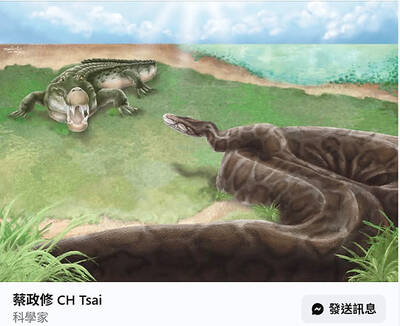
Taiwanese paleontologists have discovered fossil evidence that pythons up to 4m long inhabited Taiwan during the Pleistocene epoch, reporting their findings in the international scientific journal Historical Biology. National Taiwan University (NTU) Institute of Ecology and Evolutionary Biology associate professor Tsai Cheng-hsiu (蔡政修) led the team that discovered the largest snake fossil ever found in Taiwan. The single trunk vertebra was discovered in Tainan at the Chiting Formation, dated to between 400,000 and 800,000 years ago in the Middle Pleistocene, the paper said. The area also produced Taiwan’s first avian fossil, as well as crocodile, mammoth, saber-toothed cat and rhinoceros fossils, it said. Discoveries

Taiwanese paleontologists have discovered fossil evidence that pythons up to 4m long inhabited Taiwan during the Pleistocene epoch, reporting their findings in the international scientific journal Historical Biology. National Taiwan University (NTU) Institute of Ecology and Evolutionary Biology associate professor Tsai Cheng-hsiu (蔡政修) led the team that discovered the largest snake fossil ever found in Taiwan. A single trunk vertebra was discovered in Tainan at the Chiting Formation, dated to between 800,000 to 400,000 years ago in the Middle Pleistocene, the paper said. The area also produced Taiwan’s first avian fossil, as well as crocodile, mammoth, sabre-toothed cat and rhinoceros fossils, it said. Discoveries
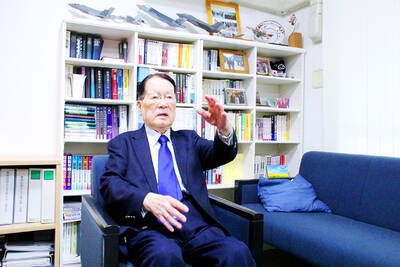
Whether Japan would help defend Taiwan in case of a cross-strait conflict would depend on the US and the extent to which Japan would be allowed to act under the US-Japan Security Treaty, former Japanese minister of defense Satoshi Morimoto said. As China has not given up on the idea of invading Taiwan by force, to what extent Japan could support US military action would hinge on Washington’s intention and its negotiation with Tokyo, Morimoto said in an interview with the Liberty Times (sister paper of the Taipei Times) yesterday. There has to be sufficient mutual recognition of how Japan could provide
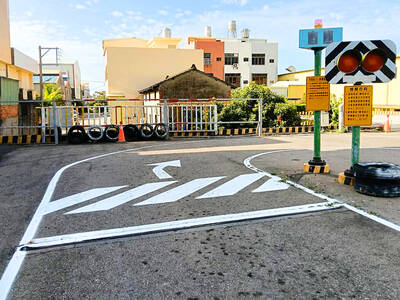
UPDATED TEST: The new rules aim to assess drivers’ awareness of risky behaviors and how they respond under certain circumstances, the Highway Bureau said Driver’s license applicants who fail to yield to pedestrians at intersections or to check blind spots, or omit pointing-and-calling procedures would fail the driving test, the Highway Bureau said yesterday. The change is set to be implemented at the end of the month, and is part of the bureau’s reform of the driving portion of the test, which has been criticized for failing to assess whether drivers can operate vehicles safely. Sedan drivers would be tested regarding yielding to pedestrians and turning their heads to check blind spots, while drivers of large vehicles would be tested on their familiarity with pointing-and-calling


 RSS
RSS