


A pack of 30 Taiwanese macaques overran a school in Yunlin County’s Linnei Township (林內) for about 30 minutes on Wednesday morning, destroying one surveillance camera as they tried to steal students’ breakfasts.
Macaque invasions have been happening for about a year, Yuanming Junior High School principal Ting Ching-feng (丁清?) said, adding that Wednesday’s incident had the largest group so far.
“Normally we only see groups of about 10 who try to slip into the school kitchen to steal some food,” Ting said.
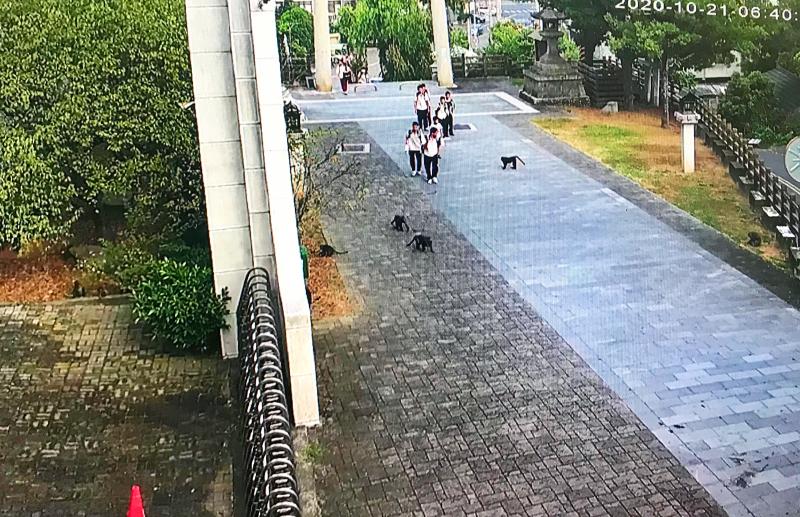
Photo provided by Yuanming Junior High School via CNA
The macaques wandered into the school, showing no fear of humans, and tried to grab the students’ breakfasts right out of their hands, Ting said.
They caroused around the school for about 30 minutes before the school faculty succeeded in chasing them away, although several macaques were seen loitering outside the school walls, Ting said.
Upon hearing of the incident, Yunlin County Councilor Chiu Shih-wen (邱世文) informed the Yunlin County Department of Agriculture, asking that the situation be resolved.
The school is near the Longguomai Path (龍過脈), so it is likely that the monkeys are visiting due to a food shortage in the mountains or because there are fewer tourists feeding them, Forestry Conservation Division Director Chang Wen-tung (張文東) said.
“We will continue to put up signs warning tourists not to feed macaques and will use public funds to purchase paintball guns so that the school can scare them off,” he said.
Yunlin County Department of Education Deputy Director Lin Hui-jung (林慧蓉) said the bureau would provide assistance to the school after it received the Department of Agriculture’s assessment.
Taiwanese macaques were on the conservation list from 1989 to 2019. Even though they are no longer on the list, the Wildlife Conservation Act (野生動物保育法) prohibits hunting or trapping them. Breaches of the act carry a fine of NT$60,000 to NT$300,000.

Considering that most countries issue more than five denominations of banknotes, the central bank has decided to redesign all five denominations, the bank said as it prepares for the first major overhaul of the banknotes in more than 24 years. Central bank Governor Yang Chin-lung (楊金龍) is expected to report to the Legislative Yuan today on the bank’s operations and the redesign’s progress. The bank in a report sent to the legislature ahead of today’s meeting said it had commissioned a survey on the public’s preferences. Survey results showed that NT$100 and NT$1,000 banknotes are the most commonly used, while NT$200 and NT$2,000

The Centers for Disease Control (CDC) yesterday reported the first case of a new COVID-19 subvariant — BA.3.2 — in a 10-year-old Singaporean girl who had a fever upon arrival in Taiwan and tested positive for the disease. The girl left Taiwan on March 20 and the case did not have a direct impact on the local community, it said. The WHO added the BA.3.2 strain to its list of Variants Under Monitoring in December last year, but this was the first imported case of the COVID-19 variant in Taiwan, CDC Deputy Director-General Lin Ming-cheng (林明誠) said. The girl arrived in Taiwan on

South Korea is planning to revise its controversial electronic arrival card, a step Taiwanese officials said prompted them to hold off on planned retaliatory measures, a South Korean media report said yesterday. A Yonhap News Agency report said that the South Korean Ministry of Foreign Affairs is planning to remove the “previous departure place” and “next destination” fields from its e-arrival card system. The plan, reached after interagency consultations, is under review and aims to simplify entry procedures and align the electronic form with the paper version, a South Korean ministry official said. The fields — which appeared only on the electronic form

The Ministry of Foreign Affairs (MOFA) is suspending retaliation measures against South Korea that were set to take effect tomorrow, after Seoul said it is updating its e-arrival system, MOFA said today. The measures were to be a new round of retaliation after Taiwan on March 1 changed South Korea's designation on government-issued alien resident certificates held by South Korean nationals to "South Korea” from the "Republic of Korea," the country’s official name. The move came after months of protests to Seoul over its listing of Taiwan as "China (Taiwan)" in dropdown menus on its new online immigration entry system. MOFA last week


 RSS
RSS