


Taipei and New Taipei City were on Wednesday chosen to jointly host the 2025 World Masters Games, defeating bids by Paris and Perth, Australia, to host the multi-sports event aimed at athletes of all abilities mostly over the age of 35.
The Games are held every four years, with the next edition to be hosted in Japan’s Kansai region.
Taipei Deputy Mayor Tsai Ping-kun (蔡炳坤) said that the board of the International Masters Games Association (IMGA) communicated its decision via video conference.
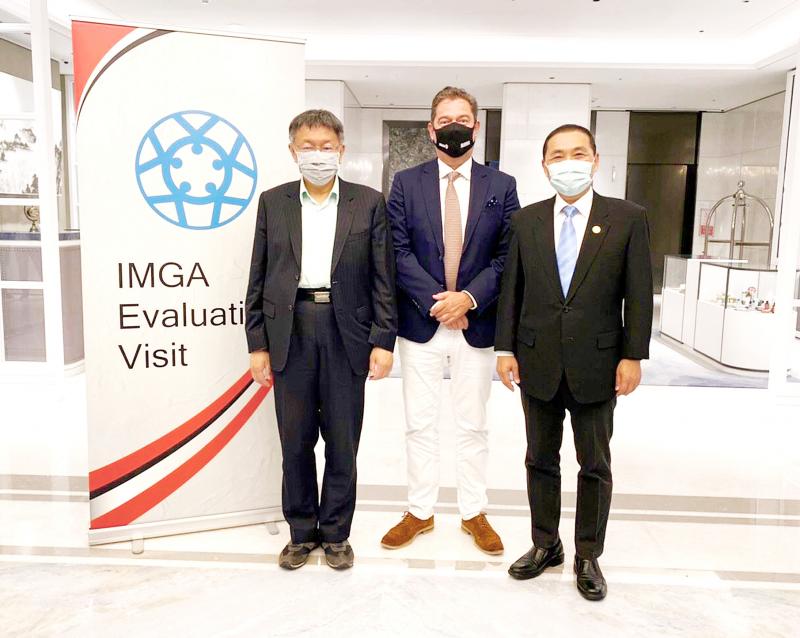
Photo courtesy of the Taipei Department of Sports via CNA
“We have in the past few years pursued opportunities to host international sports events and last year submitted our bid to host the World Masters. Taipei and New Taipei City have many venues to host the event,” Tsai said, adding that he also spoke on behalf of Taipei Mayor Ko Wen-je (柯文哲) and New Taipei City Mayor Hou You-yi (侯友宜).
Tsai said that the key to the winning bid was Taiwan successfully containing its outbreak of COVID-19.
IMGA president Kai Holm on Wednesday last week met with the cities’ mayors, who assured him that they were determined to host the Games, Tsai said, adding that Holm’s visit made Taiwan stand out from its competitors.
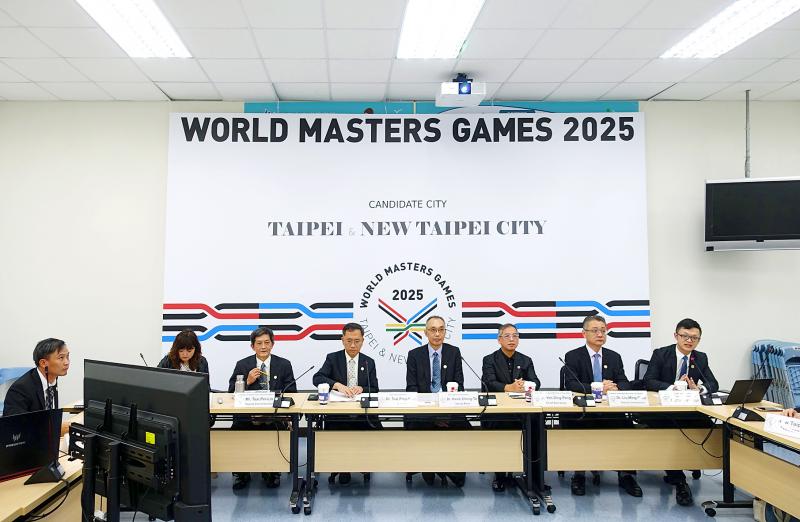
Photo courtesy of the Taipei Department of Sports via CNA
“We also showed the committee that we have experience after hosting the 2017 Summer Universiade. I believe that this also assured Holm that we are capable of hosting another large sports event,” he added.
The event is to be held from May 17 to 30, 2025, Tsai said, adding that some competitions would also be held in Taoyuan, and Hsinchu and Yilan counties. Tsai said that 70 venues were chosen to host the competitions in 32 sports and 14 others as training facilities for athletes. Of these 84 venues, 29 were also used in 2017, he added.
A total of 210 people in the host cities would be employed to prepare the Games, and 40,000 additional people would be needed during the two-week event, including 30,000 stationed at sports facilities, 4,500 staff members and professionals adjudicating the competitions, and 6,000 volunteers, he said.
“There are 1,694 hotels in Taipei, New Taipei City, Hsinchu and Yilan, with 70,388 rooms, enough to accommodate athletes and their families,” Tsai said.
About 15,000 athletes from 110 countries are expected to compete, Tsai said, adding that the event would boost the tourism industry.
The budget estimate for the event would be about NT$1.6 billion (US$55.36 million), with 40 percent coming from the central government and 60 percent from local governments, Tsai said, adding that the host cities are still to discuss how to divide the costs.
Asked if China had interfered during the selection process, Taipei Department of Sports Commissioner Li Tsai-li (李再立) said that cities rather than countries were behind the applications, and the chance of political interferences was low.
The event could help generate NT$10 billion in tourism revenue, Li said.

SECURITY: Starlink owner Elon Musk has taken pro-Beijing positions, and allowing pro-China companies to control Taiwan’s critical infrastructure is risky, a legislator said Starlink was reluctant to offer services in Taiwan because of the nation’s extremely high penetration rates in 4G and 5G services, the Ministry of Digital Affairs said yesterday. The ministry made the comments at a meeting of the legislature’s Transportation Committee, which reviewed amendments to Article 36 of the Telecommunications Management Act (電信管理法). Article 36 bans foreigners from holding more than 49 percent of shares in public telecommunications networks, while shares foreigners directly and indirectly hold are also capped at 60 percent of the total, unless specified otherwise by law. The amendments, sponsored by Chinese Nationalist Party (KMT) Legislator Ko

The military has spotted two Chinese warships operating in waters near Penghu County in the Taiwan Strait and sent its own naval and air forces to monitor the vessels, the Ministry of National Defense (MND) said. Beijing sends warships and warplanes into the waters and skies around Taiwan on an almost daily basis, drawing condemnation from Taipei. While the ministry offers daily updates on the locations of Chinese military aircraft, it only rarely gives details of where Chinese warships are operating, generally only when it detects aircraft carriers, as happened last week. A Chinese destroyer and a frigate entered waters to the southwest

The eastern extension of the Taipei MRT Red Line could begin operations as early as late June, the Taipei Department of Rapid Transit Systems said yesterday. Taipei Rapid Transit Corp said it is considering offering one month of free rides on the new section to mark its opening. Construction progress on the 1.4km extension, which is to run from the current terminal Xiangshan Station to a new eastern terminal, Guangci/Fengtian Temple Station, was 90.6 percent complete by the end of last month, the department said in a report to the Taipei City Council's Transportation Committee. While construction began in October 2016 with an

NON-RED SUPPLY: Boosting the nation’s drone industry is becoming increasingly urgent as China’s UAV dominance could become an issue in a crisis, an analyst said Taiwan’s drone exports to Europe grew 41.7-fold from 2024 to last year, with demand from Ukraine’s fight against Russian aggression the most likely driver of growth, a study showed. The Institute for Democracy, Society and Emerging Technology (DSET) in a statement on Wednesday said it found that many of Taiwan’s uncrewed aerial vehicle (UAV) sales were from Poland and the Czech Republic. These countries likely transferred the drones to Ukraine to aid it in its fight against the Russian invasion that started in 2022, it said. Despite the gains, Taiwan is not the dominant drone exporter to these markets, ranking second and fourth


 RSS
RSS