


The Taiwan Transportation Safety Board (TTSB) yesterday came under fire from members of the Legislative Yuan’s Transportation Committee over its release on Monday of the final investigation report on the 2018 derailment of a Puyuma Express train.
Board Chairman Young Hong-tsu (楊宏智) was at the committee meeting to brief lawmakers about the board’s performance over the past fiscal year and answer questions about its budget for the next fiscal year.
However, as yesterday was the second anniversary of the derailment, which killed 18 people and injured more than 200, the committee chairman, Democratic Progressive Party Legislator Chen Ou-po (陳歐珀), asked participants to stand for a minute of silence for the victims before starting the question-and-answer session.
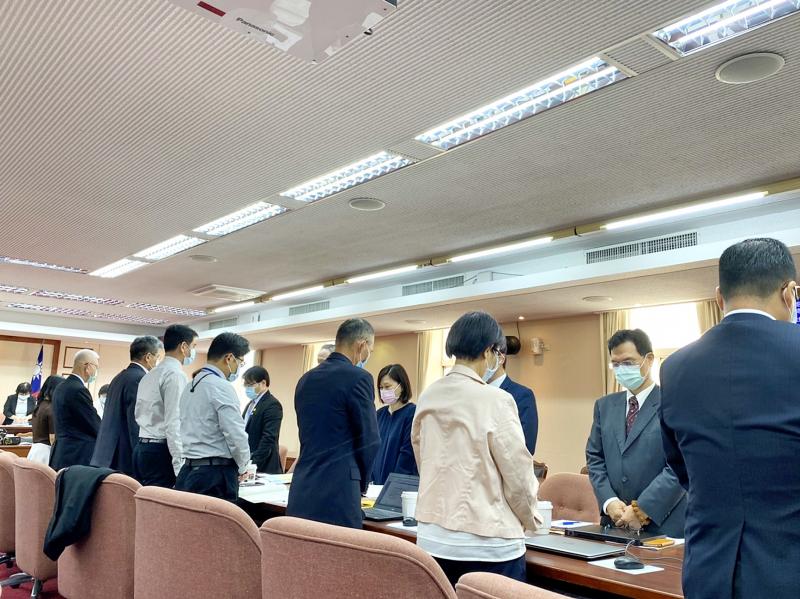
Photo: Hsiao Yu-hsin, Taipei Times
After that, lawmakers focused their questions on how the board released its 435-page report, the culmination of a year-long probe.
They criticized the board’s meeting with victims’ families on Sunday to tell them about the report, where the relatives were asked to sign non-disclosure agreements before the meeting began, even though the agreements had been designed for investigators working on the board’s probe and board members.
Young was also criticized for saying that the board would not give a media briefing when it released the report to avoid raising painful memories for family members, only for the board to notify reporters at 10:05am on Monday that it would hold a news conference at 10:30am to present the report.
There is nothing wrong with considering the feelings of family members, but what relatives want is the truth and to know that such a tragedy would not be repeated, lawmakers said.
The board decided to hold a news conference after family members said such an event would not hurt their feelings, and after it received requests for interviews from multiple media outlets, Young said.
The board rarely hosts an information session just for relatives, and Sunday’s was only the second time such an event was held, he said, adding that it meant the board’s staff also had to work overtime.
“We did notice that some of the family members refused to sign a non-disclosure agreement, but we did not ban them from attending the meeting. However, instead of voicing their disagreements at the meeting, they took the agreement and chose to talk to reporters downstairs about it,” he said.
The committee passed a resolution that the board should hold information sessions for victims’ families before releasing a final investigation report, unless the relatives live overseas or would have trouble attending such a meeting.
Young told lawmakers that the final report on the collapse of the Nanfangao Bridge in Yilan County’s Suao Township (蘇澳) on Oct. 1 last year would be made public on Nov.27.
He also confirmed that the board is investigating the May 19 accident near Taichung’s Chenggong Station (成功), when a Taiwan Railways Administration (TRA) commuter train hit a 44cm crack on a rail.
The TRA’s preliminary investigation found that the crack had been reported in March, but the track had not been replaced.
Minister of Transportation and Communications Lin Chia-lung (林佳龍) said that the TRA should fully cooperate with the board’s investigation and carry out all track checks requested by the board.
Senior TRA management would be held accountable for May incident, Lin said.

Considering that most countries issue more than five denominations of banknotes, the central bank has decided to redesign all five denominations, the bank said as it prepares for the first major overhaul of the banknotes in more than 24 years. Central bank Governor Yang Chin-lung (楊金龍) is expected to report to the Legislative Yuan today on the bank’s operations and the redesign’s progress. The bank in a report sent to the legislature ahead of today’s meeting said it had commissioned a survey on the public’s preferences. Survey results showed that NT$100 and NT$1,000 banknotes are the most commonly used, while NT$200 and NT$2,000

The Centers for Disease Control (CDC) yesterday reported the first case of a new COVID-19 subvariant — BA.3.2 — in a 10-year-old Singaporean girl who had a fever upon arrival in Taiwan and tested positive for the disease. The girl left Taiwan on March 20 and the case did not have a direct impact on the local community, it said. The WHO added the BA.3.2 strain to its list of Variants Under Monitoring in December last year, but this was the first imported case of the COVID-19 variant in Taiwan, CDC Deputy Director-General Lin Ming-cheng (林明誠) said. The girl arrived in Taiwan on

South Korea is planning to revise its controversial electronic arrival card, a step Taiwanese officials said prompted them to hold off on planned retaliatory measures, a South Korean media report said yesterday. A Yonhap News Agency report said that the South Korean Ministry of Foreign Affairs is planning to remove the “previous departure place” and “next destination” fields from its e-arrival card system. The plan, reached after interagency consultations, is under review and aims to simplify entry procedures and align the electronic form with the paper version, a South Korean ministry official said. The fields — which appeared only on the electronic form

The Ministry of Foreign Affairs (MOFA) is suspending retaliation measures against South Korea that were set to take effect tomorrow, after Seoul said it is updating its e-arrival system, MOFA said today. The measures were to be a new round of retaliation after Taiwan on March 1 changed South Korea's designation on government-issued alien resident certificates held by South Korean nationals to "South Korea” from the "Republic of Korea," the country’s official name. The move came after months of protests to Seoul over its listing of Taiwan as "China (Taiwan)" in dropdown menus on its new online immigration entry system. MOFA last week


 RSS
RSS