


The Railway Bureau yesterday began demolition of the last three homes standing in the way of a railway relocation project in Tainan, giving the families no choice but to leave the sites.
A home in East District (東) owned by Chen Chih-hsiao (陳致曉) was cordoned off at about 5am and the demolition began an hour later, after Chen’s elderly parents, his sisters, and several protesters were forced to vacate the property.
In North District (北), two houses owned by Huang Chun-hsiang (黃春香) were knocked down at about 7am, as several protesters were forced off the properties before the work started.
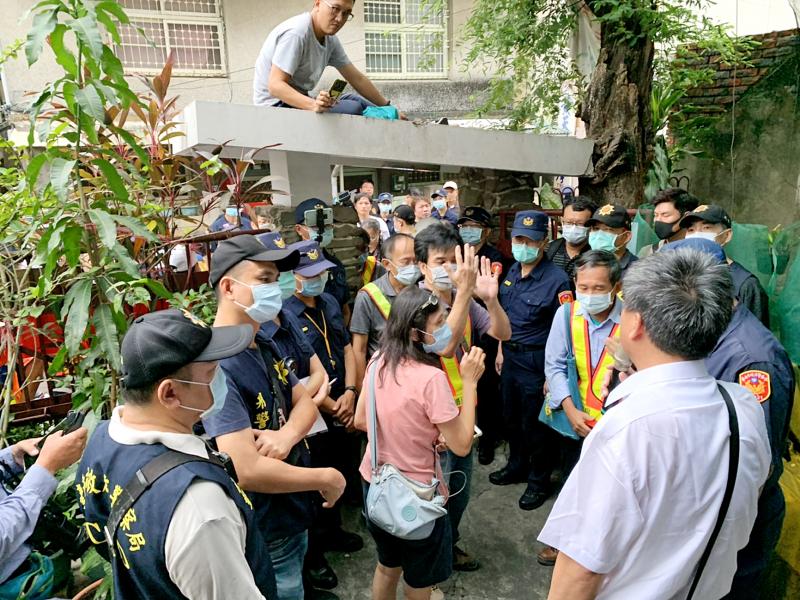
Photo: Liu Wan-chun, Taipei Times
The demolition of the three properties by the bureau’s central engineering office brought an end to a long standoff between homeowners and the local government over the project that is to relocate part of the Tainan railway line underground.
The project was initiated in 1993 and approved in 2009 by then-president Ma Ying-jeou (馬英九).
Work began in 2012, when Vice President Lai Ching-te (賴清德) was Tainan mayor.
The construction of the new underground rail segment required the demolition of 340 properties, a plan that was opposed by 121 of the homeowners.
Eventually, all except six of them yielded.
The city government began demolition of those six homes in June, forcing the families to vacate.
Huang and Chen were the last two holdouts.
Chen described the forced evacuation as “shameless.”
“First, the city government refused to hold negotiations with us, as we had requested to avoid demolition, then it suddenly decided to start the demolition during the negotiations,” Chen said. “I can only say that I had underestimated the shamelessness of the Democratic Progressive Party.”
Tainan Mayor Huang Wei-che (黃偉哲) said it was time to end the standoff, because the city residents want the project completed as soon as possible to avoid accidents, injuries and train delays.
The property owners would receive the best possible compensation, he said.
The rail relocation project was scheduled to be completed in 2024, but the date was pushed back to 2026 due to delays caused by protests and confrontations with some of the homeowners.
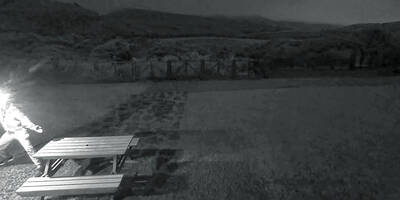
Yangmingshan National Park authorities yesterday urged visitors to respect public spaces and obey the law after a couple was caught on a camera livestream having sex at the park’s Qingtiangang (擎天崗) earlier in the day. The Shilin Police Precinct in Taipei said it has identified a suspect and his vehicle registration number, and would summon him for questioning. The case would be handled in accordance with public indecency charges, it added. The couple entered the park at about 11pm on Thursday and began fooling around by 1am yesterday, the police said, adding that the two were unaware of the park’s all-day live

A former soldier and an active-duty army officer were yesterday indicted for allegedly selling classified military training materials to a Chinese intelligence operative for a total of NT$79,440. The Taipei District Prosecutors’ Office indicted Chen Tai-yin (陳泰尹) and Lee Chun-ta (李俊達) for contravening the National Security Act (國家安全法) and the Anti-Corruption Act (貪污治罪條例). Chen left the military in September 2013 after serving alongside then-staff sergeant Lee, now an army lieutenant, at the 21st Artillery Command of the army’s Sixth Corps from 2011 to 2013, according to the indictment. Chen met a Chinese intelligence operative identified as “Wang” (王) through a friend in November

Minister of Digital Affairs Lin Yi-ching (林宜敬) yesterday cited regulatory issues and national security concerns as an expert said that Taiwan is among the few Asian regions without Starlink. Lin made the remarks on Facebook after funP Innovation Group chief executive officer Nathan Chiu (邱繼弘) on Friday said Taiwan and four other countries in Asia — China, North Korea, Afghanistan and Syria — have no access to Starlink. Starlink has become available in 166 countries worldwide, including Ukraine, Malaysia, the Philippines and Vietnam, in the six years since it became commercial, he said. While China and North Korea block Starlink, Syria is not
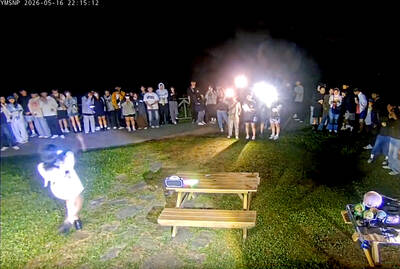
Yangmingshan National Park’s Qingtiangang (擎天崗) nature area has gone viral after a park livestream camera observed a couple in the throes of intimate congress, which was broadcast live on YouTube, drawing large late-night crowds and sparking a backlash over noise, bright lights and disruption to wildlife habitat. The area’s livestream footage appeared to show a couple engaging in sexual activity on a picnic table in the park on Friday last week, with the uncensored footage streamed publicly online. The footage quickly spread across social media, prompting a tide of visitors to travel to the site to “check in” and recreate the


 RSS
RSS