


The legislature yesterday ground to a halt as Chinese Nationalist Party (KMT) legislators occupied the speaker’s podium to prevent Premier Su Tseng-chang (蘇貞昌) from giving his first policy address of the session in protest at the Democratic Progressive Party’s (DPP) policies on US pork and beef imports.
Su was arrogant and offered false data when answering legislators’ questions at a briefing on the imports on Friday last week, KMT caucus whip Lin Wei-chou (林為洲) said.
“The administration of former president Ma Ying-jeou (馬英九) in 2012 only allowed the import of US beef from cattle aged 30 months or below, while it maintained a zero-tolerance policy for ractopamine residues in imported pork. DPP legislators in the same year voted unanimously to ban the import of US beef. As of 2016, the DPP still opposed the import of US pork containing ractopamine residues,” Lin said.
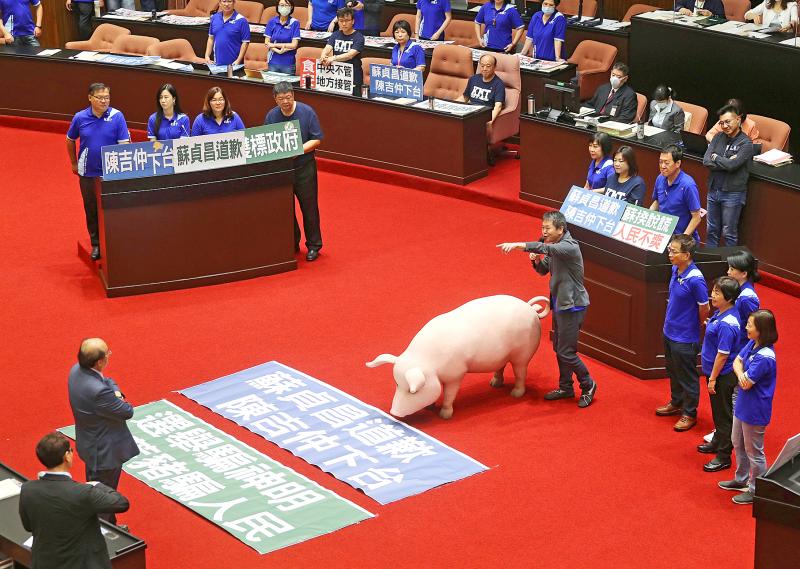
Photo: CNA
President Tsai Ing-wen (蔡英文) then on Aug. 28 announced that the nation would permit the import of pork and internal organs from the US, as well as US beef from cattle aged older than 30 months, starting next year, Lin said, adding that Su should apologize for such a drastic change in policy and a complete disregard for the health of the public.
During the plenary session on Friday last week, Su circumvented questions from legislators by preventing government officials from speaking and answering questions with questions, which shows that he completely disrespects legislators, Lin said.
Aside from asking Su to apologize, Lin said that Tsai should report to the legislature on the policy and Council of Agriculture Minister Chen Chi-chung (陳吉仲) should resign.
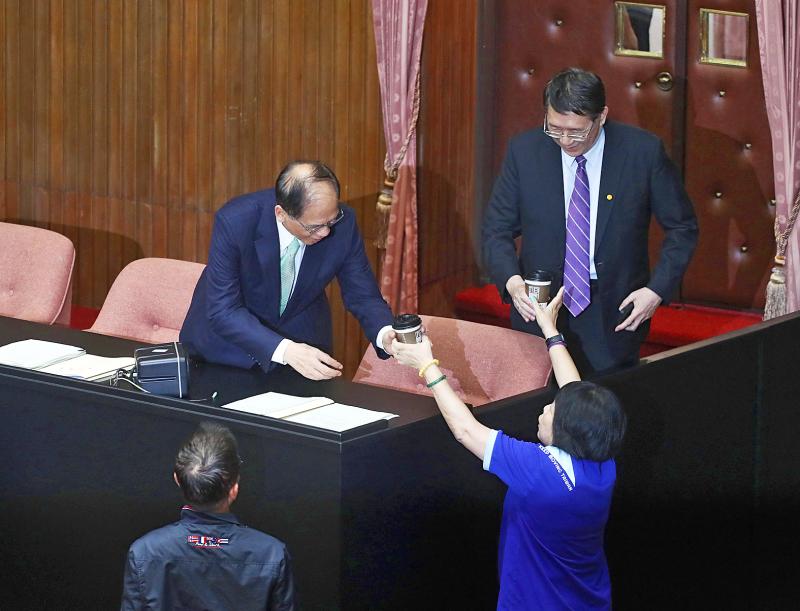
Photo: CNA
KMT Legislator Lai Shyh-bao (賴士葆) said that Su has made many contradictory remarks on the importation of US pork.
“If pork containing residues of ractopamine was safe to eat, then why is the Ministry of Education encouraging the use of Taiwanese pork in school lunches? Su said last week that Taiwanese are accustomed to eating Taiwanese pork, which tastes better. So why do we need to design a new label for Taiwanese pork? Why was the public review period for the US pork policy shortened from 60 days to seven days?” Lai asked.
Su “was lying to the gods, lying to Taiwanese and lying to Americans” when he said Taiwanese pork was the best, while also agreeing to allow imports of US pork, he said.
“Taiwan has gained absolutely nothing from saying that it is to allow imports of US pork. There is neither a trade and investment framework agreement nor a free-trade agreement with the US, not even a bilateral trade agreement. The policy only exposes Taiwanese to greater health risks,” Lai said.
DPP Legislator Chen Ting-fei (陳亭妃) said that she found the KMT’s tactics strange, adding that the party would only resort to boycotting Su’s policy address because it was afraid that its legislators would be outsmarted by the premier.
“They should express their opinions and concerns about US pork imports by grilling the premier with all the tough questions they have. If he became speechless, then that would have proved that they were right all along,” she said.
Taiwan People’s Party Legislator Chiu Chen-yuan (邱臣遠) said that he was angry and thought it was unfortunate that the KMT had obstructed the legislature in this way, as he had prepared many questions for Su.
Taiwan Statebuilding Party Legislator Chen Po-wei (陳柏惟) also criticized the KMT on social media, calling them giant babies from China.
They are like students who want to skip class and then lock the classroom so that other students cannot attend either, he said.
“Can’t these giant babies get lost if they do not want to work? They should not do this at the expense of other lawmakers’ right to question government officials,” he added.
New Power Party caucus whip Chiu Hsien-chih (邱顯智) said that he had prepared 30 slides and was ready to pepper Su with questions, and that the KMT’s unexpected move was upsetting.
“The party should not use an old trick that was used by lawmakers 20 to 30 years ago to avoid real debate. We hope that the KMT will stop what it is doing and let the premier give his address, so that all lawmakers have a chance to question him,” Chiu said.

Yangmingshan National Park authorities yesterday urged visitors to respect public spaces and obey the law after a couple was caught on a camera livestream having sex at the park’s Qingtiangang (擎天崗) earlier in the day. The Shilin Police Precinct in Taipei said it has identified a suspect and his vehicle registration number, and would summon him for questioning. The case would be handled in accordance with public indecency charges, it added. The couple entered the park at about 11pm on Thursday and began fooling around by 1am yesterday, the police said, adding that the two were unaware of the park’s all-day live

A former soldier and an active-duty army officer were yesterday indicted for allegedly selling classified military training materials to a Chinese intelligence operative for a total of NT$79,440. The Taipei District Prosecutors’ Office indicted Chen Tai-yin (陳泰尹) and Lee Chun-ta (李俊達) for contravening the National Security Act (國家安全法) and the Anti-Corruption Act (貪污治罪條例). Chen left the military in September 2013 after serving alongside then-staff sergeant Lee, now an army lieutenant, at the 21st Artillery Command of the army’s Sixth Corps from 2011 to 2013, according to the indictment. Chen met a Chinese intelligence operative identified as “Wang” (王) through a friend in November

Minister of Digital Affairs Lin Yi-ching (林宜敬) yesterday cited regulatory issues and national security concerns as an expert said that Taiwan is among the few Asian regions without Starlink. Lin made the remarks on Facebook after funP Innovation Group chief executive officer Nathan Chiu (邱繼弘) on Friday said Taiwan and four other countries in Asia — China, North Korea, Afghanistan and Syria — have no access to Starlink. Starlink has become available in 166 countries worldwide, including Ukraine, Malaysia, the Philippines and Vietnam, in the six years since it became commercial, he said. While China and North Korea block Starlink, Syria is not
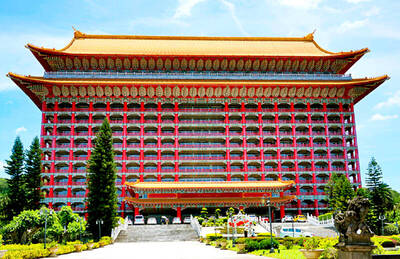
The Grand Hotel Taipei has rejected media reports claiming that the hotel had prevented CBS from broadcasting coverage of the Beijing summit between U.S. President Donald Trump and Chinese President Xi Jinping (習近平) on its premises. Media reports alleging that the hotel owner, dissatisfied with CBS’s coverage, prohibited the network from broadcasting political content on the hotel premises, are not true, the hotel said in a statement issued last night. The reports were “inconsistent with how the hotel actually handled the matter,” it said. The hotel said it received a refund request from a


 RSS
RSS