


The Central Epidemic Command Center (CECC) yesterday urged people undergoing a 14-day mandatory quarantine and those in mandatory seven-day self-health management to abide by the rules, as 899 people have been fined for violations.
However, the center reported no new case of COVID-19 and the number of confirmed cases in the nation remains at 495.
Minister of Health and Welfare Chen Shih-chung (陳時中), head of the center, also said that Vietnam has been moved to the list of “low infection risk countries or areas,” from which short-term business travelers can apply for a shorter quarantine period of five days.
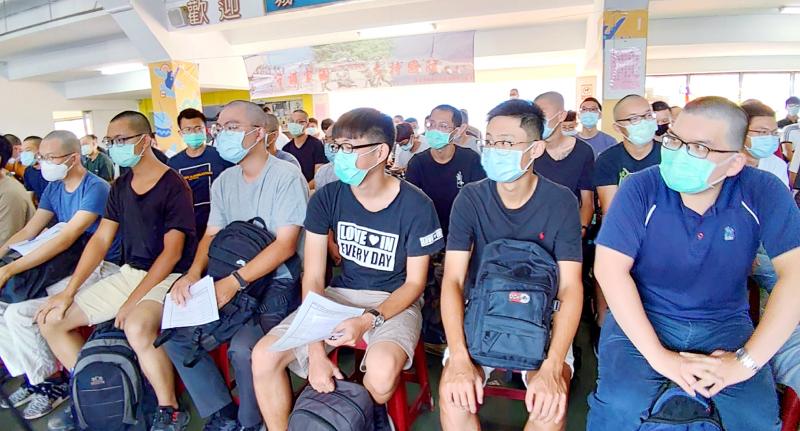
Photo: Lin Yi-chang, Taipei Times, courtesy of Chiayi City Councilor Cheng Kuang-hung’s office
Meanwhile, Hong Kong has been moved to the list of “low to medium infection risk countries or areas,” for which the quarantine period can be shortened to seven days upon approved application, Chen added.
He said that the center in the past few weeks noticed that some people have let their guard down and neglected the quarantine orders, citing local news reports on Tuesday about the chairman of a New Taipei City-based company being fined NT$500,000 (US$16,932) for violating quarantine rules.
Kang Hsuan Educational Publishing Group chairman Mike Lee (李萬吉) was reported to have left his home quarantine to exercise and attend business meetings at his company, after having returned from China. The company issued a statement on Tuesday saying that Lee appologize for his behavior.
Deputy Minister of the Interior Chen Tsung-yen (陳宗彥), who is also the deputy head of the center, said that Lee had left his mobile phone at home so that the “electronic fence” system could not track him.
The system notifies police if people leave their quarantine locations or turn off their mobile phones.
Among more than 270,000 people who have been put under quarantine in Taiwan, the violation rate is below 0.35 percent, he said, adding that Lee represents a very rare case.
The fines imposed on 899 people total NT$116.04 million, he said.
Local media yesterday reported the case of a 26-year-old military draftee who did not report to his unit about having had close contact with his brother, who is under home quarantine after returning from Spain on Friday last week, before boarding a bus with 30 other draftees.
All the draftees on the bus were later put under home quarantine.
Asked about the case, Centers for Disease Control (CDC) Deputy Director-General Chuang Jen-hsiang (莊人祥), who is also the CECC spokesman, said the man and his brother had stayed on different floors with separate bathrooms at their home, but had close contact for a short period of time.
However, as the brother is not a confirmed COVID-19 case, those who had close contact with him are not required to quarantine under CECC guidelines, and the decision to impose quarantines was made by the military, Chuang said.
In addition, Chen Shih-chung said that people who purchased masks with “Carry mask” imprints through the government’s rationing system could still exchange them for new ones at National Health Insurance-contracted pharmacies and local public health centers after Friday, the original deadline.

The Centers for Disease Control (CDC) yesterday reported the first case of a new COVID-19 subvariant — BA.3.2 — in a 10-year-old Singaporean girl who had a fever upon arrival in Taiwan and tested positive for the disease. The girl left Taiwan on March 20 and the case did not have a direct impact on the local community, it said. The WHO added the BA.3.2 strain to its list of Variants Under Monitoring in December last year, but this was the first imported case of the COVID-19 variant in Taiwan, CDC Deputy Director-General Lin Ming-cheng (林明誠) said. The girl arrived in Taiwan on

South Korea is planning to revise its controversial electronic arrival card, a step Taiwanese officials said prompted them to hold off on planned retaliatory measures, a South Korean media report said yesterday. A Yonhap News Agency report said that the South Korean Ministry of Foreign Affairs is planning to remove the “previous departure place” and “next destination” fields from its e-arrival card system. The plan, reached after interagency consultations, is under review and aims to simplify entry procedures and align the electronic form with the paper version, a South Korean ministry official said. The fields — which appeared only on the electronic form

The Ministry of Foreign Affairs (MOFA) is suspending retaliation measures against South Korea that were set to take effect tomorrow, after Seoul said it is updating its e-arrival system, MOFA said today. The measures were to be a new round of retaliation after Taiwan on March 1 changed South Korea's designation on government-issued alien resident certificates held by South Korean nationals to "South Korea” from the "Republic of Korea," the country’s official name. The move came after months of protests to Seoul over its listing of Taiwan as "China (Taiwan)" in dropdown menus on its new online immigration entry system. MOFA last week
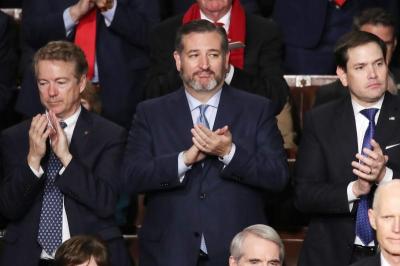
A bipartisan group of US senators has introduced a bill to enhance cooperation with Taiwan on drone development and to reduce reliance on supply chains linked to China. The proposed Blue Skies for Taiwan Act of 2026 was introduced by Republican US senators Ted Cruz and John Curtis, and Democratic US senators Jeff Merkley and Andy Kim. The legislation seeks to ease constraints on Taiwan-US cooperation in uncrewed aerial systems (UAS), including dependence on China-sourced components, limited access to capital and regulatory barriers under US export controls, a news release issued by Cruz on Wednesday said. The bill would establish a "Blue UAS


 RSS
RSS