


Taiwan faces a number of challenges amid the current US-China conflict, Chinese Nationalist Party (KMT) politicians and academics told a discussion hosted by the party’s National Policy Foundation in Taipei yesterday.
Taiwan’s current situation is reminiscent of an African proverb: “When elephants fight, it is the grass that suffers,” said former KMT legislator Lin Yu-fang (林郁方), convener of the foundation’s national security division.
While Taiwan is not an “elephant” and does not have the ability to intervene in the struggle between the US and China, it does not want to become the grass trampled by the elephants, Lin said.
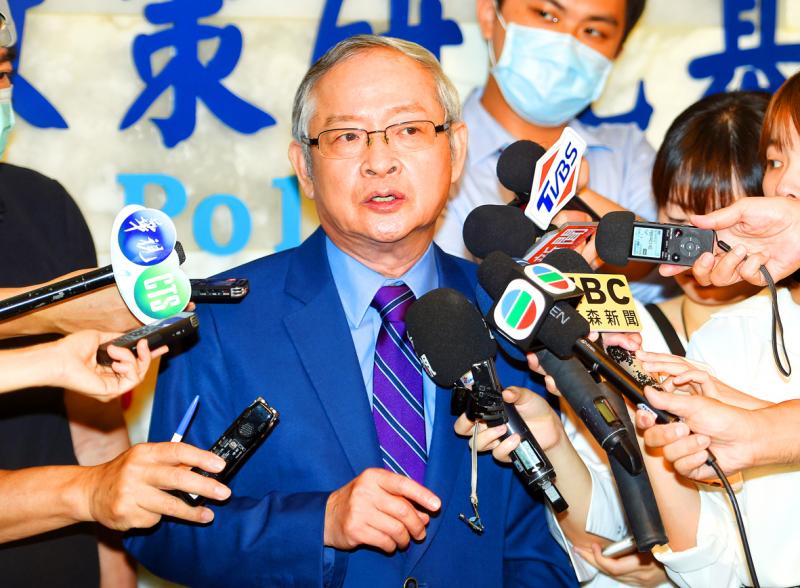
Photo: Liu Hsin-de, Taipei Times
To maintain cross-strait peace, President Tsai Ing-wen’s (蔡英文) administration should propose “creative” solutions to Beijing to restore official channels for communication, he said.
During former president Ma Ying-jeou’s (馬英九) eight years in office, discussions of the world’s hotspots by international experts did not include the Taiwan Strait, former Mainland Affairs Council minister Andrew Hsia (夏立言) said.
However, now almost everyone wonders whether there will be a war between the US and China, and whether there will be a conflict in the Strait, he said.
Given the ongoing US-China disputes, the US presidential election on Nov. 3 could be a dangerous time, Hsia said.
Taiwan’s leaders, politicians or commentators should not use the word “war” lightly, Hsia said, adding that it is the responsibility of government leaders to maintain peace.
“A new cold war” is a good term for describing the US-China situation, said Huang Kwei-bo (黃奎博), head of the Center for Foreign Policy Studies at National Chengchi University’s College of International Affairs.
The president, who is elected by the people, should make strategic judgements for the nation, and one of Tsai’s is to have Taiwan “stand at the forefront of the world’s resistance to China,” Huang said.
Tsai’s administration needs to explain to the public why Taiwan should take this stance, instead of pursuing coexistence, or even peace and prosperity, he said.
Under the Democratic Progressive Party’s rule, cross-strait relations are “not very important,” and it has allowed relations to deteriorate as a way of building its domestic political capital, he added.
Japanese columnist Yoshihiko Honda told the attendees that on the surface, Japan’s diplomacy looks very biased toward the US.
However, over the past seven years under Japanese Prime Minister Shinzo Abe, and the time that US President Donald Trump has been in office, Tokyo has attached great importance to neighboring countries, including Russia and China, he said.
The US is not as reliable as it once was, but Japan cannot afford a large military budget, so under such circumstances, its “only” approach is to establish stable relations with its neighbors, he said.
Over the past four years, Japan has been handling its relations with the US and China very carefully, and he expects it to continue to do so over the next few years whether Trump wins in November, Honda said.

Taiwan is to receive the first batch of Lockheed Martin F-16 Block 70 jets from the US late this month, a defense official said yesterday, after a year-long delay due to a logjam in US arms deliveries. Completing the NT$247.2 billion (US$7.69 billion) arms deal for 66 jets would make Taiwan the third nation in the world to receive factory-fresh advanced fighter jets of the same make and model, following Bahrain and Slovakia, the official said on condition of anonymity. F-16 Block 70/72 are newly manufactured F-16 jets built by Lockheed Martin to the standards of the F-16V upgrade package. Republic of China

Taiwan-Japan Travel Passes are available for use on public transit networks in the two countries, Taoyuan Metro Corp said yesterday, adding that discounts of up to 7 percent are available. Taoyuan Metro, the Taipei MRT and Japan’s Keisei Electric Railway teamed up to develop the pass. Taoyuan Metro operates the Taiwan Taoyuan International Airport MRT Line, while Keisei Electric Railway offers express services between Tokyo’s Narita Airport, and the Keisei Ueno and Nippori stations in the Japanese capital, as well as between Narita and Haneda airports. The basic package comprises one one-way ticket on the Taoyuan MRT Line and one Skyliner ticket on

Starlux Airlines, Taiwan’s newest international carrier, has announced it would apply to join the Oneworld global airline alliance before the end of next year. In an investor conference on Monday, Starlux Airlines chief executive officer Glenn Chai (翟健華) said joining the alliance would help it access Taiwan. Chai said that if accepted, Starlux would work with other airlines in the alliance on flight schedules, passenger transits and frequent flyer programs. The Oneworld alliance has 13 members, including American Airlines, British Airways, Cathay Pacific and Qantas, and serves more than 900 destinations in 170 territories. Joining Oneworld would also help boost

A new tropical storm formed late yesterday near Guam and is to approach closest to Taiwan on Thursday, the Central Weather Administration (CWA) said. Tropical Storm Pulasan became the 14th named storm of the year at 9:25pm yesterday, the agency said. As of 8am today, it was near Guam traveling northwest at 21kph, it said. The storm’s structure is relatively loose and conditions for strengthening are limited, WeatherRisk analyst Wu Sheng-yu (吳聖宇) said on Facebook. Its path is likely to be similar to Typhoon Bebinca, which passed north of Taiwan over Japan’s Ryukyu Islands and made landfall in Shanghai this morning, he said. However, it


 RSS
RSS