


While conventional war between Taiwan and China is unlikely, low-intensity conflict is a possibility, security analysts said in Taipei.
In light of an increase in military activity conducted near Taiwan by China, it would be advisable for the military to be on the alert for low-intensity conflict, which can start with very little warning, retired air force deputy commander Lieutenant General Chang Yen-ting (張延廷) told a security forum on Tuesday.
The hotspots for potential low-intensity armed conflict include the Pratas Islands (Dongsha Islands, 東沙群島) and Itu Aba Island (Taiping Island, 太平島) in the South China Sea, as well as Wuciou Township (烏坵) in Kinmen County, which are all under Taiwan’s jurisdiction, Chang said.
One common characteristic of the islands is that they are “easy to attack, but difficult to defend,” he said.
Yuan Ze University social and policy sciences professor Chen Ching-pu (陳勁甫) said that a military conflict between Taiwan and China is not a remote possibility, as they have been testing each other’s red line on various issues.
The two sides should reduce hostilities and avoid such a crisis, as there would be no winner in a war, Chen said.
Former National Security Bureau director Tsai De-sheng (蔡得勝) said that nationalistic sentiment is high in China due to the political developments in Hong Kong, the pressure resulting from the COVID-19 pandemic and the worry that Taiwan might move toward independence.
Beijing might take a tougher stance in the region to divert domestic attention from those issues, which could lead to a more complicated regional situation, Tsai said.
Institute for National Defense and Security Research research fellow Shu Hsiao-huang (舒孝煌) said that accidental encounters between China and the US are possible, despite the preventive mechanisms that are in place.
The two nations differ on many regional issues, and both have been conducting military maneuvers near the Korean Peninsula, and in the Taiwan Strait and the South China Sea, Shu said.
Although their restrained actions indicate that neither side wants a conflict, they are obviously both preparing for such an eventuality, Shu added.
There were 18 instances of US military ships or planes passing near Taiwan last month, while Chinese military assets were spotted 13 times, according to the July 3 edition of Defense Security magazine.

Yangmingshan National Park authorities yesterday urged visitors to respect public spaces and obey the law after a couple was caught on a camera livestream having sex at the park’s Qingtiangang (擎天崗) earlier in the day. The Shilin Police Precinct in Taipei said it has identified a suspect and his vehicle registration number, and would summon him for questioning. The case would be handled in accordance with public indecency charges, it added. The couple entered the park at about 11pm on Thursday and began fooling around by 1am yesterday, the police said, adding that the two were unaware of the park’s all-day live
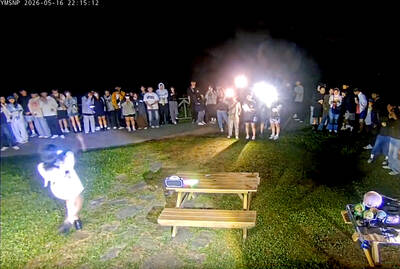
Yangmingshan National Park’s Qingtiangang (擎天崗) nature area has gone viral after a park livestream camera observed a couple in the throes of intimate congress, which was broadcast live on YouTube, drawing large late-night crowds and sparking a backlash over noise, bright lights and disruption to wildlife habitat. The area’s livestream footage appeared to show a couple engaging in sexual activity on a picnic table in the park on Friday last week, with the uncensored footage streamed publicly online. The footage quickly spread across social media, prompting a tide of visitors to travel to the site to “check in” and recreate the
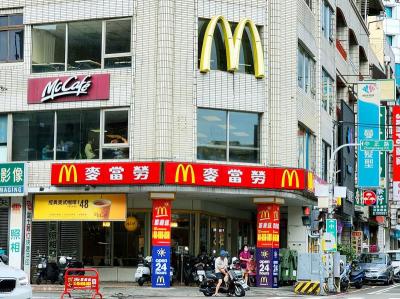
Fast food chain McDonald's is to raise prices by up to NT$5 on some products at its restaurants across Taiwan, starting on Wednesday next week, the company announced today. The prices of all extra value meals and sharing boxes are to increase by NT$5, while breakfast combos and creamy corn soup would go up by NT$3, the company said in a statement. The price of the main items of those meals, if ordered individually, would remain the same. Meanwhile, the price of a medium-sized lemon iced tea and hot cappuccino would rise by NT$3, extra dipping sauces for chicken nuggets would go up

Minister of Digital Affairs Lin Yi-ching (林宜敬) yesterday cited regulatory issues and national security concerns as an expert said that Taiwan is among the few Asian regions without Starlink. Lin made the remarks on Facebook after funP Innovation Group chief executive officer Nathan Chiu (邱繼弘) on Friday said Taiwan and four other countries in Asia — China, North Korea, Afghanistan and Syria — have no access to Starlink. Starlink has become available in 166 countries worldwide, including Ukraine, Malaysia, the Philippines and Vietnam, in the six years since it became commercial, he said. While China and North Korea block Starlink, Syria is not


 RSS
RSS