


An exhibition featuring hundreds of insect-themed postage stamps from around the world is on display at the National Museum of Natural Science in Taichung.
Stamps are like “miniature versions of encyclopedias,” the Ministry of Education, which runs the museum, said in a statement yesterday.
Besides enabling correspondence, stamps, from a humanities perspective, contain designs that can express regional characteristics, natural landscapes and major historical events, the ministry said.
From a scientific and cultural viewpoint, they bear the imprint of the times, and reflect scientific developments and social changes, it said.
The insect collection at the museum is not only the best in Taiwan, but also a leading one in Asia, museum director-deneral Sun Wei-hsin (孫維新) said in a statement.
Unlike other insect-themed exhibitions the museum has held, “Insects on Stamps” (郵說昆蟲) introduces the science and wonder of insects to viewers through the stamps, he said.
The exhibition, which opened on June 24, is divided into five sections: “Successful Adaptation,” “Spinning Silk to Make Cocoons,” “All About Bees,” “The Human-Mosquito War” and “Coexistence of Humans and Insects.”
It was co-organized by the Postal Museum, the Miaoli District Agricultural Research and Extension Station, National Taiwan University’s Department of Public Health and the Chinese Culture and Fine Arts Philatelic Association.
In addition to stamps from around the world, the exhibition also features nearly 100 insect specimens and silk products, the ministry said, encouraging visitors to use the magnifying glasses at the exhibition to get a closer look at the exhibits.
A BBC video introducing the mysteries of insects would also be played at the exhibition, it said.
“Insects have flourished on Earth for more than 300 million years,” the National Museum of Natural Science said.
“Through morphological, physiological, biochemical and reproductive adaptations, they have adjusted to changes in the environment,” it said, adding that they are important components of the Earth’s biosphere.
The ministry hopes the exhibition will enable viewers to not only appreciate the beauty of stamps and explore the insect world, but also consider the relationship between humans and insects, and how they can coexist in harmony, it said.
Postal Museum director Wang Chun-ju (王君如) said in a statement that she hopes the exhibition will inspire among the public a passion for stamp collecting.
From Wednesday next week to Aug. 30, the National Museum of Natural Science, typically closed on Mondays, would be open daily, it said.
Insects on Stamps runs through Feb. 21 next year.

LOUD AND PROUD Taiwan might have taken a drubbing against Australia and Japan, but you might not know it from the enthusiasm and numbers of the fans Taiwan might not be expected to win the World Baseball Classic (WBC) but their fans are making their presence felt in Tokyo, with tens of thousands decked out in the team’s blue, blowing horns and singing songs. Taiwanese fans have packed out the Tokyo Dome for all three of their games so far and even threatened to drown out home team supporters when their team played Japan on Friday. They blew trumpets, chanted for their favorite players and had their own cheerleading squad who dance on a stage during the game. The team struggled to match that exuberance on the field, with
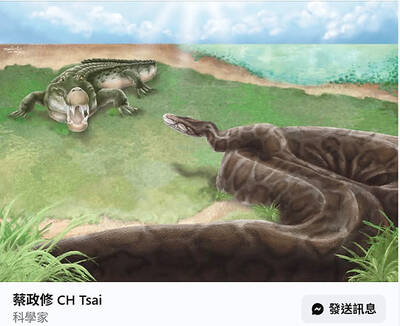
Taiwanese paleontologists have discovered fossil evidence that pythons up to 4m long inhabited Taiwan during the Pleistocene epoch, reporting their findings in the international scientific journal Historical Biology. National Taiwan University (NTU) Institute of Ecology and Evolutionary Biology associate professor Tsai Cheng-hsiu (蔡政修) led the team that discovered the largest snake fossil ever found in Taiwan. The single trunk vertebra was discovered in Tainan at the Chiting Formation, dated to between 400,000 and 800,000 years ago in the Middle Pleistocene, the paper said. The area also produced Taiwan’s first avian fossil, as well as crocodile, mammoth, saber-toothed cat and rhinoceros fossils, it said. Discoveries

Taiwanese paleontologists have discovered fossil evidence that pythons up to 4m long inhabited Taiwan during the Pleistocene epoch, reporting their findings in the international scientific journal Historical Biology. National Taiwan University (NTU) Institute of Ecology and Evolutionary Biology associate professor Tsai Cheng-hsiu (蔡政修) led the team that discovered the largest snake fossil ever found in Taiwan. A single trunk vertebra was discovered in Tainan at the Chiting Formation, dated to between 800,000 to 400,000 years ago in the Middle Pleistocene, the paper said. The area also produced Taiwan’s first avian fossil, as well as crocodile, mammoth, sabre-toothed cat and rhinoceros fossils, it said. Discoveries

Whether Japan would help defend Taiwan in case of a cross-strait conflict would depend on the US and the extent to which Japan would be allowed to act under the US-Japan Security Treaty, former Japanese minister of defense Satoshi Morimoto said. As China has not given up on the idea of invading Taiwan by force, to what extent Japan could support US military action would hinge on Washington’s intention and its negotiation with Tokyo, Morimoto said in an interview with the Liberty Times (sister paper of the Taipei Times) yesterday. There has to be sufficient mutual recognition of how Japan could provide


 RSS
RSS