


A photography exhibition on South Korea’s democratization opened yesterday at the National 228 Memorial Museum in Taipei.
The exhibition, titled 1987 Awakening of the People (1987人民覺醒: 韓國民主見證影像展), showcases dozens of photographs taken in the streets of South Korea during the June Democratic Struggle, a nationwide pro-democracy movement with mass protests in Seoul from June 10 to June 29, 1987, which forced the government at the time to begin making democratic reforms and hold elections.
The photographs were taken by Rick Chu (朱立熙), CEO of the Taiwan-based Korean Studies Academy, who was a photojournalist stationed in Seoul between 1985 and 1988.
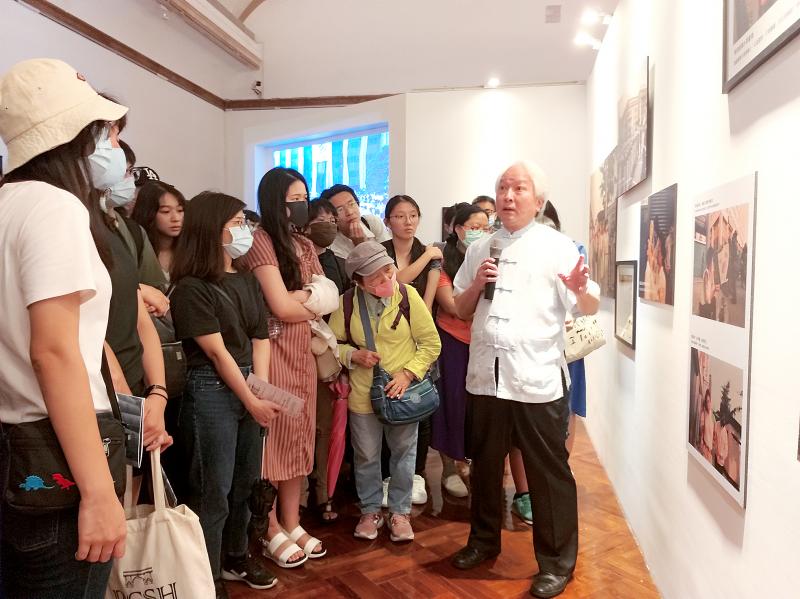
Photo: Chen Yu-hsun, Taipei Times
During the opening, Chu gave a guided tour to dozens of visitors, mostly young people, sharing his recollections of being on the front lines of the protests and the stories behind the photographs.
One of the photographs shows a man in a black suit with plastic wrap covering his eyes, standing on the street calling to drivers to honk their horns as part of the protest against the authoritarian regime.
Several photographs showed clashes between students and police.
Also included are photographs of the national funeral of Lee Han-yeol, a Yonsei University student who was seriously injured and died after a tear gas grenade penetrated his skull during the protests. More than a million people attended Lee’s funeral.
Chu said the road to democracy in Taiwan and South Korea occurred at about the same time, starting with the 1979 Kaohsiung Incident that led to demonstrations and the lifting of Martial Law in July 1987, and in South Korea with the 1980 Gwangju Uprising.
The Kaohsiung Incident, also known as the Formosa Incident, refers to a police crackdown, under the then-Chinese Nationalist Party (KMT) regime, on a rally held by Formosa Magazine and opposition politicians on Dec. 10, 1979, to mark Human Rights Day.
The two nation achieved democracy from the bottom up, with the people’s demonstrations forcing the authoritarian regimes to give in, Chu said.
“Without the sacrifice and dedication of previous activists, there would be no democracy, freedom and human rights today,” he said.
Quoting South Korean independence activist Sin Chae-ho, Chu said: “A nation that forgets its history does not have a future.”
Chu added that Taiwanese should be conscious of history.
The exhibition runs through Sept. 27.
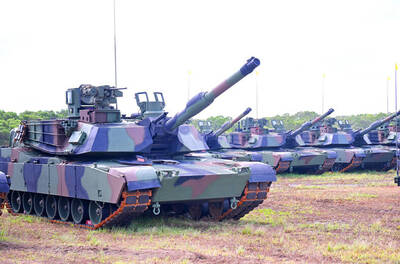
The manufacture of the remaining 28 M1A2T Abrams tanks Taiwan purchased from the US has recently been completed, and they are expected to be delivered within the next one to two months, a source said yesterday. The Ministry of National Defense is arranging cargo ships to transport the tanks to Taiwan as soon as possible, said the source, who is familiar with the matter. The estimated arrival time ranges from late this month to early next month, the source said. The 28 Abrams tanks make up the third and final batch of a total of 108 tanks, valued at about NT$40.5 billion
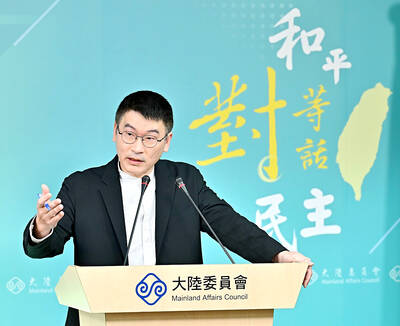
Two Taiwanese prosecutors were questioned by Chinese security personnel at their hotel during a trip to China’s Henan Province this month, the Mainland Affairs Council (MAC) said yesterday. The officers had personal information on the prosecutors, including “when they were assigned to their posts, their work locations and job titles,” MAC Deputy Minister and spokesman Liang Wen-chieh (梁文傑) said. On top of asking about their agencies and positions, the officers also questioned the prosecutors about the Cross-Strait Joint Crime-Fighting and Judicial Mutual Assistance Agreement, a pact that serves as the framework for Taiwan-China cooperation on combating crime and providing judicial assistance, Liang
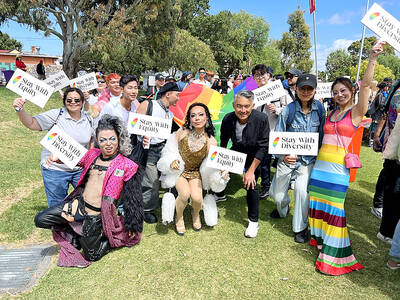
A group from the Taiwanese Designers in Australia association yesterday represented Taiwan at the Midsumma Pride March in Melbourne. The march, held in the St. Kilda suburb, is the city’s largest LGBTQIA+ parade and the flagship event of the annual Midsumma Festival. It attracted more than 45,000 spectators who supported the 400 groups and 10,000 marchers that participated this year, the association said. Taiwanese Designers said they organized a team to march for Taiwan this year, joining politicians, government agencies, professionals and community organizations in showing support for LGBTQIA+ people and diverse communities. As the first country in Asia to legalize same-sex
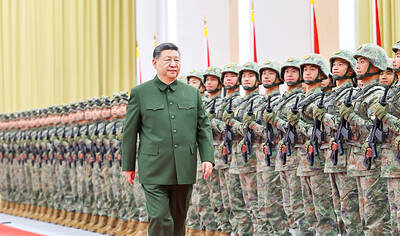
MOTIVES QUESTIONED The PLA considers Xi’s policies toward Taiwan to be driven by personal considerations rather than military assessment, the Epoch Times reports Chinese President Xi Jinping’s (習近平) latest purge of the Chinese People’s Liberation Army (PLA) leadership might have been prompted by the military’s opposition to plans of invading Taiwan, the Epoch Times said. The Chinese military opposes waging war against Taiwan by a large consensus, putting it at odds with Xi’s vision, the Falun Gong-affiliated daily said in a report on Thursday, citing anonymous sources with insight into the PLA’s inner workings. The opposition is not the opinion of a few generals, but a widely shared view among the PLA cadre, the Epoch Times cited them as saying. “Chinese forces know full well that


 RSS
RSS