


A coalition of civic groups and lawmakers yesterday raised concerns about the security of the government’s planned electronic identification card (eID) project over links to China and demanded its implementation be delayed.
Ministry of the Interior officials have said Taipei-based Guo Ju Consultants Co won the tender for the eID project in April last year, while production of the eIDs was awarded to the state-owned Central Engraving and Printing Plant, a central bank subsidiary that prints the nation’s banknotes, passports and government-issued identification cards.
Attorney Alex Hsin (幸大智) is the registered owner of Guo Ju Consultants, but is also a senior partner with MHP Law Firm in Shanghai, Taiwan Citizen Front spokesman Chiang Min-yen (江旻諺) told a news conference in Taipei.

Photo: Chien Jung-fong, Taipei Times
Guo Ju’s Web site says Hsin earned graduate and law degrees from universities in Taiwan and the US, and a doctorate in international economic law from East China University of Political Science and Law in Shanghai.
He is also listed as having given lectures for Shanghai Jiao Tong University’s EMBA program.
Guo Ju Consultants’ connections to China should worry Taiwanese concerned about the leak of their personal data to the Chinese government, Chiang said.
As the senior partner for MHP, Hsin and the law firm must adhere to China’s Regulations Governing Law Firms, which was revised in 2016 to include in Article 3 the statement that “a law firm shall take supporting the leadership of the Chinese Communist Party and the socialist rule of law as the basic requirements for its practice,” Chiang said.
“This and other articles are the basic requirements for lawyers to practice in China, but are contrary to the principles of democracy and counter to Taiwan’s national interest,” Chiang said.
“The Chinese government could use this firm to obtain the private and personal information of Taiwanese. This would be an enormous disaster for our national security,” he said.
“China has multiple ways to infiltrate Taiwan. It does not need to apply them right away, but will wait for a crucial time. For example, it could do so when we hold elections, public referendums, or during major natural disasters. It can mobilize its agents and concealed working units to control our social and communication networks, and to launch attacks against Taiwan,” he added.
New Power Party Legislator Chiu Hsien-chih (邱顯智) also raised concerns about potential access by Beijing’s government to the personal data of Taiwanese.
“If the eID scheme goes through, then Beijing will have full access to all the personal information on each Taiwanese citizen, this is very dangerous. Interior ministry officials have yet to respond to these concerns,” Chiu said.
Taiwan People’s Party Legislator Kao Hung-an (高虹安) called on the government to conduct a more careful evaluation of the project before going ahead with it.
Attendees at the news conference called on the ministry to give people the choice of retaining their current ID cards without embedded IC chips, to enact legislation protecting the public’s rights under the scheme before it begins, and to establish an independent body charged with protecting personal data.

The manufacture of the remaining 28 M1A2T Abrams tanks Taiwan purchased from the US has recently been completed, and they are expected to be delivered within the next one to two months, a source said yesterday. The Ministry of National Defense is arranging cargo ships to transport the tanks to Taiwan as soon as possible, said the source, who is familiar with the matter. The estimated arrival time ranges from late this month to early next month, the source said. The 28 Abrams tanks make up the third and final batch of a total of 108 tanks, valued at about NT$40.5 billion

Two Taiwanese prosecutors were questioned by Chinese security personnel at their hotel during a trip to China’s Henan Province this month, the Mainland Affairs Council (MAC) said yesterday. The officers had personal information on the prosecutors, including “when they were assigned to their posts, their work locations and job titles,” MAC Deputy Minister and spokesman Liang Wen-chieh (梁文傑) said. On top of asking about their agencies and positions, the officers also questioned the prosecutors about the Cross-Strait Joint Crime-Fighting and Judicial Mutual Assistance Agreement, a pact that serves as the framework for Taiwan-China cooperation on combating crime and providing judicial assistance, Liang

A group from the Taiwanese Designers in Australia association yesterday represented Taiwan at the Midsumma Pride March in Melbourne. The march, held in the St. Kilda suburb, is the city’s largest LGBTQIA+ parade and the flagship event of the annual Midsumma Festival. It attracted more than 45,000 spectators who supported the 400 groups and 10,000 marchers that participated this year, the association said. Taiwanese Designers said they organized a team to march for Taiwan this year, joining politicians, government agencies, professionals and community organizations in showing support for LGBTQIA+ people and diverse communities. As the first country in Asia to legalize same-sex
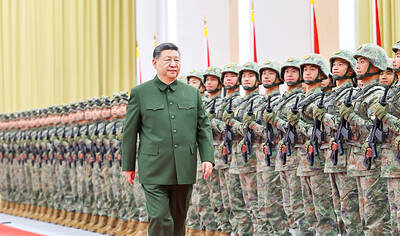
MOTIVES QUESTIONED The PLA considers Xi’s policies toward Taiwan to be driven by personal considerations rather than military assessment, the Epoch Times reports Chinese President Xi Jinping’s (習近平) latest purge of the Chinese People’s Liberation Army (PLA) leadership might have been prompted by the military’s opposition to plans of invading Taiwan, the Epoch Times said. The Chinese military opposes waging war against Taiwan by a large consensus, putting it at odds with Xi’s vision, the Falun Gong-affiliated daily said in a report on Thursday, citing anonymous sources with insight into the PLA’s inner workings. The opposition is not the opinion of a few generals, but a widely shared view among the PLA cadre, the Epoch Times cited them as saying. “Chinese forces know full well that


 RSS
RSS