


More than 20 members of the US Congress on Monday in a joint letter to US Secretary of State Mike Pompeo called for “updated guidelines for relations with Taiwan” to end restrictions that impede Taiwan-US relations.
US Representative Guy Reschenthaler on Thursday shared the letter on Twitter, showing that it was endorsed by 26 other Congress members.
“Currently, the world is struggling to address a pandemic exacerbated by the Chinese Communist Party, a crisis in which Taiwan has demonstrated its value as a US ally and international force for good,” the letter read. “US-Taiwan relations have never been more important. However, to our knowledge, unnecessarily restrictive guidelines put in place by the prior administration continue to impede our bilateral relationship.”
Photo: Lu Yi-hsuen, Taipei Times
The letter appears to be referring to guidelines from former US president Barack Obama in 2015, which prohibited Taiwanese diplomats and military personnel from displaying the national flag on US government property, prompted by an incident in January 2015 when Taiwan’s representative office in the US raised the national flag at Twin Oaks estate in Washington, the former residence of Republic of China ambassadors to the US.
“We believe our interactions with Taiwan should strengthen the US-Taiwan relationship in the areas of trade, defense, technology supply chains, democratic norms, personal liberties and other substantive areas of cooperation,” it said.
“Existing restrictions on various aspects of US-Taiwan relations, including those for travel, government-to-government meetings and media, are inconsistent with these principles and not required by the Taiwan Relations Act or relevant policies,” it said.
Although US President Donald Trump in 2018 signed the Taiwan Travel Act into law, “it appears that high-level US visits have not increased,” the letter said.
The Congress members asked Pompeo to review such restrictive guidelines and “provide us with the guidelines currently in place.”
Ministry of Foreign Affairs spokeswoman Joanne Ou (歐江安) thanked the Congress members for their support, adding that the government would continue to maintain close communication with the US based on the principles of mutual trust and reciprocity, in a bid to deepen Taiwan-US ties.
In other news, the ministry reaffirmed its 63-year relationship with Paraguay — the nation’s only diplomatic ally in South America, after the Americas Quarterly on Thursday reported that allies in that country are facing increasing pressure to end the relationship.
The Paraguayan Senate last month voted 25 to 16 against a proposal by opposition and pro-China senators to switch ties from Taipei to Beijing, it said.
However, the debate is not over, especially when Paraguayan farmers fear exclusion from the Chinese market and Taiwan’s supporters in that country might have to justify not recognizing the world’s second-largest economy, it said.
Taiwan’s embassy in Paraguay would continue to communicate with senators to clarify their doubts about bilateral ties, Ou said.
Since the COVID-19 pandemic began, Taiwan has donated masks and thermal imaging cameras to help Paraguay’s disease prevention efforts, she said, adding that the nation would discuss other feasible aid with the Paraguayan government.
Paraguayan President Mario Abdo Benitez has on multiple occasions voiced support for deepening bilateral ties, she said, adding that many bilateral projects for boosting Paraguayan civic life are conducted smoothly.

The manufacture of the remaining 28 M1A2T Abrams tanks Taiwan purchased from the US has recently been completed, and they are expected to be delivered within the next one to two months, a source said yesterday. The Ministry of National Defense is arranging cargo ships to transport the tanks to Taiwan as soon as possible, said the source, who is familiar with the matter. The estimated arrival time ranges from late this month to early next month, the source said. The 28 Abrams tanks make up the third and final batch of a total of 108 tanks, valued at about NT$40.5 billion
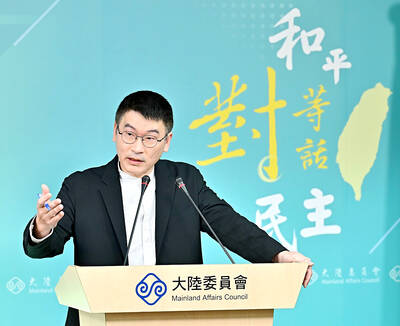
Two Taiwanese prosecutors were questioned by Chinese security personnel at their hotel during a trip to China’s Henan Province this month, the Mainland Affairs Council (MAC) said yesterday. The officers had personal information on the prosecutors, including “when they were assigned to their posts, their work locations and job titles,” MAC Deputy Minister and spokesman Liang Wen-chieh (梁文傑) said. On top of asking about their agencies and positions, the officers also questioned the prosecutors about the Cross-Strait Joint Crime-Fighting and Judicial Mutual Assistance Agreement, a pact that serves as the framework for Taiwan-China cooperation on combating crime and providing judicial assistance, Liang
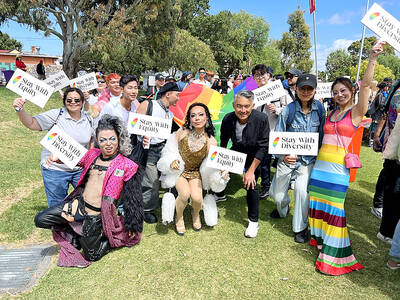
A group from the Taiwanese Designers in Australia association yesterday represented Taiwan at the Midsumma Pride March in Melbourne. The march, held in the St. Kilda suburb, is the city’s largest LGBTQIA+ parade and the flagship event of the annual Midsumma Festival. It attracted more than 45,000 spectators who supported the 400 groups and 10,000 marchers that participated this year, the association said. Taiwanese Designers said they organized a team to march for Taiwan this year, joining politicians, government agencies, professionals and community organizations in showing support for LGBTQIA+ people and diverse communities. As the first country in Asia to legalize same-sex
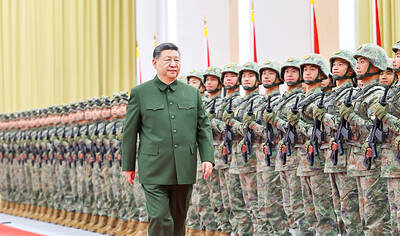
MOTIVES QUESTIONED The PLA considers Xi’s policies toward Taiwan to be driven by personal considerations rather than military assessment, the Epoch Times reports Chinese President Xi Jinping’s (習近平) latest purge of the Chinese People’s Liberation Army (PLA) leadership might have been prompted by the military’s opposition to plans of invading Taiwan, the Epoch Times said. The Chinese military opposes waging war against Taiwan by a large consensus, putting it at odds with Xi’s vision, the Falun Gong-affiliated daily said in a report on Thursday, citing anonymous sources with insight into the PLA’s inner workings. The opposition is not the opinion of a few generals, but a widely shared view among the PLA cadre, the Epoch Times cited them as saying. “Chinese forces know full well that


 RSS
RSS