

Democratic Progressive Party (DPP) Legislator Su Chiao-hui (蘇巧慧) yesterday urged the Ministry of Health and Welfare to issue “guidelines for living” for people to follow on weekends and holidays amid the COVID-19 pandemic.
Speaking to Deputy Minister of Health and Welfare Ho Chi-kung (何啟功) at a meeting of the legislature’s Social Welfare and Environmental Hygiene Committee, Su said that before the Children’s Day and Tomb Sweeping Day holiday from Thursday to Sunday, she had advised the ministry to set guidelines on how people should spend the four-day break.
While the ministry asked people to practice social distancing, it fell short of telling people to stay home during the holiday, she said.
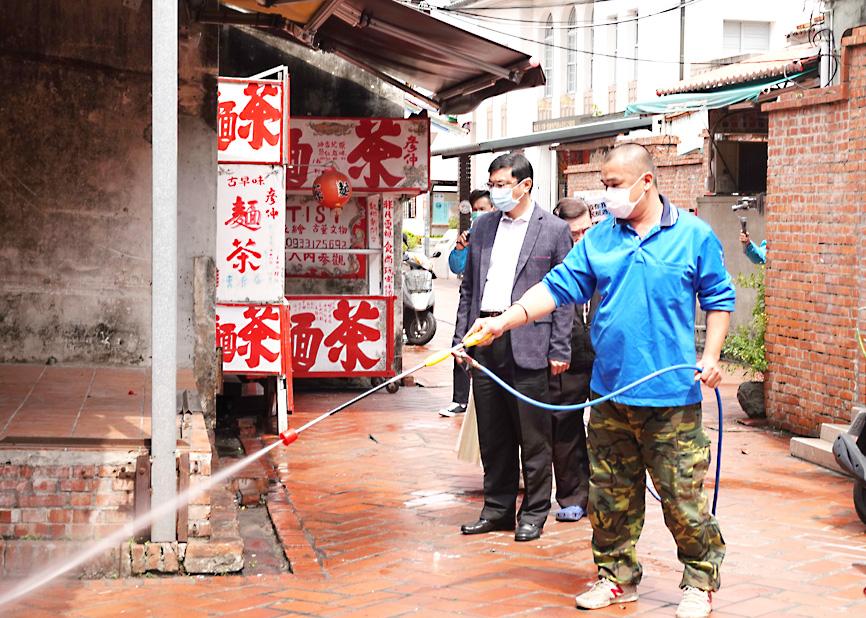
Photo: Tang Shih-ming, Taipei Times
“We had originally looked forward to being able to breathe a sigh of relief after this spring break,” she said.
“Now, not only are we not relieved, everyone is more tense,” she said.
After the Central Epidemic Command Center on Saturday sent two text messages warning people to avoid crowded areas and to follow social distancing regulations — at least 1.5m apart indoors and 1m outdoors — people were “very obedient,” Su said.
Roads became empty the day after the messages were sent, she said.
She said she hoped the ministry would set clearer guidelines on what people should do during the upcoming Labor Day weekend and on weekends, and ask people to try to stay home during the pandemic.
Chinese Nationalist Party (KMT) Legislator Wu Sz-huai (吳斯懷), also a committee member, asked the health ministry to explore the feasibility of working with the Ministry of Education to allow students to pick up their purchases of masks at school.
Many people still have to wait in line to buy masks at pharmacies, Wu said.
With parents at work and children at school, it is often the grandparents who are standing in line, he said.
Ho said while the health ministry would consider the proposal, it might result in the education ministry having to “spend more effort.”
DPP Legislator Hung Sun-han (洪申翰), another committee member, raised the importance of including the homeless population in the fight against the coronavirus.
Homeless people often gather in transportation hubs like Taipei Railway Station — the same places people returning from abroad often pass through — and might be more vulnerable than others to contracting the virus, he said.
They might also be physically weaker due to spending long periods of time outdoors, he said.
He urged the health ministry to help keep homeless people up to date on the latest information about the pandemic and to make washing facilities more accessible to them.

A total of 400 foreign “high- level” professionals have been naturalized as Republic of China (Taiwan) citizens over the past decade as the government has eased nationality rules to attract talent from a wider range of fields, the Ministry of the Interior said yesterday. The 400th high-level professional, who works in the electronics industry, was approved for ROC citizenship on Aug. 26, the MOI said. The MOI quoted the newly naturalized citizen as saying that Taiwan is a leader in fields such as semiconductors, electronics manufacturing, artificial intelligence development and energy technology. He also said
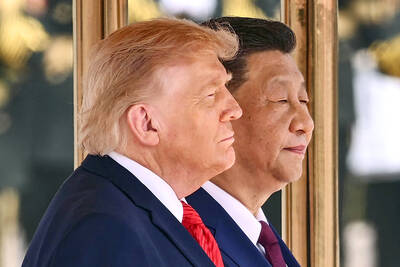
China has warned that it could cancel a planned US-China leaders’ summit if Washington approves new arms sales to Taiwan, a Japanese media outlet quoted sources as saying yesterday. US President Donald Trump, “apparently eager to showcase some diplomatic achievements ahead of November’s midterm congressional elections, places great importance on holding the summit with Chinese President Xi Jinping (習近平),” Japan’s Kyodo News reported. “While preparing for Xi’s upcoming trip, China has restated its position that the Taiwan issue is a ‘red line’ in bilateral relations,” the report said. The report said that when Xi met with Trump in Beijing in May, Xi said
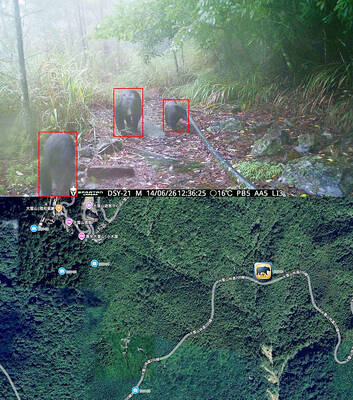
RARE PEEK: The footage released showed one of the bears staying in a cave for as long as 70 days, providing the first record of Formosan black bear’s overwintering The Forestry and Nature Conservation Agency yesterday released tracking records of released Formosan black bears for the first time, showing that they get much closer to human settlements than previously thought. The agency said it had captured two bears, Da Qu-ali (達古阿里) and Aziman (阿里曼), in indigenous villages in Hualien County and began to track them with a camera-mounted satellite collar after releasing them back into the wild. The results confirmed that the bears have moved from deep mountain areas into lowland hills closer to human communities, leading to an increase in human-bear conflicts, it said. The agency has introduced artificial intelligence-assisted early

DIPLOMATIC TOUR: Chinese President Xi Jinping began a series of overseas visits last month to Kyrgyzstan, Egypt and India, aimed at securing leverage, an official said Recent Chinese diplomatic and military moves are aimed at creating pressure ahead of a planned meeting between Chinese President Xi Jinping (習近平) and US President Donald Trump, National Security Council adviser Huang Chung-yen (黃重諺) said. Trump when visiting China in May extended an invitation to Xi to visit Washington on Sept. 24. China is yet to officially announce plans for Xi’s visit to the US. In an interview with the Liberty Times (sister paper of the Taipei Times) on Thursday, Huang said Xi’s overseas visits, China’s “gray zone” activities along the First Island Chain and efforts to expand its trade surplus with the


 RSS
RSS