

Public adherence to social distancing measures would be key to determining whether people would still be free to travel domestically, Minister of Transportation and Communications Lin Chia-lung (林佳龍) said yesterday.
Yesterday was the first workday after people returned from the four-day Children’s Day and Tomb Sweeping Day holiday.
Media reports showed that tourists in some popular travel destinations, such as Kenting (墾丁), failed to observe the Central Epidemic Command Center’s social distancing recommendations, which advised people to keep a distance of at least 1m when they are outdoors.
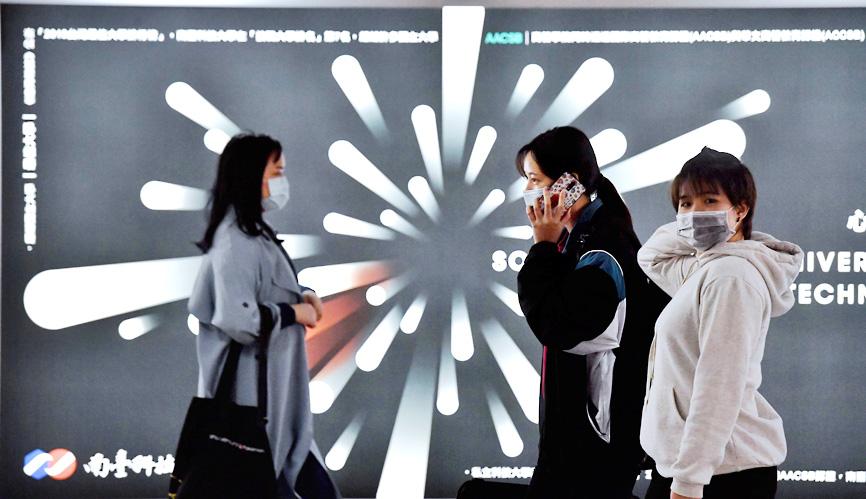
Photo: CNA
As the International Workers’ Day long weekend from May 1 to 3 is coming in three weeks, some have suggested that the government cancel the holiday to prevent crowds during the pandemic, or the nation’s efforts to effectively contain the spread of COVID-19 in the past two months would be wasted.
Asked if canceling the Workers’ Day weekend would be another heavy blow to domestic tourism, Lin said that preventing the spread of the disease remained the government’s top priority.
The ministry had ensured that travelers comply with the government’s disease-prevention policy during the past holiday, including wearing masks and having their temperature taken.
“Visitors to the 13 national scenic areas and 25 amusement parks supervised by the Tourism Bureau were down 50 percent compared with the same period last year. If you look at the usage rate of the parking space in amusement parks, except for the 30 to 40 percent at Lipao Resort and 20 to 30 percent at Janfusun Fancyworld the rest had a usage rate of less than 10 percent,” he said.
People can enjoy their holiday outdoors and feel just as relaxed when they adhere to disease-prevention policies, including observing social distancing, wearing masks, visiting less-crowded areas and avoiding peak travel time, Lin said.
The next two weeks would be a critical period to gauge whether people had strictly followed official disease-prevention measures during the holiday, he said.
“If the answer is yes, then we might still be free to travel domestically during long weekends. If people failed to restrain themselves and subsequently caused the virus to spread further, we could all be grounded,” Lin added.
Capping the number of people visiting a scenic area or entering a hotel is worth considering, he said, adding that hotels or travel service operators could follow this rule to avoid cluster infections in their facilities.
Most of the hoteliers across the nation had a pretty low occupancy rate during the holiday, except those in Kenting, Hualien, Taitung and Taichung’s Cingjing Farm (清境農場), he said.

A total of 400 foreign “high- level” professionals have been naturalized as Republic of China (Taiwan) citizens over the past decade as the government has eased nationality rules to attract talent from a wider range of fields, the Ministry of the Interior said yesterday. The 400th high-level professional, who works in the electronics industry, was approved for ROC citizenship on Aug. 26, the MOI said. The MOI quoted the newly naturalized citizen as saying that Taiwan is a leader in fields such as semiconductors, electronics manufacturing, artificial intelligence development and energy technology. He also said
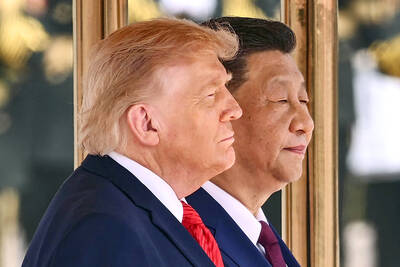
China has warned that it could cancel a planned US-China leaders’ summit if Washington approves new arms sales to Taiwan, a Japanese media outlet quoted sources as saying yesterday. US President Donald Trump, “apparently eager to showcase some diplomatic achievements ahead of November’s midterm congressional elections, places great importance on holding the summit with Chinese President Xi Jinping (習近平),” Japan’s Kyodo News reported. “While preparing for Xi’s upcoming trip, China has restated its position that the Taiwan issue is a ‘red line’ in bilateral relations,” the report said. The report said that when Xi met with Trump in Beijing in May, Xi said
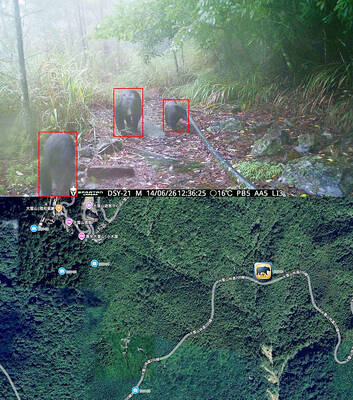
RARE PEEK: The footage released showed one of the bears staying in a cave for as long as 70 days, providing the first record of Formosan black bear’s overwintering The Forestry and Nature Conservation Agency yesterday released tracking records of released Formosan black bears for the first time, showing that they get much closer to human settlements than previously thought. The agency said it had captured two bears, Da Qu-ali (達古阿里) and Aziman (阿里曼), in indigenous villages in Hualien County and began to track them with a camera-mounted satellite collar after releasing them back into the wild. The results confirmed that the bears have moved from deep mountain areas into lowland hills closer to human communities, leading to an increase in human-bear conflicts, it said. The agency has introduced artificial intelligence-assisted early

DIPLOMATIC TOUR: Chinese President Xi Jinping began a series of overseas visits last month to Kyrgyzstan, Egypt and India, aimed at securing leverage, an official said Recent Chinese diplomatic and military moves are aimed at creating pressure ahead of a planned meeting between Chinese President Xi Jinping (習近平) and US President Donald Trump, National Security Council adviser Huang Chung-yen (黃重諺) said. Trump when visiting China in May extended an invitation to Xi to visit Washington on Sept. 24. China is yet to officially announce plans for Xi’s visit to the US. In an interview with the Liberty Times (sister paper of the Taipei Times) on Thursday, Huang said Xi’s overseas visits, China’s “gray zone” activities along the First Island Chain and efforts to expand its trade surplus with the


 RSS
RSS