


People who are caught littering used masks face a fine of up to NT$6,000, the Environmental Protection Administration (EPA) said yesterday, as more masks are being found on beaches amid the COVID-19 pandemic.
Beach cleaning volunteers said they have found an increasing number of masks for adults and children in a variety of colors, Society of Wilderness chairwoman Liu Yueh-mei (劉月梅) said, calling on the government to increase public education and implement regulations about garbage disposal.
Mask littering pollutes the environment and threatens public health, as masks with nonwoven fabrics cannot naturally decompose, while used masks might carry the virus, Greenpeace Taiwan campaigner Chang Kai-ting (張凱婷) said.
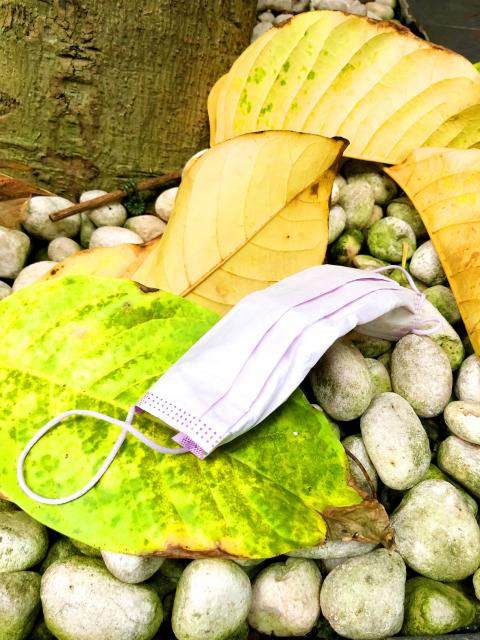
Photo: Lo Chi, Taipei Times
As human-to-human transmission remains the primary method of infection for COVID-19, garbage bins that contain disposed masks in urban areas are more likely to become a vector of transmission than those at less populated seaside areas, National Taiwan University College of Public Health dean Chan Chang-chuan (詹長權) said.
Masks with fabrics that do not decompose are classified as general waste, and people caught littering face a fine of between NT$1,200 and NT$6,000 under the Waste Disposal Act (廢棄物清理法), EPA Department of Waste Management Director-General Lai Ying-ying (賴瑩瑩) said.
The EPA would ask local authorities to increase patrolling and cleaning in areas in which littered masks are more likely to be found and post more notices, she added.
In related news, a woman buying masks at a pharmacy in Taipei on Friday demanded that a pharmacist kneel and apologize after they handed her the wrong National Health Insurance card, sparking criticism.
Although the pharmacist said that she had asked the customer to check her card before leaving, she still knelt and apologized when the customer returned to fetch the correct card.
In a statement yesterday, the Taiwan Pharmacist Association denounced the request.
Most people are patient when lining up to buy masks, but a few have treated pharmacists disrespectfully, such as the demand that the pharmacist kowtow in apology, which has severely humiliated the pharmacist and affected the morale of all other pharmacists working hard to protect public health, it said.
The association would provide pharmacists who experience similar treatment with legal counseling resources, it said, calling on people to respect medical professionals during the pandemic.
Additional reporting by Lin Hui-chin
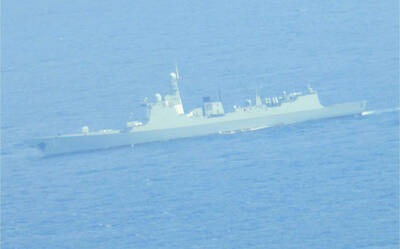
The military has spotted two Chinese warships operating in waters near Penghu County in the Taiwan Strait and sent its own naval and air forces to monitor the vessels, the Ministry of National Defense (MND) said. Beijing sends warships and warplanes into the waters and skies around Taiwan on an almost daily basis, drawing condemnation from Taipei. While the ministry offers daily updates on the locations of Chinese military aircraft, it only rarely gives details of where Chinese warships are operating, generally only when it detects aircraft carriers, as happened last week. A Chinese destroyer and a frigate entered waters to the southwest

The eastern extension of the Taipei MRT Red Line could begin operations as early as late June, the Taipei Department of Rapid Transit Systems said yesterday. Taipei Rapid Transit Corp said it is considering offering one month of free rides on the new section to mark its opening. Construction progress on the 1.4km extension, which is to run from the current terminal Xiangshan Station to a new eastern terminal, Guangci/Fengtian Temple Station, was 90.6 percent complete by the end of last month, the department said in a report to the Taipei City Council's Transportation Committee. While construction began in October 2016 with an
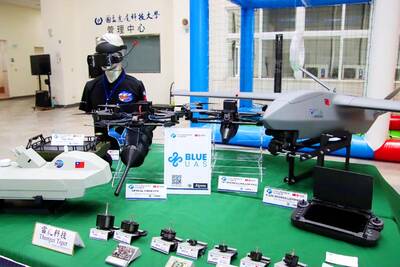
NON-RED SUPPLY: Boosting the nation’s drone industry is becoming increasingly urgent as China’s UAV dominance could become an issue in a crisis, an analyst said Taiwan’s drone exports to Europe grew 41.7-fold from 2024 to last year, with demand from Ukraine’s fight against Russian aggression the most likely driver of growth, a study showed. The Institute for Democracy, Society and Emerging Technology (DSET) in a statement on Wednesday said it found that many of Taiwan’s uncrewed aerial vehicle (UAV) sales were from Poland and the Czech Republic. These countries likely transferred the drones to Ukraine to aid it in its fight against the Russian invasion that started in 2022, it said. Despite the gains, Taiwan is not the dominant drone exporter to these markets, ranking second and fourth

Japanese Prime Minister Sanae Takaichi’s comment last year on Tokyo’s potential reaction to a Taiwan-China conflict has forced Beijing to rewrite its invasion plans, a retired Japanese general said. Takaichi told the Diet on Nov. 7 last year that a Chinese naval blockade or military attack on Taiwan could constitute a “survival-threatening situation” for Japan, potentially allowing Tokyo to exercise its right to collective self-defense. Former Japan Ground Self-Defense Force general Kiyofumi Ogawa said in a recent speech that the remark has been interpreted as meaning Japan could intervene in the early stages of a Taiwan Strait conflict, undermining China’s previous assumptions


 RSS
RSS