


The US Senate on Wednesday unanimously passed the Taiwan Allies International Protection and Enhancement Initiative (TAIPEI) Act, designed to help Taiwan stabilize diplomatic ties, which awaits US President Donald Trump’s signature to take effect.
The passage came just one week after the legislation unanimously cleared the US House of Representatives on Wednesday last week.
First introduced in the Senate in May last year by Cory Gardner, with US Representative John Curtis proposing a similar version in the US House in October, the bill is aimed at showing US support for Taiwan’s diplomatic alliances around the world amid growing pressure from Beijing.
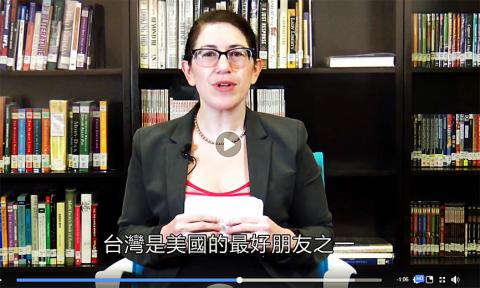
Photo: Screen grab from American Institute in Taiwan’s video
The bill authorizes the US Department of State to consider “reducing its economic, security and diplomatic engagements with nations that take serious or significant actions to undermine Taiwan.”
It also calls on Washington to help Taiwan gain participation in international organizations, either as a member or an observer, and shows support for Taiwan’s international participation when it interacts with Beijing.
US legislative procedure requires a proposed law passed by Congress be presented to the president, who then has 10 days to approve or disapprove it.
Normally, bills not signed or vetoed within 10 days become law, even without Trump’s signature.
The bill’s passage at the US Senate shows that Taiwan-US ties are growing closer, Legislative Speaker You Si-kun (游錫堃) said on Facebook yesterday, thanking the US Congress and Americans.
In related news, American Institute in Taiwan spokeswoman Amanda Mansour said that Taiwan is one of the US’ best friends and most important partners, and the US’ Taiwan Relations Act, which took effect in 1979, was designed to promote close collaboration and communication between the US and Taiwan.
Mansour, speaking in Mandarin in a video clip posted on Facebook on Tuesday, was answering online questions about why the US has not established formal relations with Taiwan.
“We think that maintaining the ‘status quo’ has brought about peace and prosperity across the Taiwan Strait over the past 40 years,” she said. “Any attempt to change the ‘status quo’ will threaten the stability.”
While current Taiwan-US ties are imperfect, they are the best in history, she said, adding that bilateral relations are “real friends” making “real progress.”
The US switched diplomatic relations from Taipei to Beijing in 1979, leading many other nations to cut ties with Taiwan.
Taiwan now has 15 diplomatic allies.

The military has spotted two Chinese warships operating in waters near Penghu County in the Taiwan Strait and sent its own naval and air forces to monitor the vessels, the Ministry of National Defense (MND) said. Beijing sends warships and warplanes into the waters and skies around Taiwan on an almost daily basis, drawing condemnation from Taipei. While the ministry offers daily updates on the locations of Chinese military aircraft, it only rarely gives details of where Chinese warships are operating, generally only when it detects aircraft carriers, as happened last week. A Chinese destroyer and a frigate entered waters to the southwest
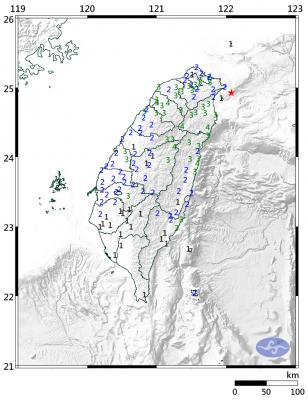
A magnitude 6.1 earthquake struck off the coast of Yilan County at 8:39pm tonight, the Central Weather Administration (CWA) said, with no immediate reports of damage or injuries. The epicenter was 38.7km east-northeast of Yilan County Hall at a focal depth of 98.3km, the CWA’s Seismological Center said. The quake’s maximum intensity, which gauges the actual physical effect of a seismic event, was a level 4 on Taiwan’s 7-tier intensity scale, the center said. That intensity level was recorded in Yilan County’s Nanao Township (南澳), Hsinchu County’s Guansi Township (關西), Nantou County’s Hehuanshan (合歡山) and Hualien County’s Yanliao (鹽寮). An intensity of 3 was

Japanese Prime Minister Sanae Takaichi’s comment last year on Tokyo’s potential reaction to a Taiwan-China conflict has forced Beijing to rewrite its invasion plans, a retired Japanese general said. Takaichi told the Diet on Nov. 7 last year that a Chinese naval blockade or military attack on Taiwan could constitute a “survival-threatening situation” for Japan, potentially allowing Tokyo to exercise its right to collective self-defense. Former Japan Ground Self-Defense Force general Kiyofumi Ogawa said in a recent speech that the remark has been interpreted as meaning Japan could intervene in the early stages of a Taiwan Strait conflict, undermining China’s previous assumptions
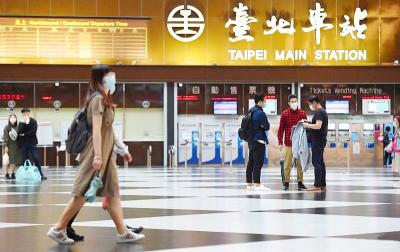
Taiwan Railways Corp (TRC) today announced that Shin Kong Mitsukoshi has been selected as the preferred bidder to operate the Taipei Railway Station shopping mall, replacing the current operator, Breeze Development Co Ltd. Among eight qualified firms that delivered presentations and were evaluated by a review committee, Shin Kong Mitsukoshi was ranked first, while Breeze was named the runner-up, the rail company said in a statement. Contract negotiations are to proceed in accordance with regulations, it said, adding that if negotiations with the top bidder fail, it could invite the second-ranked applicant to enter talks. Breeze in a statement today expressed doubts over


 RSS
RSS